How much does it cost to install a Level 2 EV charger at home?
A Level 2 EV charger install in Southern California typically costs $1,000 to $2,000 for the new 240-volt circuit and mounting, with the permit. The charger itself is often extra, and a panel upgrade pushes the total to $3,600 to $7,500.
Typical SoCal range, October 2026
$1,000 to $2,000
new 240V circuit, charger mounted, permit (charger often extra). Starts from the published ranges listed under Sources. We moved the low or high end to fit Southern California, so this is an estimate, not a quote.
For most Southern California homes, a Level 2 charger install is a $1,000 to $2,000 job as of October 2026. Fixr’s national guide gives $1,000 to $2,500, with a $1,200 average. NRG Clean Power lists simple California installs at $1,200 to $2,000. The ranges overlap because the question underneath is the same: how hard is it to get power from the panel to the wall where the charger goes?
For circuit sizing, panel checks and the permit, see the EV charger installation guide.
Cheap job or expensive job
Fixr’s national guide puts a typical install at $1,000 to $2,500 and says it can reach $4,500 at the high end. NRG’s regional table shows how much the panel changes the number for LA and San Diego:
| Scenario | NRG installed range, LA / San Diego |
|---|---|
| 200A panel, charger within 25 feet | $1,300 to $2,000 |
| 200A panel, 50-foot run or exterior | $1,900 to $2,800 |
| 100A panel plus load management | $1,900 to $3,100 |
| 100A panel upgraded to 200A | $4,500 to $7,000 |
| Detached garage with trenching | $3,300 to $5,800 |
The first line is the simple case. The others show where jobs leave this page’s range. NRG’s simple-install range starts higher than the low end used here, so the low end on this page is an estimate for an easy job with a short run. For jobs that include the panel work, see the panel add-on page.
Line items to look for
NRG breaks a typical install into hardware ($400 to $900), electrician labor and materials for a short run ($600 to $1,200), and extras for long or outdoor runs ($500 to $1,500). Labor is $95 to $150 an hour in its data. A quote with one lump sum is hard to compare; ask for the pieces.
Charger size changes the circuit
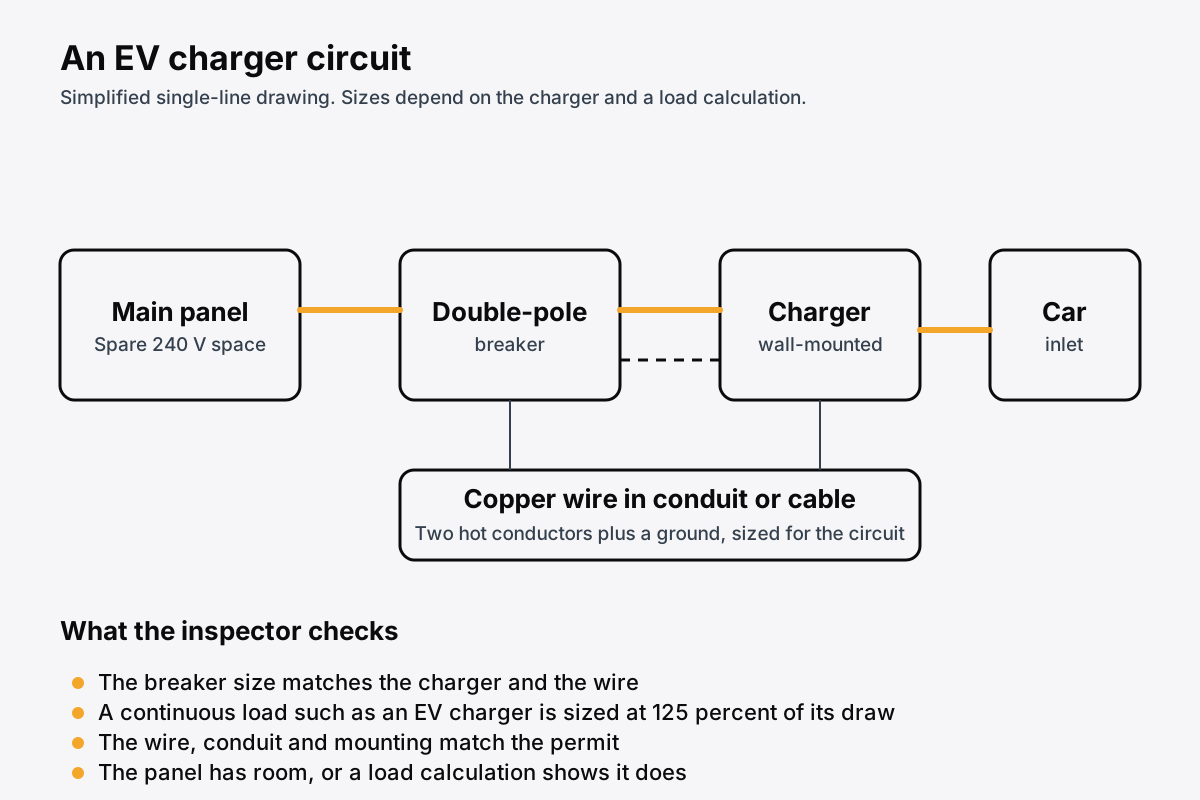
A charger that delivers up to 48 amps needs a 60-amp circuit, per NRG. A 32-amp or 40-amp unit needs smaller wire and breaker. A bigger charger is not always better. The load calculation page shows how the electrician sizes it. The Ford F-150 Lightning is the usual case where an 80 amp circuit comes up, and the Ford Lightning charger page covers it.
Reading a flat-rate quote
A flat rate is usually quoted for a standard 240-volt, 40-amp install with a normal run. It is a fair way to price when the garage wall shares the panel wall. It stops being fair when the run is long, the garage is detached or the panel is full. Ask the bidder what distance and circuit size the flat rate assumes, and what each extra foot or step costs. A good quote states those limits up front, so the number does not change on the day of the work.
Permit fees and rebates
Permit fees are set by each city and vary, so the quote confirms yours. The permit fee comparison lists what cities post in their own fee schedules. Some utilities offer rebates that require a passed inspection. Look at the Los Angeles page, San Diego or Riverside, or the rebate guide and the calculator. Rebates are not subtracted from the range.
How to compare quotes
- Is the charger included, and which model?
- How many feet of wire does the quote assume?
- Is the permit included, and is the inspection scheduled by the electrician?
- What happens if the panel turns out to be full?
- Is there a load-management option priced as an alternative?
What is not included
A panel upgrade, trenching to a detached garage in the base price, HOA approval, a dedicated utility meter, and the charger in some quotes. Network or app subscription fees are separate. Read the HOA guide if you live in a condo or HOA.
What moves the price
| Factor | Effect | Range |
|---|---|---|
| Panel capacity | With space in the panel the job can start near $1,000. A required panel upgrade moves it to $3,600 to $7,500 (see the panel upgrade cost page) | |
| Distance from panel to charger | A long or exterior run can add $500 to $1,500 (wire at $10 to $20 per foot, NRG) | |
| Detached garage | Trenching to a detached garage can add $1,500 to $3,500 (NRG) | |
| Charger amperage | A 48A charger needs a 60A circuit; the heavier wire and breaker cost more | |
| Charger hardware | Hardware is about $400 to $900 (NRG), and is often priced separately from labor | |
| Load management | A load-management device can replace a panel upgrade for $300 to $700 (NRG) |
EV charger install cost by city
Each page uses that city's utility, permit office and fee schedule.
Questions people ask
Is the charger included in the install price?
Often not. The range here covers the new circuit, mounting and permit, and notes that the charger is often extra. Charger hardware runs about $400 to $900 in the California data. Ask the quote to say who supplies the unit, which model, and what the total is with it.
Why do Fixr and NRG numbers differ?
They measure different scopes. Fixr's national guide gives $1,000 to $2,500 for a typical install. NRG gives $1,200 to $2,000 for a simple install and $1,200 to $2,800 all in with a 200A panel. Hardware, run length and what counts as simple all change the number. Match quotes by scope.
Can I skip the permit for a plug-in charger?
A plug-in unit on a new 240-volt outlet still needs a new circuit, and new circuits are generally permitted. The permit fee is set by your city and varies, so it is confirmed in the quote. Skipping the permit can cause trouble with insurance and utility rebates, which often ask for proof of a passed inspection.
Do I need a 200 amp panel for a home charger?
Not always. Many homes with a 100-amp panel add a charger with a load-management device instead of a panel upgrade. A load calculation decides. The guide on whether a charger needs a panel upgrade walks through the test, and the electrician's load calculation gives the answer for your house.
Related
Home EV charger installation: circuit, panel and permit
A home Level 2 charger runs on its own 240 volt circuit, usually 40 to 60 amps. Whether the panel has room…
How much does a Tesla Wall Connector install cost?
A Tesla Wall Connector installed in SoCal typically costs $1,500 to $2,800 with the charger, the circuit…
EV charger plus panel upgrade: what the whole job costs
When your panel cannot carry a charger, the combined job typically costs $3,600 to $7,500 in SoCal, as of…
EV charger load calculation
Before a charger goes in, the electrician adds up your home's electrical load and checks that a new…
Do I need a panel upgrade for an EV charger?
How to tell if your panel can carry a Level 2 charger, when a load manager saves the upgrade, and what…
EV charger cost calculator
Check if your panel can carry a Level 2 charger and see the typical cost.
SCE Charge Ready Home: what it pays, who qualifies and the order of steps
What Charge Ready Home covers, who qualifies, the order of steps, and what to check before you apply.
Panel upgrade cost estimator
Pick your panel, target size and site conditions to get a typical SoCal range.
$1,000 to $2,000
new 240V circuit, charger mounted, permit (charger often extra).
Get this quote