Home charging for the Ford F-150 Lightning
A Standard Range Lightning charges at up to 48 amps, so a 60 amp circuit is enough. Only the Extended Range truck can use the 80 amp Charge Station Pro, which needs a 100 amp circuit.
- Standard Range: 48 A, 11.3 kW
- Extended Range: 80 A, 19.2 kW
- Charge Station Pro circuit: 100 A
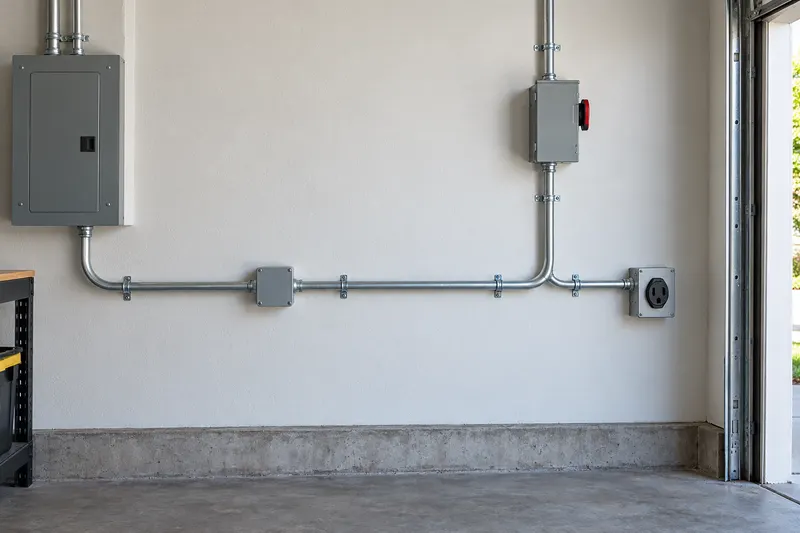
Two trucks, two charging limits
The Lightning has been offered with two battery options, and they do not charge the same way at home. Production and availability of the truck are things to confirm with Ford and a dealer, and this page applies to trucks already owned or on order.
| Truck | Onboard charger | Max from a home charger |
|---|---|---|
| Standard Range | One 48 amp charger | About 11.3 kW |
| Extended Range | Two 40 amp chargers | 80 amps, 19.2 kW |
That split decides your circuit. Many owners over-build because the biggest Ford charger sounds like the safe choice. For a Standard Range truck, the extra copper buys nothing at the plug.
The three Ford home options
According to coverage of the launch, Ford offered three ways to charge at home.
- Mobile charger on a 14-50 outlet. About 30 amps (roughly 7 kW) on a dedicated 50 amp circuit. Slow, but cheap to wire.
- Connected Charge Station. 48 amps, hardwired, on a dedicated 60 amp circuit, up to 11.3 kW.
- Charge Station Pro. 80 amps (19.2 kW), hardwired, with an 80 foot attached cable according to Siemens, and the only one built to send power from the truck back to the house.
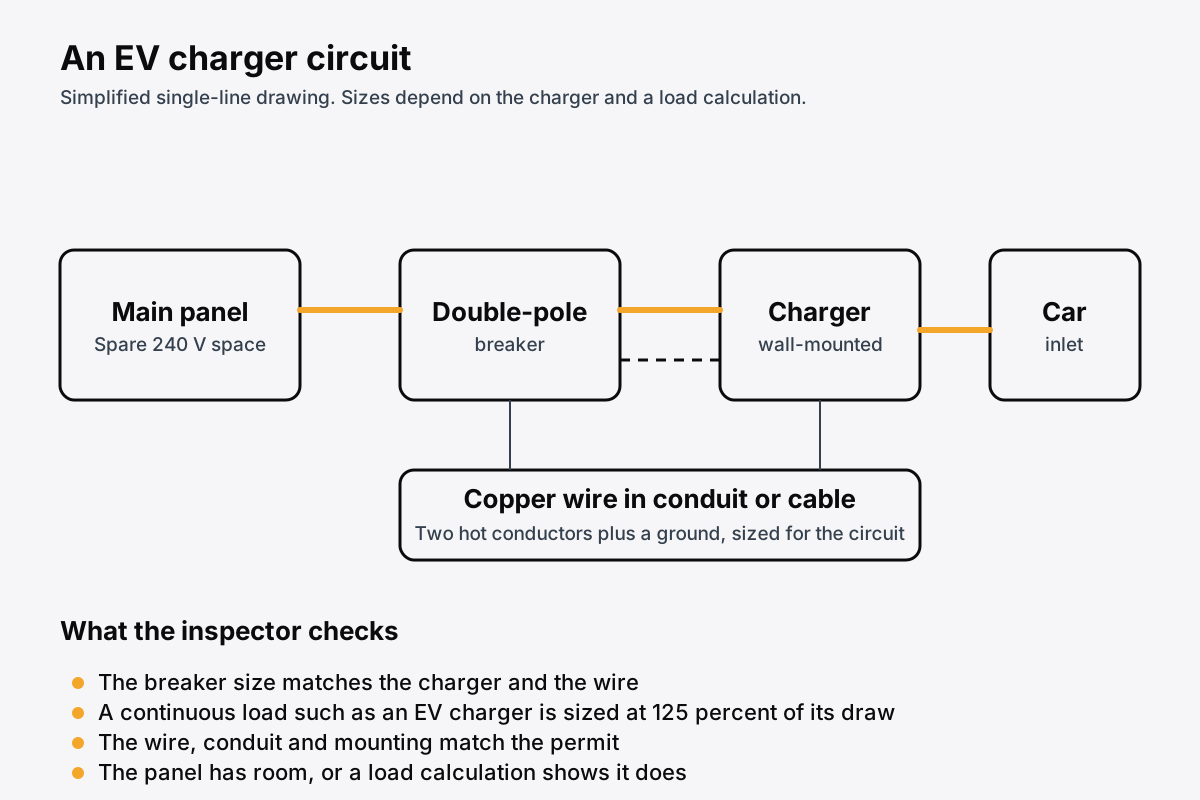
The 100 amp circuit for the Charge Station Pro follows the same 125 percent rule used for all EV charging: 80 amps times 1.25 is 100 amps. Check the install sheet that ships with your unit for the exact breaker and wire.
When the Charge Station Pro makes sense
Choose it if you have an Extended Range truck and want about 80 amps, or if you want Intelligent Backup Power for the house. The unit supports power flow from truck to home, which launch coverage described as up to 9.6 kW. It also needs an automatic transfer switch so the truck never feeds the grid during an outage. That switch is a separate piece of equipment with its own permit and its own cost.
A 100 amp EV circuit plus a transfer switch is a lot to ask of an older panel. Expect the electrician to run a load calculation first. If the calculation fails, you can use a lower output setting if your unit allows it, add a load management device, or move to a bigger service. The related backup choices are covered on the home battery page.
Garage layout and subpanels
Many Southern California garages sit far from the main panel. A 100 amp feeder over 60 feet is real money in copper. An electrician may instead run a feeder to a garage subpanel and land the charger there. That also gives you spare slots for a second charger later.
What changes the cost
The base install uses the same drivers as any Level 2 job: wire distance, panel space, trenching and permit. A typical SoCal Level 2 install runs $1,000 to $2,000 as of October 2026, but that range is for a standard circuit. An 80 amp circuit uses thicker wire, a larger breaker and often a new subpanel, so expect the high end or more. If the panel itself needs work, the combined range is about $3,600 to $7,500. See the panel-plus-charger cost page.
Other vehicles and the price
Other vehicles have different limits. The Tesla Wall Connector page, the Rivian page and the Hyundai and Kia page cover them, and the home EV charger hub lists the rest. For price drivers on any Level 2 job, see the EV charger installation cost page.
Before you order
- Confirm whether your truck is Standard or Extended Range.
- Decide whether home backup is a goal. If not, skip the Charge Station Pro.
- Photo the panel label and the main breaker, and count open slots.
- Ask the electrician for a written load calculation.
- Check with the city for the permit steps for a transfer switch, if you want backup.
Ford changes its home charging packages and installer partners from time to time. Check Ford’s current page for the unit you are buying before the electrician orders wire.
Seen from the electrician’s side
Three questions shape a Lightning quote: which battery, which Ford charger, and whether backup power is in the plan. A Standard Range owner who skips backup gets the cheapest job, a 60 amp circuit with a 48 amp charger. An Extended Range owner with a Charge Station Pro and a transfer switch is closer to a small service project, with a bigger breaker, thicker wire, a possible subpanel and extra permit steps. Say up front which one you want, so the quotes are for the same job.
If you already own a Lightning and a charger from the dealer, bring the model number and the install sheet. The electrician can size the breaker from the paper, not from memory.
Questions people ask
Does the Lightning need a 100 amp circuit?
Only the Extended Range truck can use one. It has two 40 amp onboard chargers, so it can draw 80 amps from the 80 amp Ford Charge Station Pro on a 100 amp breaker. The Standard Range truck stops near 48 amps, so a 60 amp breaker and a 48 amp charger are enough.
What does Intelligent Backup Power need at the house?
It needs the Charge Station Pro, which can pass power both ways, plus an automatic transfer switch that isolates the house from the grid. Reports at launch described up to 9.6 kW sent to the home. Check Ford's current requirements, because the setup and the partner installers have changed since 2022.
Can a Standard Range owner still buy the Charge Station Pro?
Yes, mainly for the backup power feature. It will not charge a Standard Range truck any faster than a 48 amp charger, because the truck has one onboard charger. If you do not want backup power, a 48 amp charger on a 60 amp circuit costs less to wire.
Can I turn the Charge Station Pro down for a small panel?
Often yes. Ask the electrician and check Ford's install sheet for the lower output settings on your unit. A lower setting lets a house without room for a 100 amp circuit still use the charger, with a smaller breaker and thinner wire. The trade-off is slower charging, not a different charger.
Keep reading
Home EV charger installation: circuit, panel and permit
A home Level 2 charger runs on its own 240 volt circuit, usually 40 to 60 amps. Whether the panel has room…
EV charger load calculation
Before a charger goes in, the electrician adds up your home's electrical load and checks that a new…
EV charger load management and circuit sharing
A load management device lowers the charger's draw when the rest of the house is busy. The code allows the…
Home batteries: what the electrician does and where one can go
The electrician mounts the battery, connects it to the panel or a backup subpanel, and gets it permitted…
Subpanel installation: when it fits and how it is wired
A subpanel is a second breaker box fed from your main panel, and it adds circuit space for a garage, ADU…
EV charger plus panel upgrade: what the whole job costs
When your panel cannot carry a charger, the combined job typically costs $3,600 to $7,500 in SoCal, as of…
Send a photo, get a range.
Share your ZIP and a photo of your panel. Your request goes to a licensed partner electrician, who contacts you.
Get this quoteAurion Electric is a referral service operated by Roviq LLC. Electrical work is done by a licensed partner electrician.
