Do I need a panel upgrade for an EV charger?
Often not. The number on your main breaker matters less than the spare capacity left after the house is counted. A 200 amp panel usually fits a Level 2 charger. A crowded 100 amp panel often does not.
A panel upgrade is not automatic. Many homes add a Level 2 charger with a new breaker and a short run of wire. Others need a bigger panel first. The difference is how much capacity is actually left, and only a load calculation shows that.
Large trucks such as the Ford F-150 Lightning can ask for more than a standard charger, as the Ford Lightning charger page explains.
What a charger asks of your panel
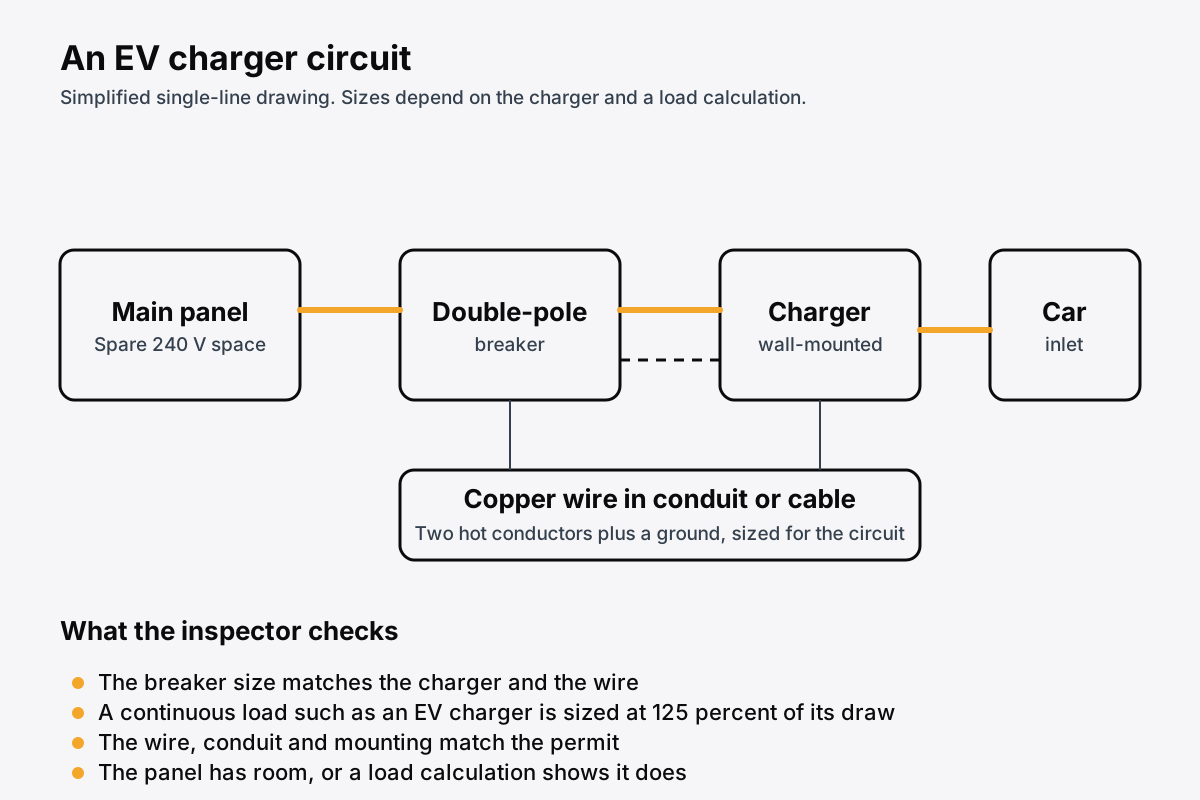
EV charging runs for hours, so the code calls it a continuous load and sizes the circuit at 125 percent of the charger’s current.
| Charger current | Breaker needed | Common use |
|---|---|---|
| 32 amp | 40 amp | Many 7.7 kW home chargers |
| 40 amp | 50 amp | The circuit behind a NEMA 14-50 outlet |
| 48 amp | 60 amp | Wall units such as the Tesla Wall Connector at full rate |
That is a lot to find in a house on 100 amp service with central air, an electric dryer or a spa. Faster is also not always needed. A 32 amp charger refills most daily commutes overnight.
How the load calculation decides
An electrician has two ways to check whether a service can take a new load. Both are in the National Electrical Code.
- The standard method (NEC 220.83) adds up the house from its floor area and appliances, with demand factors.
- The measured method (NEC 220.87) uses your real peak demand from a year of utility data plus a safety margin (or a 30-day recording). It often shows more spare room than the standard method, because most homes never run everything at once.
Either way the result is a number, not a guess. The load calculation guide walks through one, and the EV charger load calculation page covers the charger side.
Four common outcomes
| Your situation | Typical result |
|---|---|
| 200 amp panel, gas appliances, open spaces | Add the charger circuit. No panel work. |
| 200 amp panel, all-electric, or spa and pool | Load management or a subpanel |
| 100 amp panel, gas heat and cooking | A 32 amp charger may fit. The calculation decides. |
| 100 amp panel, all-electric, or no open spaces | Panel upgrade to 200 amps |
Two cases skip the question. A Federal Pacific or Zinsco panel are commonly replaced no matter what, because of known breaker problems. See Zinsco and Federal Pacific panels. And a panel with no open breaker spaces may need a subpanel, even if the amps are fine.
The shortcut: load management
A load manager sits between the panel and the charger, or lives inside a smart charger or smart panel. When the house is busy, it lowers the charger’s current or pauses it, then brings it back. The NEC lets the circuit be sized to the limit the manager sets (625.42) instead of the charger’s full rating, if the local inspector and the utility accept the setup. That is how a “full” panel can host a charger.
It fits best when the car sits for 10 hours overnight and the house is quiet. It fits worst when you need the fastest charge at dinner time. The load management page has the details, and smart electrical panels do the same job for the whole house.
What each path costs
These are typical SoCal ranges as of October 2026, with permit.
- Charger circuit, panel has room: $1,000 to $2,000. The charger itself is often extra.
- Charger plus the panel work it needs: $3,600 to $7,500.
- Panel swap alone, 200 amp: $2,500 to $4,500.
A load manager costs less than a panel swap, but the device price depends on the model, so get it as a line on the quote. A national cost guide puts a plain panel upgrade at $1,500 to $4,500, which runs lower than SoCal because of labor and permits. Use the EV charger cost calculator for your own numbers, or see the cost page.
Rebates that may pay for panel work
SCE’s Charge Ready Home program reimburses a panel upgrade to 200 amps plus a dedicated 240-volt circuit, up to $4,200 for eligible income-qualified households; check current tiers. If the panel is already 200 amps or more, the outlet alone can get up to $1,000. SCE takes applications while you plan, during the work, or up to six months after, but holds funds only once you are approved. Read the Charge Ready Home explainer. LADWP pays up to $1,000 toward a qualified home charger, with more for some customers. Pasadena also pays $1,000 toward a 200 amp panel upgrade tied to a charger or electric water heater, as covered in the city utility rebates guide.
As of October 2026, the federal credits for home chargers have ended for new 2026 installs. See the federal tax credits status page.
What to have ready for the electrician
Three photos make the first answer faster: the open panel door with the label, the meter, and the wall where the charger will go. Add a recent electric bill if you have one. With these, an electrician can often say whether you are in the “no upgrade” group before the visit. Start at the EV charger hub, or compare with a 200 amp panel upgrade.
Questions people ask
Can a 100 amp panel run an EV charger?
Sometimes. A 100 amp panel with gas heat, a gas stove and no central air may have room for a 32 amp charger. An all-electric house on 100 amps usually does not. The load calculation decides, and an electrician can run it in one visit from a photo of the panel label and your electric bill history.
What size breaker does a 48 amp charger need?
A 60 amp breaker. The code treats EV charging as a continuous load and sizes the circuit at 125 percent of the charger's current. A 40 amp charger needs a 50 amp breaker, and a 32 amp charger needs a 40 amp breaker. Many drivers buy a 48 amp charger and never use the full speed.
What is a load management device?
It is a device that watches your whole-home use and slows or pauses the charger when the house needs the power. Because the charger can never push the panel past its limit, the circuit can be sized to the managed load. That is how many full panels take a charger without an upgrade.
Will the utility need to upgrade my service for a charger?
Not for most homes. A charger that fits inside your existing service needs no utility work. A panel upgrade that raises the service size, or a meter move, can involve the utility. The utility steps are covered in the guide on utility coordination for service upgrades.
Keep reading
EV charger cost calculator
Check if your panel can carry a Level 2 charger and see the typical cost.
Home EV charger installation: circuit, panel and permit
A home Level 2 charger runs on its own 240 volt circuit, usually 40 to 60 amps. Whether the panel has room…
EV charger load management and circuit sharing
A load management device lowers the charger's draw when the rest of the house is busy. The code allows the…
EV charger load calculation
Before a charger goes in, the electrician adds up your home's electrical load and checks that a new…
200 amp panel upgrade: what changes and when you need it
A 200 amp panel upgrade swaps your old main panel for a new one and, usually, the wire from the meter to…
EV charger plus panel upgrade: what the whole job costs
When your panel cannot carry a charger, the combined job typically costs $3,600 to $7,500 in SoCal, as of…
SCE Charge Ready Home: what it pays, who qualifies and the order of steps
What Charge Ready Home covers, who qualifies, the order of steps, and what to check before you apply.
Who files, who pays and who to call in a service upgrade
The four parties in a panel or service upgrade, what each files, what each pays and what to say when you call.