EV charger load calculation
Before a charger goes in, the electrician adds up your home's electrical load and checks that a new continuous EV circuit still fits. Your city may ask for that calculation with the permit.
- Continuous load: 125% of charger amps
- Common methods: NEC 220.83 or 220.87
- Who signs: Licensed electrician
The idea in plain terms
Your service has a size, such as 100 or 200 amps. Everything in the house that can run at once adds up to a demand number. A load calculation checks that the demand, plus a new EV charger, stays under the service size. The code gives the formulas, and the electrician fills them in.
The California Building Standards Commission lists the 2025 California Building Standards Code as in effect from January 1, 2026. The electrical part is based on the National Electrical Code, so the section numbers below follow it. Your city can adopt local changes, so confirm with the building department.
The sections that matter
- NEC 625.42 treats EV charging as a continuous load, so it counts at its full rating and the breaker is sized 125 percent above the charger’s amps. The same section lets an energy management system limit the charger so the service load uses the capped value.
- NEC 220.83 is the optional method for adding load to an existing dwelling. It uses square footage, fixed appliances and a demand factor.
- NEC 220.87 lets the electrician use measured demand from utility records or a recording, which often gives a lower, real-world number.
- NEC 705.13 applies when solar or storage is on the same service and a power control system limits the current on the busbar. It matters mostly for homes that already have solar.
The result is whatever the numbers show.
A worked example
This is a rough example, not a design for your house.
A 1,800 square foot house on a 100 amp service. At 240 volts, 100 amps is 24,000 VA. Suppose the standard method gives a 15,000 VA demand for the existing house. A 48 amp charger at 240 volts is 11,520 VA. Add them: 26,520 VA, over the 24,000 VA limit. The charger does not fit at full output.
Now change one thing. A 32 amp charger is 7,680 VA. The total is 22,680 VA, which fits under 24,000. So a smaller charger fits where the larger one does not. A real calculation has many more lines, so use the number only as a picture of how it goes.
When the numbers fail
You have four choices, in rough order of cost.
- A lower-amp charger. Cheapest. Fits many homes.
- Measured demand. If your real usage is low, a 220.87 calculation may pass where the estimate failed.
- Load management. A device or smart panel that caps the charger when the house is busy.
- A bigger service. See 200 amp panel upgrades and the panel upgrade guide for EV chargers.
What to gather before the visit
- A photo of the panel with the door off, and a photo of the main breaker label.
- Your square footage and the age of the house.
- The nameplate of your air conditioner, heat pump, range, dryer and water heater.
- Twelve months of utility bills, for a measured demand check.
- Any solar or battery paperwork.
The load calculation guide covers the formulas in more depth, and how to read your panel helps with the photos.
What it costs
The calculation is normally part of the install quote, not a separate charge. The typical SoCal range for a Level 2 install is $1,000 to $2,000 as of October 2026, and a failed calculation that needs panel work lands the total near $3,600 to $7,500. Ask for the calculation in writing before you agree to the price.
Common reasons a calculation fails
- Electric heat or a heat pump with backup strips. The strips alone can use 10 kW or more.
- A second kitchen, ADU or guest unit on the same service. Everything on the meter counts.
- Old estimates. An estimate from the original build may not reflect the pool pump or hot tub added since. See the pool and spa wiring hub.
- A 100 amp service in a house with air conditioning, a range and a dryer. These add up fast.
On the other hand, a gas home with a small dryer often passes with room to spare. The reason to run the calculation is that appearances mislead in both directions.
How the job goes
- Read the service sizethe main breaker rating on your panel, usually 100, 125, 150 or 200 amps.
- Pick a methodthe standard calculation, the existing dwelling method in NEC 220.83, or measured demand under NEC 220.87.
- List the loadsfloor area, small appliance and laundry circuits, range, dryer, water heater, heat, air conditioning.
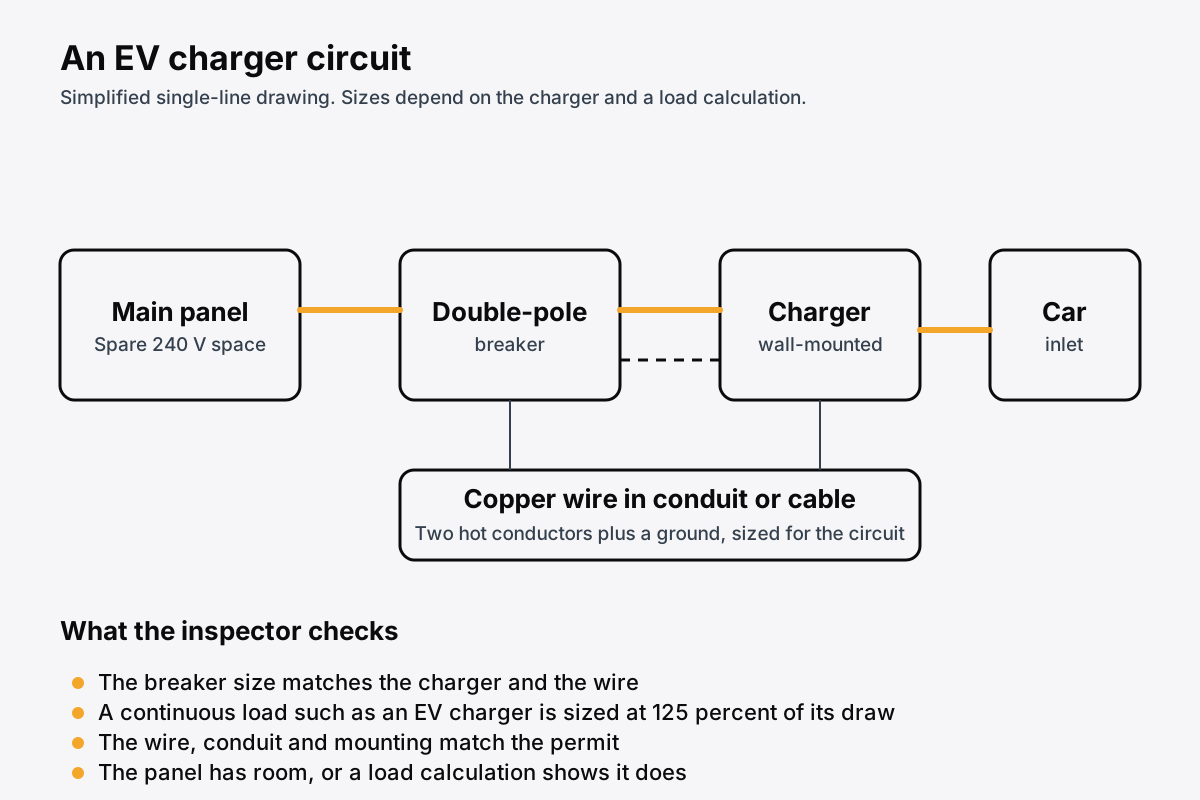
- Add the charger at its full rated load, treated as a continuous load under NEC 625.42.
- Compare the total to the service rating, then choosefits, fits with load management, or needs a larger service.
Questions people ask
What is a load calculation for an EV charger?
It is a worksheet that adds up the power your home can use at once, then adds the charger, and compares the total to the size of your electrical service. It answers one question: will the main breaker and service wires carry the new charger without overload? Many city building departments want it with the permit application.
What is the difference between NEC 220.83 and 220.87?
NEC 220.83 estimates an existing home from its floor area, appliances and nameplate ratings. NEC 220.87 uses real utility demand data, such as a year of billing history or a recorded peak. Measured demand often shows a lower number, which can let a charger fit on a smaller panel. The city decides which method it accepts.
Can I skip the calculation by using a smaller charger?
A smaller charger lowers the load, but the permit may still ask for the numbers. A 32 amp charger on a 40 amp breaker takes much less room than a 48 amp charger on a 60 amp breaker. The calculation proves the smaller choice fits, so it is still worth doing.
Do I need an inspector or engineer to sign the calculation?
In most cases the licensed electrician prepares it and attaches it to the permit. Larger or unusual services, such as a service with solar and battery, may draw more review. Ask your building department what it accepts, because forms and rules differ from city to city.
Keep reading
Home EV charger installation: circuit, panel and permit
A home Level 2 charger runs on its own 240 volt circuit, usually 40 to 60 amps. Whether the panel has room…
EV charger load management and circuit sharing
A load management device lowers the charger's draw when the rest of the house is busy. The code allows the…
Load calculation explained in plain English
The 220.83 method step by step with a worked example for a 1,800 sq ft home, and the 220.87 option based…
Do I need a panel upgrade for an EV charger?
How to tell if your panel can carry a Level 2 charger, when a load manager saves the upgrade, and what…
200 amp panel upgrade: what changes and when you need it
A 200 amp panel upgrade swaps your old main panel for a new one and, usually, the wire from the meter to…
How to read your electrical panel
A safe five-step read of your panel: main breaker, label, brand, free spaces and directory, plus when to…
Send a photo, get a range.
Share your ZIP and a photo of your panel. Your request goes to a licensed partner electrician, who contacts you.
Get this quoteAurion Electric is a referral service operated by Roviq LLC. Electrical work is done by a licensed partner electrician.
