Power from RPU
Level 2 charger installation in Riverside
In Riverside the electric utility is the city itself, and a 100 F afternoon is common. Both facts shape which charger to buy, how to wire it and which rate plan fits.
Plug-in or hard-wired
Many installers offer a plain 240-volt outlet so the owner can plug in a portable charger. In Riverside that shortcut can cost you the utility incentive, which is written around a wall-mounted unit. The conditions are in the rebate table on this page, and the city utility rebate guide compares them with other cities. Decide on the incentive before you buy hardware, and read the dates and household limits in the terms before the electrician starts, so a deadline does not catch you after the install.
Heat changes the rate question
Riverside’s July highs average about 93 F, and the year has roughly three weeks at 100 F or more. Central air runs hardest in the same late-afternoon hours when time-of-use prices are highest. A household that cools and charges after work may do better on the standard rate than on the time-of-use one, and a household that charges overnight may do better on the second. Model both from a year of meter data. The time-of-use guide walks through the comparison. RPU has no separate residential EV rate page, so be wary of any installer who promises one.
Panel room, old and new
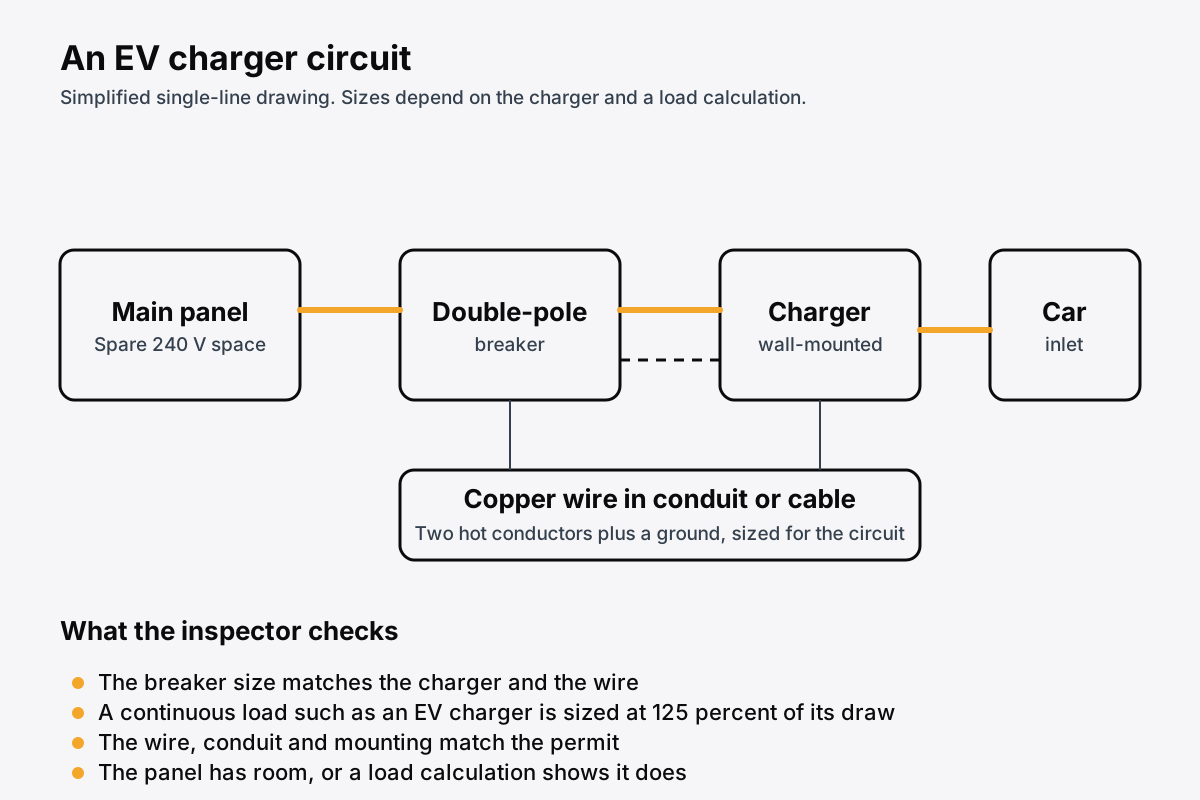
About four in ten Riverside homes were built before 1970, and downtown houses may still have 60 or 100 amp service. Newer tracts usually have 200 amp panels, but breaker spaces fill up after solar or a heat pump. A charger is a continuous load, so ask for a load calculation either way. If the result says the service has to grow, the job moves from a circuit to a panel upgrade, and the charger cost page shows how the typical range changes.
Permit and paperwork
The city’s Public Permit Portal lists electric vehicle charging stations as a project type with extra documents at submittal, and a residential charger guideline is posted there. Ask the electrician which documents they will upload and who attaches the final inspection record. Keep that record with the receipts. The Riverside city page has the wider local picture, including battery and heat pump programs that also depend on permitted work.
Charger permit path
The Public Permit Portal lists 'Electric Vehicle Charging Stations' as a project type that needs extra documents at submittal and links a 'Residential EV Charger Guidelines' document. The city's EV charger fee is a flat $66.00 plus the permit issuance fee. The portal page does not cite AB 1236 (Gov. Code 65850.7) by name.
Permit lines that can apply
City of Riverside Building & Safety Division (Community & Economic Development Department). Confirm the current amount at the counter.
Rebates that match this job
| Program | Amount |
|---|---|
| RPU EV Level 2 Residential Charger Rebate Active RPU electric customers with a new wall-mounted Level 2 charger installed on or after July 1, 2021 | Up to $1,500 (up to $2,500 for SHARE enrollees); hard-wired or new/modified 240V needs an electrical permit; outlets alone not eligible; one per household every three years; apply within 180 days |
Questions people ask
Should I install a 240-volt outlet now and a charger later in Riverside?
Only if you do not plan to claim a utility rebate. Riverside Public Utilities' charger incentive is written for a new wall-mounted unit, and an outlet alone is listed as not eligible. If you want the incentive, have the wall unit installed in one visit and keep the permit record and receipts.
Which RPU rate should an EV driver in Riverside pick?
RPU says EV charging works on either the Domestic rate or the Domestic Time-of-Use rate, and the better one depends on when you charge. Hot afternoons mean the air conditioner often runs during peak hours. Ask RPU for the current time-of-use hours, then compare against your own meter history.
Can a Riverside tenant make the landlord allow a charger?
In many leases, yes. Civil Code 1947.6 says a landlord shall approve a written request for a charger at the tenant's assigned parking space, for leases signed or renewed after July 1, 2015. The tenant pays for the work, the power and the insurance. Buildings with fewer than five spaces are excluded.
How do I book the charger inspection in Riverside?
By phone, as of the city's Inspections page. Call the automated line at (951) 826-5361 with the permit number and the three-digit inspection code from the job card. Requests made before 5 p.m. are usually scheduled for the next business day, and inspections run between 8 a.m. and 4 p.m.
EV charger installation in nearby cities
Related
Electrician in Riverside
Home EV charger installation: circuit, panel and permit
A home Level 2 charger runs on its own 240 volt circuit, usually 40 to 60 amps. Whether the panel has room…
How much does it cost to install a Level 2 EV charger at home?
A Level 2 EV charger install in Southern California typically costs $1,000 to $2,000 for the new 240-volt…
EV charger load calculation
Before a charger goes in, the electrician adds up your home's electrical load and checks that a new…
City utility rebates in Pasadena, Burbank, Glendale, Riverside and Anaheim
What Pasadena Water and Power, Burbank, Glendale, Riverside and Anaheim utilities pay for chargers, panels…
Time-of-use rates for EV owners
Plan names, peak hours and sign-up rules for SCE, SDG&E and LADWP EV owners, with no price claims that go…