Power from SCE
Home EV charger installation in San Bernardino
In San Bernardino the first question is the panel, not the charger. The median home dates to 1973, and an older service often has no room for a Level 2 circuit.
Check the panel before the charger
San Bernardino has older housing than most cities in the Inland Empire. The median home dates to 1973, and nearly half of homes were built before 1970. That era often means 60 to 100 amp services, fuse boxes, and Federal Pacific or Zinsco panels. A Level 2 charger runs for hours, so its circuit is sized at 125% of the draw, and an old service often cannot carry that on top of the house. The panel-for-charger guide shows how to tell.
With room in the panel, the typical SoCal range is $1,000 to $2,000. If the service has to grow, charger plus panel work runs $3,600 to $7,500, as the cost page breaks out. Ask any bidder to show the load calculation behind the answer, since that single page explains the price.
Rebates and the city form
SCE Charge Ready Home is aimed at SCE customers in income-qualified or disadvantaged-community households, and it pays toward the panel side of a charger job, not the charger itself. Terms change, so check current rules. SCE takes applications while you plan, during the work or up to six months after. The Charge Ready Home guide explains who qualifies. Ask your electrician whether the work needs to follow the program’s contractor rules before you sign.
On the city side, the paperwork is a short form that travels with the permit application, and state law requires the city to run a streamlined review. The AB 1236 guide explains that rule. Inspections are booked afterward by phone, so keep the permit number handy.
Where the charger goes
Look at the meter and panel area before you pick a spot. SCE’s older electrician guide, still posted on the city site, calls for a work space 36 inches wide, 36 inches deep and 78 inches high in front of service equipment, so a fence, shelf or water heater in that zone becomes a problem. A garage wall near the panel keeps the wire run short and the cost down.
Charging hours
Summers in this valley are hot, and the 4 to 9 p.m. window is also when most air conditioners run. SCE’s TOU-D-PRIME plan puts its peak in those hours every day, so the plan rewards charging after 9 p.m. The time-of-use guide shows how to set the car’s schedule. Half of San Bernardino homes are rented, so renters and condo owners should read the HOA and condo page. If the building needs more service, the panel page is next.
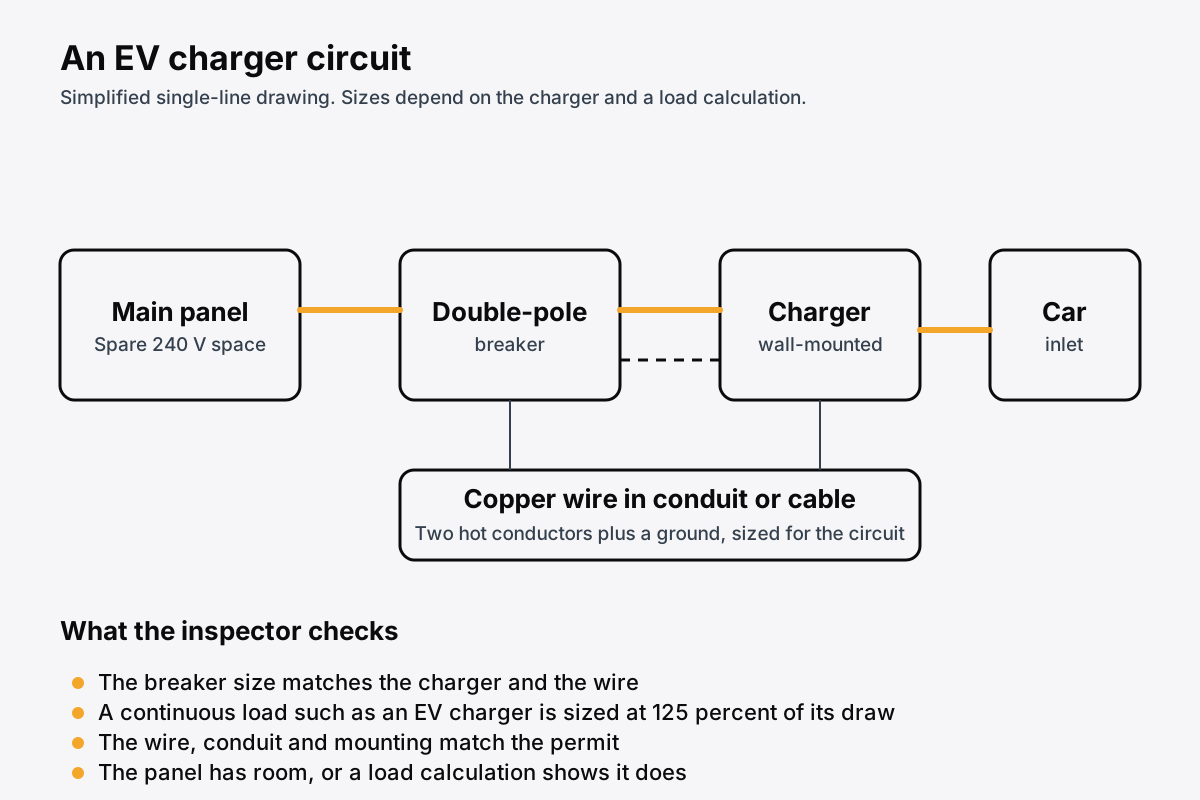
Charger permit path
San Bernardino has an 'EV Charging Station Guidelines for Residential Application' form; submit it with a building permit application. Residential EV charging station applications may be submitted online (email the guidelines form and permit application to Community Development and Housing) or in person, and are expedited. A new 120 V outlet needs a permit with no plans or load calculations; Level 2 needs basic information showing the service can handle the load. AB 1236 (Gov. Code 65850.7) requires every city to run an expedited, administrative review for EV charger permits and publish a checklist, and AB 970 (Gov. Code 65850.71) adds review timelines (GO-Biz).
Permit lines that can apply
| Item | Fee |
|---|---|
| Permit issuance fee (to be included on all permits) | $60.00 |
City of San Bernardino Building & Safety Division (Community Development & Housing). Confirm the current amount at the counter.
Questions people ask
Which SCE plan do I need to charge cheaply?
TOU-D-PRIME is the plan built for EV households. It needs an EV, home battery or electric heat pump on file, has a 4 to 9 p.m. peak every day, and swaps the baseline credit for a fixed daily charge. Prices differ between SCE pages and change over time, so read the current tariff before you switch.
Can a 60 amp fuse box support a charger?
Usually not. A Level 2 charger is a continuous load, so its circuit is sized at 125% of the charger's draw, and a 60 amp service is mostly used up by the house. The electrician does a load calculation first. Many older homes need the service raised, which is why the panel and the charger are priced together.
Can my landlord refuse a charger at my San Bernardino rental?
Often not. Civil Code 1947.6 says a landlord must approve a tenant's written request to install a charger at the tenant's assigned parking space, if the lease is covered and the tenant follows the landlord's process and pays the costs. It does not apply with fewer than five parking spaces or when parking is not part of the lease.
How long does a condo association have to answer a charger request?
Civil Code 4745 gives the association 60 days to deny a charger request in writing. If it does not, the request is deemed approved, unless the delay comes from a reasonable request for more information. Restrictions that effectively prohibit a charger, or unreasonably raise its cost, are void. Send the request in writing and keep a copy.
EV charger installation in nearby cities
Related
Electrician in San Bernardino
Home EV charger installation: circuit, panel and permit
A home Level 2 charger runs on its own 240 volt circuit, usually 40 to 60 amps. Whether the panel has room…
How much does it cost to install a Level 2 EV charger at home?
A Level 2 EV charger install in Southern California typically costs $1,000 to $2,000 for the new 240-volt…
SCE Charge Ready Home: what it pays, who qualifies and the order of steps
What Charge Ready Home covers, who qualifies, the order of steps, and what to check before you apply.
Do I need a panel upgrade for an EV charger?
How to tell if your panel can carry a Level 2 charger, when a load manager saves the upgrade, and what…
Time-of-use rates for EV owners
Plan names, peak hours and sign-up rules for SCE, SDG&E and LADWP EV owners, with no price claims that go…
Upgrading a panel in San Bernardino
A San Bernardino panel upgrade is two appointments with two agencies. The city issues the permit and…