How much does a Tesla Wall Connector install cost?
A Tesla Wall Connector installed in SoCal typically costs $1,500 to $2,800 with the charger, the circuit and the permit. This is a desk estimate, and your total moves with the wire run and the panel.
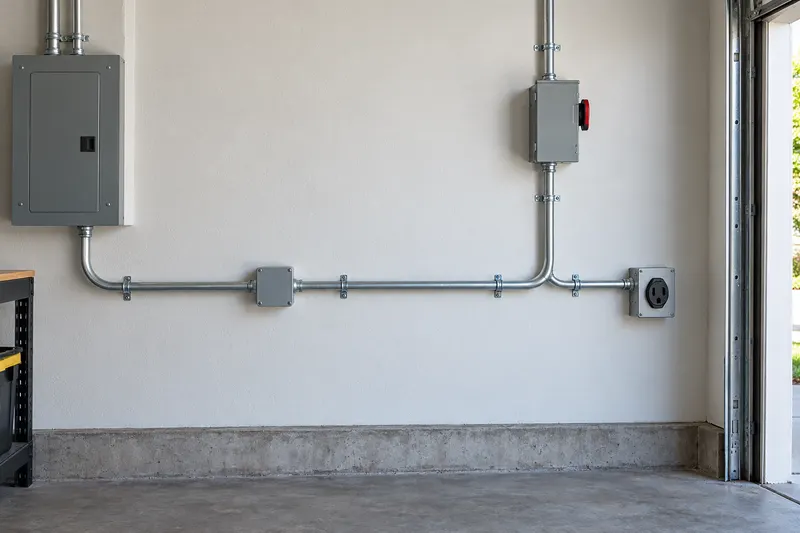
Typical SoCal range, October 2026
$1,500 to $2,800
Wall Connector supplied and installed, circuit, permit. This is a desk estimate, not a quote.
Basis: estimate. The $1,500 to $2,800 range is a desk estimate: the charger plus a normal install, as of October 2026. Wall Connector installs do not have a published SoCal price list, but NRG Clean Power gives the pieces. The unit costs about $450 to $500. On a 200-amp panel NRG shows an installed charger at $1,200 to $2,800, and $4,500 to $7,500 if the panel must be replaced. The estimate sits inside those numbers and assumes the electrician supplies the charger.
The circuit, wire and breaker details are on the Tesla Wall Connector installation page.
Circuit sizes: the choice that sets the price
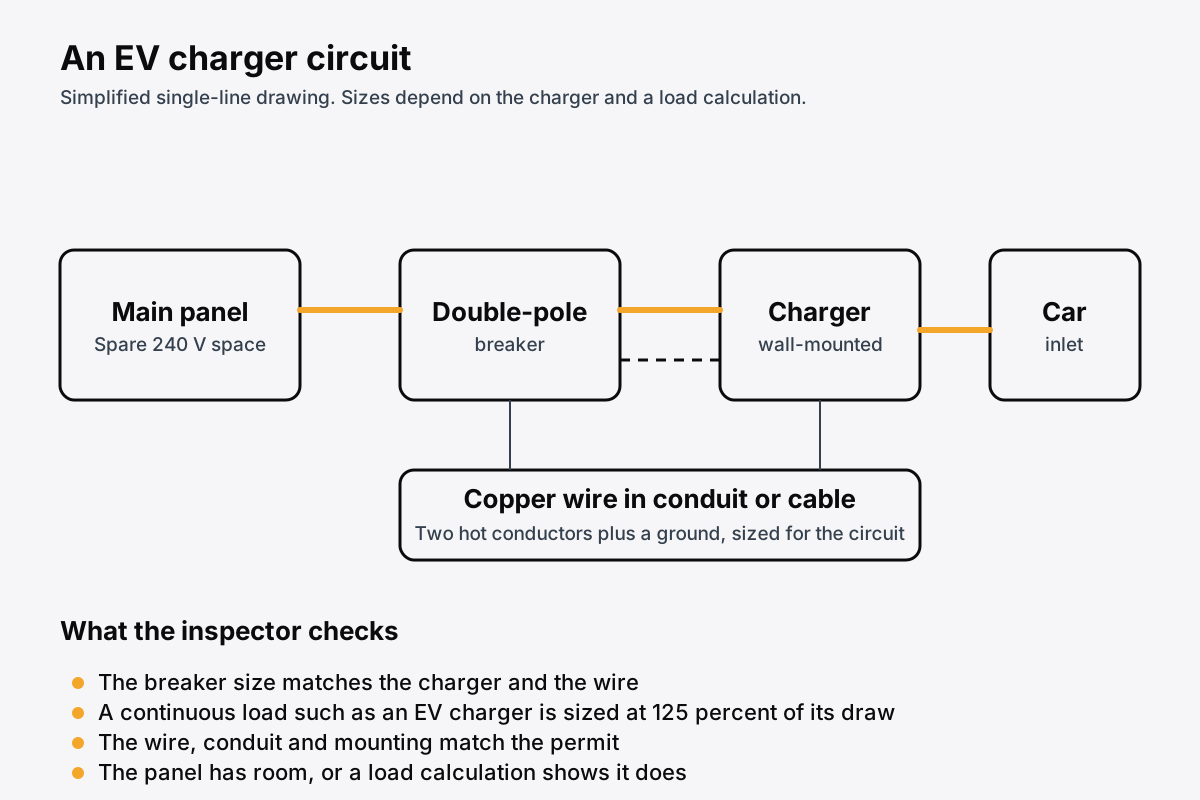
Tesla’s installation manual ties the Wall Connector’s output to the breaker. A 60 amp double-pole breaker gives the full 48 amps (11.5 kW). Smaller breakers work and give less: 50 amps gives 40 amps of charging, 40 amps gives 32, and 30 amps gives 24. The breaker size is entered in the unit when it is commissioned, so the breaker and the setting must match. Many cars charge slower than the unit can deliver, because the car’s onboard charger sets its own limit, so a 48 amp circuit does not always buy faster charging.
For cost, this matters in two ways. A 60 amp circuit needs heavier copper wire and a larger breaker than a 40 amp circuit, which adds a little to materials and more on a long run. It also takes more capacity from the panel, and that can tip a 100 amp panel into needing help. Ask the electrician to price the circuit at 60, 50 and 40 amps, then pick based on how far you drive each day and what the panel can carry. The EV charger cost page covers the general install; this page covers what is specific to this unit.
Hardwired, with Wi-Fi
The Gen 3 Wall Connector is hardwired to a breaker. There is no plug and no 14-50 outlet. That removes the outlet as a weak point. Wiring and mounting are one job, and the permit covers both.
Wi-Fi is part of the setup. Tesla’s manual lists 2.4 GHz Wi-Fi, and the electrician or owner connects the unit during commissioning. Pick the mounting spot with signal in mind. If the garage has weak Wi-Fi, a router closer to the wall or an extender costs little compared with the install.
Load sharing and lower-cost options
Tesla describes power sharing for sites with more than one Wall Connector: up to six units can split the total current set for the site, so the group never goes over it. The same idea helps a household with two EVs and one spare 60 amp circuit. Tesla also lists load features that lower charging amps to fit the available supply. Whether the city and the utility accept a given load-management setup is a question for the electrician and the inspector, since the 2023 National Electrical Code that California’s 2025 code is based on allows an energy management system to limit load, with conditions. The load management page explains the options. Load management is the usual way to avoid a panel upgrade, and NRG puts the hardware at $300 to $700.
Three common cases
Short run, 200A panel. The garage wall shares the panel wall. Expect the low end, around $1,500 to $2,000.
Long or exterior run. The charger is on the other side of the garage or outside. NRG adds $500 to $1,500 for long or exterior runs, with wire at $10 to $20 a foot.
Panel at its limit. A 100-amp panel with a gas furnace and a gas dryer may handle a lower-power setting. A 100-amp panel with electric loads may not. See the panel upgrade guide. When the panel needs work, the numbers move to the panel add-on page.
Rates matter after the install
The charger is only half the cost of owning it. Time-of-use rates change the cost per charge. See the rate guide and check the calculator.
Adding up the pieces
Using NRG’s California line items, the base is about $450 to $500 for the unit, $600 to $1,200 for labor and materials on a short run. The permit fee varies by city and is confirmed in the quote. Without the permit that sums to roughly $1,050 to $1,700. A long or exterior run adds $500 to $1,500 more, which reaches toward $3,200 in the worst case, before the permit. The $1,500 to $2,800 range sits inside that spread. Treat it as an estimate and compare it with two or three written quotes for your own wall.
Owning the charger already
If you bought a Wall Connector yourself, the install is still the same circuit and mount. Some electricians install customer-supplied equipment and some do not, so ask before you buy. Keep the model number and the manual handy for the permit and for any utility rebate form. Deduct the hardware, about $450 to $500, from the range above to see what the labor and permit alone should cost.
Permit fees and utility rebates
New 240-volt circuits are generally permitted work, and permit fees are set by each city and vary, so the quote confirms yours. Some municipal utilities pay more for a networked or smart charger than for a basic one. Burbank Water and Power, for example, lists $200 for a standard charger and $500 for a smart charger, and Glendale lists $599 for a networked unit. Ask the utility in writing whether a Wall Connector counts before you buy, because the rules are the utility’s, not Tesla’s. Check your city page, such as Burbank, Glendale or Anaheim, or the Los Angeles County hub. Programs change, so confirm the terms before you buy.
How to compare quotes
- Who supplies the charger, and is the model named?
- What circuit size and wire gauge does the quote assume?
- Is the run length stated in feet?
- Is the permit in the price?
- Is a load-management option priced?
What is not included
Panel work, trenching, HOA or landlord approval, a dedicated utility meter, and any rebates. If you already own a Wall Connector, deduct about $450 to $500 and ask the electrician to confirm they will install it.
What moves the price
| Factor | Effect | Range |
|---|---|---|
| Circuit size | The unit delivers up to 48A and needs a 60A circuit (NRG), so the wire and breaker are heavier than for a basic charger | |
| Run length and routing | A long or exterior run adds $500 to $1,500 (NRG) | |
| Panel capacity | On a 200A panel NRG shows $1,200 to $2,800 all in; with a panel replacement $4,500 to $7,500 | |
| Detached garage | Trenching adds $1,500 to $3,500 (NRG) | |
| Hardware | NRG lists the Wall Connector at about $450 to $500 |
Questions people ask
Do I need to buy the Wall Connector myself?
Not necessarily. Some electricians supply it and some install a unit you bought. The estimate here assumes the electrician supplies it. If you buy it, subtract the hardware cost, about $450 to $500 per NRG, and ask the electrician whether they will install customer-supplied equipment.
Does the Wall Connector need Wi-Fi?
Tesla's manual recommends connecting it to a local 2.4 GHz Wi-Fi network for updates and features such as power sharing. Wi-Fi is set up during commissioning, after the electrician wires it. Check that the signal reaches the garage wall before you pick a location, because a metal garage door or a far wall can block it.
Can the Wall Connector run at lower power to avoid a panel upgrade?
Often yes. Many home setups use a lower circuit size or a load-management device instead of a panel upgrade. Whether yours can depends on a load calculation. Ask the electrician to show the math. Load management runs $300 to $700 in NRG's data.
Related
Tesla Wall Connector installation: the circuit it needs
The Gen 3 Wall Connector is hardwired, with no plug. A 60 amp breaker gives the full 48 amps (11.5 kW)…
Home EV charger installation: circuit, panel and permit
A home Level 2 charger runs on its own 240 volt circuit, usually 40 to 60 amps. Whether the panel has room…
How much does it cost to install a Level 2 EV charger at home?
A Level 2 EV charger install in Southern California typically costs $1,000 to $2,000 for the new 240-volt…
EV charger plus panel upgrade: what the whole job costs
When your panel cannot carry a charger, the combined job typically costs $3,600 to $7,500 in SoCal, as of…
EV charger load management and circuit sharing
A load management device lowers the charger's draw when the rest of the house is busy. The code allows the…
EV charger cost calculator
Check if your panel can carry a Level 2 charger and see the typical cost.
Time-of-use rates for EV owners
Plan names, peak hours and sign-up rules for SCE, SDG&E and LADWP EV owners, with no price claims that go…
Panel upgrade cost estimator
Pick your panel, target size and site conditions to get a typical SoCal range.
$1,500 to $2,800
Wall Connector supplied and installed, circuit, permit.
Get this quote