Commercial EV charger installation for workplaces and retail
A business charger project is mostly an electrical capacity question. The charger is the small part; the panel, the trench, the utility and the accessible space count decide the schedule and the bill.
- 1 van-accessible and 1 standard-accessibleAccessible charging spaces needed at a site with 5 to 25 chargers (CBC 11B-228.3)
- 25 kW or more (25 percent of electricians certified)EVITP crew rule starts at ports delivering
- up to $100,000 per port, Oct. 7, 2026 to Jan. 14, 2027CEC fast charger incentive, round 1
- property placed in service after June 30, 2026 not eligibleFederal 30C credit end date
Start with the panel, not the charger
A charger needs a circuit, and a circuit needs spare capacity. The first job is a load calculation on the main panel and the utility meter. It shows whether the building can carry the chargers as they are, with load management, or only after a service upgrade. The load calculation page shows the method, and the panel and service upgrades page covers what follows when the answer is no.
Distance matters as much as amps. A parking lot at the far end of a property can mean trenching under asphalt, which costs more than the chargers. Surface conduit on a wall is cheaper and faster where the layout allows it.
Level 2 or DC fast for a business
Level 2 chargers fit places where cars sit for hours: offices, medical buildings, hotels and retail centers that keep customers on site. They run on 208 or 240 volts and can share one feed through load management.
DC fast chargers fit sites where drivers stop for minutes: fuel-style stops and travel corridors. They need a much larger service, usually three-phase 480 volt, and the utility often needs to add equipment. For most workplaces and small retail, Level 2 is the practical choice. Fleet-light users, such as a few delivery vans that return nightly, usually do well with Level 2 on a schedule.
Load management
Load management software caps the total power across several chargers, slowing some while others run. It lets a site add more ports than the panel could feed at full power. CALGreen allows automatic load management systems to reduce the required electrical capacity for charging stations, and the load management page explains how it works. Whether the building department and the utility accept a given system is a local call, so settle it at plan check and not at the final inspection.
Who must be EVITP certified
Public Utilities Code 740.20 requires customer-side charging equipment that is funded or authorized in whole or in part by the CPUC, the Energy Commission or the Air Resources Board to be installed by a licensed contractor with at least one electrician certified in the Electric Vehicle Infrastructure Training Program on each crew. If a port delivers 25 kilowatts or more, at least 25 percent of the electricians on the crew must be certified. Work funded by Low Carbon Fuel Standard credits and work done by utility employees are exempt.
A fully private project with no agency funding does not fall under the rule. If you are applying to any state program, read its terms first, because a program can require certification on its own.
Building code: how many charging spaces, and how many accessible
For new commercial parking, CALGreen requires a share of spaces to be EV capable, which means panel capacity and conduit are in place for a later charger, and a share to have chargers installed. The share grows with the size of the lot, and office and retail uses are counted differently from other uses. The 2025 edition of CALGreen took effect January 1, 2026, so a project’s edition depends on the permit application date. Retrofits to an existing lot follow different triggers, so ask the building department before you assume the new-construction table applies.
Accessible spaces are a separate rule. When chargers serve the public or are in common use, Section 11B-228.3 of the California Building Code sets a minimum number of accessible charging spaces. A site with 1 to 4 chargers needs one van-accessible space. A site with 5 to 25 needs one van-accessible and one standard-accessible space. Chargers reserved for one driver or for fleet vehicles are exempt from the minimum number. Striping, signage and an accessible route are part of the permit set.
Residential parking is covered on the multifamily and HOA charging page. For a commercial tenant asking a landlord for a charger, Civil Code 1952.7 applies at properties with 50 or more parking spaces, and the tenant pays for installation, repair and electricity.
Utility make-ready, rates and incentives
The utility owns everything up to the meter. A big charging load often needs a service request, and sometimes a transformer. Plan this early with the utility coordination guide, because it is usually the slowest step. Many cities also follow the state charger permit streamlining rules in the AB 1236 guide.
Incentive status as of October 30, 2026:
| Program | Status |
|---|---|
| SCE Charge Ready | SCE says it no longer takes new applications, and agreements must be signed by December 31, 2026. |
| SDG&E Power Your Drive, workplaces | SDG&E says the program is fully subscribed and not taking applications. |
| LADWP commercial rebate | Closed to new applications. The page, updated October 10, 2026, says an enrollment opportunity with revised terms, funding amounts and documents is planned for November 2026. The last published terms paid up to $4,000 per Level 2 charger, or $5,000 for chargers at multifamily (5 or more units) or public sites in a CalEPA-defined disadvantaged community. For DC fast chargers it listed equity tiers of $25,000 (50 to 149 kW), $68,750 (150 to 274 kW) and $125,000 (275 kW or more), and non-equity tiers of $20,000, $55,000 and $100,000. Future terms and amounts may change. The August 19, 2026 dashboard shows $45 million for Level 2 and $20 million for DC fast as pending release for fiscal year 2026-27. |
| CEC Fast Charge California | Round 1 runs October 7, 2026 to January 14, 2027, up to $100,000 per port, for publicly accessible chargers with a permit and final utility design. Round 2 runs February 24 to May 27, 2027, up to $55,000 per port. |
The federal 30C credit ended for property placed in service after June 30, 2026, per IRS instructions. See the federal credits guide for the full picture. Never buy equipment before a program confirms in writing that it will pay.
What to send for a quote
Send the building type, the address, whether you own or lease, the number of parking spaces, the number and type of chargers you want, and a photo of the main panel and meter. Commercial electrical work is available through the partner electrician. Start at the commercial hub or the quote form.
What the work covers
| Item | What it involves |
|---|---|
| Load calculation and site survey | Spare capacity at the main panel, distance to parking, trench or wall routes, meter location. |
| Service or switchgear upgrade | A larger service or a new panel when the building cannot carry the chargers. |
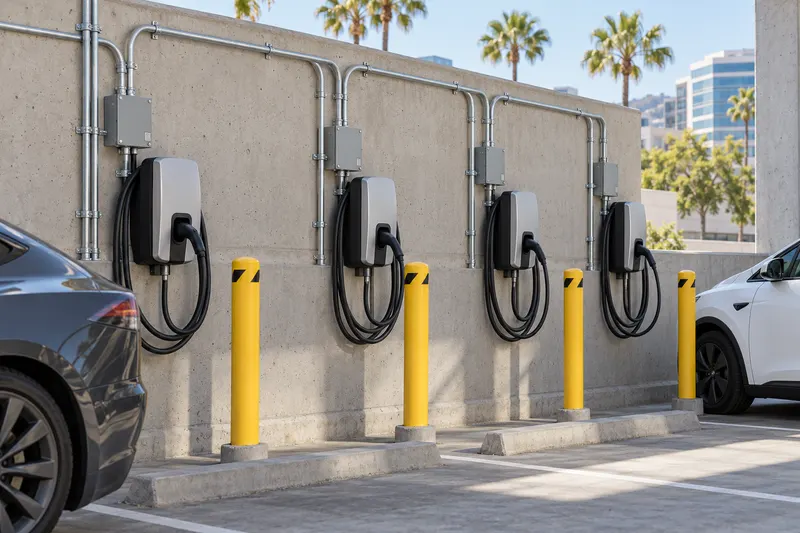
| Conduit, wire and charger pads | Trenching, boring or surface raceway, pads, bollards and wheel stops. |
| Chargers and load management | Level 2 or DC fast units, network software and power sharing between ports. |
| Accessible spaces and signs | Striping, route and signage for van and standard accessible spaces. |
| Permit, utility and inspection | Plan check, utility service request and the final inspection. |
Send three things. Get a call.
Share the building, the job and a deadline. Your request goes to a licensed partner electrician, who contacts you about the building, the load and the permit path.
Commercial electrical work is available through the partner electrician.
- The buildingType of business, address and rough size.
- Who you areOwner, tenant, property manager or HOA board.
- The jobWhat is wrong or planned, and any deadline such as a lease date or inspection.
Commercial electricians by city
Questions people ask
How much power does a workplace charger need?
It depends on the charger and how many run at once. A load calculation sets it. Many workplaces use several Level 2 chargers on one circuit with load management, which shares power between ports. A DC fast charger needs a much larger service, often 480 volt three-phase. Start with the main panel size and the utility meter.
Does my business need EVITP-certified electricians?
Only when the project is funded or authorized in whole or in part by the CPUC, the Energy Commission or the Air Resources Board. Then Public Utilities Code 740.20 requires at least one EVITP-certified electrician per crew, and at least 25 percent where any port delivers 25 kW or more. Ask the program, not the contractor, which rule applies to you.
Are there rebates for a business charger right now?
Money is limited. As of October 2026, SCE says Charge Ready no longer takes new applications, SDG&E says Power Your Drive for workplaces is fully subscribed, and LADWP is closed to new commercial applications, with a new enrollment planned for November 2026. The Energy Commission is taking public fast charger applications until January 14, 2027. Confirm status before you buy.
Is the federal charger tax credit still available?
No, not for new projects. IRS instructions say the section 30C credit cannot be claimed for charging property placed in service after June 30, 2026. A charger placed in service on or before that date could still qualify. Ask a tax adviser how that applies to a project you finished earlier.
Do I have to install accessible charging spaces?
When chargers are for public or common use, yes. Section 11B-228.3 of the California Building Code requires van-accessible and standard-accessible charging spaces, and the count rises with the number of chargers. Chargers reserved for one driver or for fleet vehicles are exempt from the minimum-number rule. Plan the striping and route before the electrical layout.
Related
Commercial
EV charging for multifamily buildings and HOAs
In a California HOA, the board cannot unreasonably block an owner's EV charger, and in many rentals the…
Commercial panel and service upgrades
A commercial service upgrade has two jobs: the electrician's work inside the building and the utility's…
EV charger load management and circuit sharing
A load management device lowers the charger's draw when the rest of the house is busy. The code allows the…
EV charger load calculation
Before a charger goes in, the electrician adds up your home's electrical load and checks that a new…
AB 1236 and EV charger permits: what California cities must offer
What Government Code 65850.7 requires of cities for EV charger permits, and how a few SoCal cities put it…
Federal tax credits for home electrical work: status in 2026
What each federal credit covered, the dates it ended, who might still claim, and where to look for money…
Who files, who pays and who to call in a service upgrade
The four parties in a panel or service upgrade, what each files, what each pays and what to say when you call.
Warehouse and industrial electrical work in Ontario and the Inland Empire
Warehouse electrical work is mostly about service size, lighting and charging capacity. In Ontario, SCE…