Exit signs and emergency lighting for businesses
Exit paths must be lit to at least 1 footcandle, and emergency lights and exit signs must run at least 90 minutes on backup power. The owner tests them monthly for 30 seconds, once a year for 90 minutes, and keeps a written log.
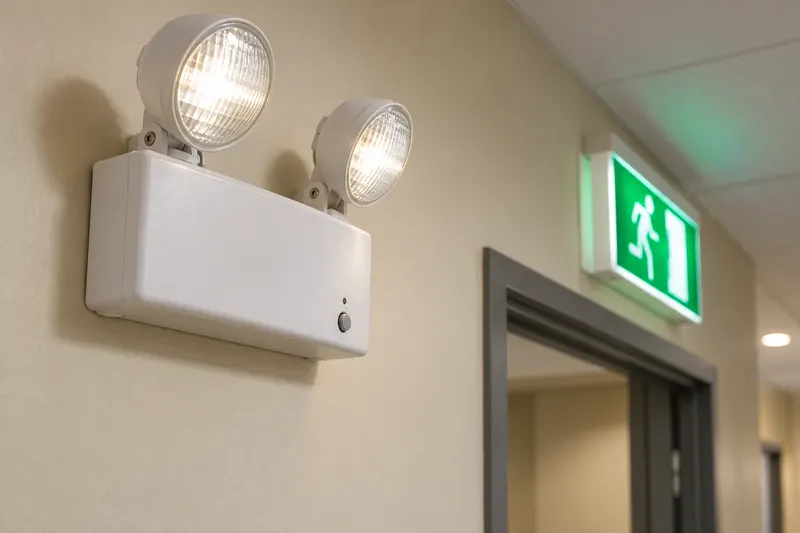
- 1 footcandleExit path light level, normal power (stairs: 10 footcandles)
- 90 minutesEmergency power run time
- 30 secondsMonthly activation test
- 90 minutesYearly power test on battery
What the fire code asks for
Exit signs and emergency lights fall under the means of egress rules in Chapter 10 of the California Fire Code. The text below is the 2022 edition as published on UpCodes. The 2025 edition took effect January 1, 2026, and the City of Temecula’s 2025 handout cites the same testing section, 1032.10. Section numbers can shift between editions, so use them as a guide and confirm with the fire authority.
Normal lighting (section 1008.2.1). The exit path must be lit to at least 1 footcandle (11 lux) at the walking surface. Exit stairways and their landings need at least 10 footcandles while in use.
Emergency lighting when power fails (sections 1008.3.1 to 1008.3.5). In rooms and spaces that need two or more exits, an emergency system must automatically light aisles, corridors and exit access stairs and ramps. Buildings that need two or more exits must also light interior and exterior exit stairs, exit passageways, vestibules and exterior landings at exit doors. The system must run at least 90 minutes on storage batteries, unit equipment or an on-site generator. At the start, the light must average at least 1 footcandle at floor level, with no point below 0.1 footcandle. It may fall to a 0.6 average and 0.06 minimum by the end of the 90 minutes. The ratio of the brightest to the dimmest point may not pass 40 to 1.
Exit signs
Under section 1013.1, exits and exit access doors must be marked by an approved sign that is readily visible from any direction of travel. Signs must also show the direction along the path where an exit is not obvious. Any point in an exit corridor must be within 100 feet, or the sign’s listed viewing distance if shorter, of the nearest exit sign. Rooms that need only one exit are excepted.
Signs must be lit (section 1013.3). Electric, self-luminous and photoluminescent signs must be listed to UL 924, and internally illuminated signs stay lit at all times (1013.5). Externally lit signs need letters at least 6 inches high (1013.6.1). For the power source, section 1013.6.3 says the sign lighting must connect to an emergency power system, so that it stays on for at least 90 minutes when normal power fails. Approved signs that stay lit without outside power for 90 minutes do not need that connection.
Raised-character and Braille exit signs at certain doors are separate and follow the accessibility rules. Section 1013.4 lists where they go.
The electrical side
The electrician mounts and wires the units, replaces batteries and failed boards, and checks that each unit is on the circuit the plan shows.
For central systems such as a generator or an inverter, the electrical code’s Article 700 sets the wiring rules. In EC&M’s 2025 summary, emergency power must be available within 10 seconds of a loss of normal power, and the layout must avoid leaving a space in total darkness if a single lamp fails. Legally required standby systems under Article 701 have a 60 second window. The designer decides which article applies to your building.
Testing and records
Section 1032.10 of the fire code covers inspection and testing:
- Monthly activation test. Run each unit for at least 30 seconds. It can be done by hand or by an automated self-test. If self-testing is used, a monthly visual check must catch any unit showing a trouble light or damage.
- Annual power test. Battery units must run on battery for at least 90 minutes.
- Written records. The owner keeps records of inspections and tests for the fire authority. Temecula cites section 110.3 for this.
Temecula’s handout and Moreno Valley’s, which comes from Riverside County Fire, both point out that a unit’s charging light can be on even though the battery will not carry a load. Moreno Valley’s form lists a monthly test window of three to five weeks. Its wording on the annual test duration is not consistent, so go with the 90 minutes written in the code text and Temecula’s 2025 handout.
A simple log works: one row per unit with a number, location, test date, start and stop time, pass or fail and the tester’s initials. A maintenance agreement is one way owners keep the dates.
When changes trigger a review
A new tenant layout, a lighting retrofit, or new racking can change the exit path and the light levels. After the work, walk the path and look for dark spots, blocked signs and signs that point the wrong way. A tenant improvement normally brings the city and the fire authority into the plan review, so ask what the fire authority wants to see. Restaurants, shops and large warehouses have different layouts but the same tests.
Who inspects
The building department checks the work on permitted jobs. The fire authority inspects existing buildings and can ask for the test log. In Southern California that authority may be a city fire department, Riverside County Fire, the Orange County Fire Authority or another agency, depending on the address. Call your local fire prevention office with the address and ask what it checks.
What to send
For a quote, send the building type, the address, say if you are the tenant, owner or property manager, how many exits and emergency lights you have, and whether any have failed tests. Commercial electrical work is available through the partner electrician. Start from the commercial hub or the service and repair page.
Where exit lighting runs from a central generator, the generator, transfer switch and testing schedule are covered on the commercial standby generator page. Exterior exit paths and parking areas are also covered by the lot controls on the parking lot lighting page.
What the work covers
| Item | What it involves |
|---|---|
| Exit signs | Listed signs at exits and along the path where an exit is not obvious, lit at all times. Replace failed LED boards, batteries or whole units. |
| Emergency light units | Self-contained battery lights over corridors, stairs, exits and large rooms, or fixtures on a central battery or generator. |
| Light level check | A meter check of the exit path at floor level against the code minimums, especially after a layout or lighting change. |
| Testing | Monthly push-button tests and the yearly 90-minute battery test, written into a log. |
| Wiring | Unswitched supply to each unit, correct circuit, and emergency system wiring under CEC Article 700 where it applies. |
| Corrections | Repairs after a failed test or a fire inspection note. |
How the job goes
- Walk the exitslist every exit sign and emergency light by location and number it.
- Test monthlypress and hold the test button for at least 30 seconds, then record the result.
- Test yearlycut power to the units and confirm they run 90 minutes.
- Repairreplace any unit that is dim, dead or fails the run time.
- Keep the logthe fire inspector may ask for it at the annual inspection.
Send three things. Get a call.
Share the building, the job and a deadline. Your request goes to a licensed partner electrician, who contacts you about the building, the load and the permit path.
Commercial electrical work is available through the partner electrician.
- The buildingType of business, address and rough size.
- Who you areOwner, tenant, property manager or HOA board.
- The jobWhat is wrong or planned, and any deadline such as a lease date or inspection.
Commercial electricians by city
Questions people ask
How bright must the path to an exit be?
Under normal power, exit path lighting must be at least 1 footcandle at the walking surface, and exit stairways need 10 footcandles while in use. When power fails, emergency lights must give an average of 1 footcandle at floor level at the start, with no point below 0.1 footcandle. Levels may drop to a 0.6 average by the end of the 90 minutes.
How often do emergency lights and exit signs need testing?
Test them monthly for at least 30 seconds, and once a year on battery power for at least 90 minutes. The monthly test can be done by pressing the unit's test button or flipping its dedicated breaker, or by a self-testing unit with a monthly visual check. Keep written records. The owner keeps them for the fire authority.
Do exit signs need battery backup?
Yes, unless they are a type that stays lit on its own. The fire code says exit signs must be lit at all times and, to stay lit 90 minutes after a power loss, must connect to an emergency power system of batteries, unit equipment or an on-site generator. Approved signs that glow independent of outside power for 90 minutes are exempt from that connection.
Who inspects exit and emergency lighting, the city or the fire department?
Both can. The building department reviews and inspects new or altered work, and the fire authority inspects existing buildings, including the test records. In Southern California the fire authority may be a city department or a county agency. Cities such as Temecula and Moreno Valley hand out test log forms and ask for the records on request.
Can I use my regular lights as emergency lights?
Only if they are connected to an emergency power source. Ordinary fixtures go dark with the grid. Emergency lighting must come on automatically when normal power fails and run from storage batteries, unit equipment or an on-site generator. A designer sizes the layout for your building.
Related
Commercial
Commercial LED lighting retrofits and Title 24
Swapping a warehouse or office to LED is regulated work in California when the change touches 10 percent…
Electrical maintenance agreements for commercial buildings
A maintenance agreement is a written list of electrical checks, how often they happen and what happens…
Commercial electrical service and repair
A business electrical problem is either inside your meter, where an electrician fixes it, or outside it…
Tenant improvement electrical: what a build-out needs
In a lease build-out, the electrician works from the landlord's service up to the last outlet. The code…
Electrical work for restaurants and retail stores
A restaurant electrical job ends with two inspectors, not one: the city building inspector and the county…
Warehouse and industrial electrical work in Ontario and the Inland Empire
Warehouse electrical work is mostly about service size, lighting and charging capacity. In Ontario, SCE…
What a property manager needs from an electrician
A property manager gets better electrical work by sending a complete request, knowing who pays, giving…
Standby generator installation for businesses
A business generator is built to one of three electrical classes, each with its own transfer time…