Commercial electrical service and repair
A business electrical problem is either inside your meter, where an electrician fixes it, or outside it, where the utility does. Knowing which saves the first phone call.
- 10% or more of the fixtures in an enclosed spaceIndoor lighting trigger
- Exempt from the lighting alteration ruleLamp-only swaps
- Required for C-10 workers unless an apprentice, trainee or exempt (Labor Code 108.2)Electrician certification
Symptoms that call for an electrician
A repair call is the most common reason a business owner first calls an electrician. The usual causes are a breaker that trips, a dead outlet circuit, a failed light fixture, a burned-out equipment feed or a loose neutral. Some problems cannot wait. Stop using the circuit and call an electrician for:
- A breaker that trips again right after a reset.
- A hot panel cover, buzzing, or a burning smell.
- Scorch marks, melted insulation or a flickering light across several rooms.
- Water in a panel, junction box or fixture.
- Equipment that runs weak or hot, which can point to a lost phase or a bad connection.
The emergency electrician page covers urgent home calls and the same safety steps.
What the electrician checks
An electrician finds the cause with a meter, not a guess. The visit usually runs in this order:
- Ask what was running and what changed, such as new equipment or a recent power blip.
- Measure voltage at the panel and at the failed equipment, then under load.
- Open the panel and check connections, breakers and labels for heat damage.
- Test the circuit for shorts and ground faults.
- Report what failed, what it will take to fix and what else was found.
The report matters to a landlord or lender, so ask for photos and a plain description of the cause. A manager can use the property manager checklist to set up the request and the paperwork.
Repairs the code requires
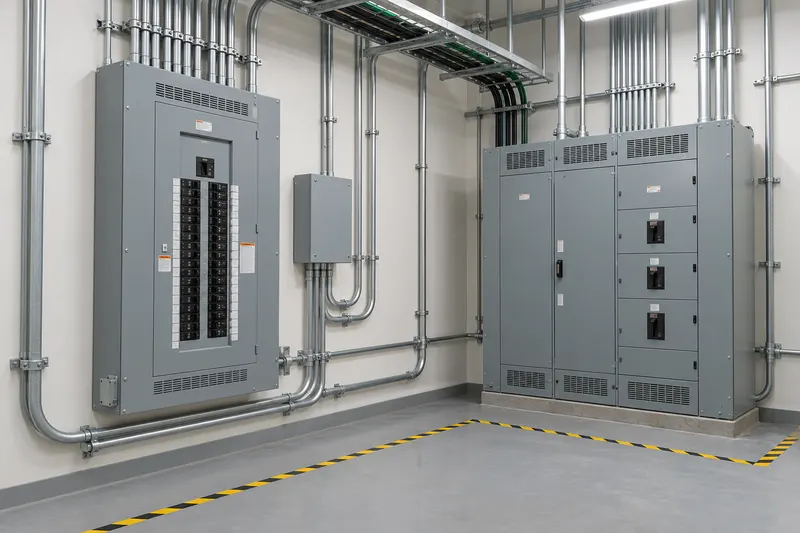
A repair is often more than a part swap. Missing panel covers, open knockouts, unlabeled breakers, damaged cable and splices outside a box are safety defects that the electrician is expected to correct when found, and a permit and inspection may apply. When a repair adds a circuit or changes a panel, it becomes a permitted job. Panel and service changes are nearly always permitted work in SoCal, and a commercial panel often needs a load calculation and plan check. The panel and service upgrade page covers that path.
Utility or electrician
The meter is the dividing line. If neighbors are dark too, the problem is probably outside, and the utility owns it. Call the utility for a whole-block outage, a downed line or damage to the service drop or meter. Call an electrician for anything on your side: the main breaker, the panel, wiring and equipment. If the utility’s work needs a customer-side repair first, such as a damaged meter socket or mast, the electrician fixes that and the utility reconnects. The utility coordination guide explains who files what. Keep refrigerated stock closed during an outage.
When a repair turns into a project
A repair call can show a bigger need. A panel with no spare spaces points to a service upgrade. A new tenant’s equipment points to tenant improvement electrical. Old fixtures may be worth changing, and the LED retrofit page lists when Title 24 applies. Under the 2025 California Energy Code, an alteration covering 10 percent or more of the fixtures in an enclosed space must meet lighting power limits and controls, while replacing only lamps, ballasts or drivers is exempt. For repeat problems, a maintenance agreement schedules the inspections.
What affects the price
Commercial prices vary more than home prices, so this page does not quote one. The drivers are how far the circuit runs, wall and ceiling type, work after hours, permit and plan check fees, whether the utility is involved and the equipment itself. The quote checklist lists what a written quote should show. To ask about a repair, send the building type, address, whether you are the tenant, owner or property manager and what is wrong through the quote form.
Who does the work
A C-10 license covers work that installs, connects or modifies electrical wiring and equipment. Under Labor Code 108.2, workers for a C-10 contractor must hold a state electrician certification unless they are registered apprentices, trainees or otherwise exempt. Low-voltage systems such as data cabling may fall under a different license class, so ask who is responsible for each part of the job. Commercial electrical work is available through the partner electrician.
What the work covers
| Item | What it involves |
|---|---|
| Repair calls | Tripping breakers, dead circuits, failed fixtures, burned feeds and loose neutrals. |
| Testing and diagnosis | Meter readings under load, connection checks in the panel, and a look at the equipment that failed. |
| Code-required repairs | Damaged panels, missing covers, unlabeled circuits and unsafe splices brought back to code. |
| Utility-side problems | Whole-block outages and service equipment the utility owns are the utility's to fix. |
| Larger follow-up work | Panel, lighting and tenant improvement jobs that a repair call uncovers. |
Send three things. Get a call.
Share the building, the job and a deadline. Your request goes to a licensed partner electrician, who contacts you about the building, the load and the permit path.
Commercial electrical work is available through the partner electrician.
- The buildingType of business, address and rough size.
- Who you areOwner, tenant, property manager or HOA board.
- The jobWhat is wrong or planned, and any deadline such as a lease date or inspection.
Commercial electricians by city
Questions people ask
What should I do first when the power goes out in my shop?
Check whether the outage is only yours. If neighbors have power, reset breakers only if you can see which one tripped, and do not reset one that trips again. Call an electrician for a breaker that will not hold, a burning smell, or a scorched panel. If the whole block is out, call the utility. Keep refrigerated stock closed.
Do I need a permit for a panel replacement in a commercial space?
Yes, nearly always. A panel or service change is permitted work in every SoCal city, and a commercial panel often needs a plan check and a load calculation. Cities differ on timing and what they ask for. Ask the building department, or ask the electrician to confirm the path before the work starts.
Who pays for electrical work in a leased space?
It depends on the lease. Repairs inside the suite are often the tenant's cost, while the building service, meter room and shared panels are often the landlord's. Tenant improvement work is usually negotiated with the landlord, sometimes through an allowance. Read the repair and alteration clauses before you call anyone.
Will changing to LED lights trigger a code upgrade?
It can. In the 2025 California Energy Code, an alteration covering 10 percent or more of the fixtures in an enclosed space must meet lighting power limits and controls. Replacing only lamps, ballasts or drivers is exempt, and so is a space with one fixture. A one-for-one swap of up to 50 fixtures per floor or tenant space a year is also exempt.
Related
Commercial
What a property manager needs from an electrician
A property manager gets better electrical work by sending a complete request, knowing who pays, giving…
Commercial panel and service upgrades
A commercial service upgrade has two jobs: the electrician's work inside the building and the utility's…
Commercial LED lighting retrofits and Title 24
Swapping a warehouse or office to LED is regulated work in California when the change touches 10 percent…
Tenant improvement electrical: what a build-out needs
In a lease build-out, the electrician works from the landlord's service up to the last outlet. The code…
Electrical maintenance agreements for commercial buildings
A maintenance agreement is a written list of electrical checks, how often they happen and what happens…
Electrical emergency: what to do first and who to call
If you see fire, smoke or sparks, get out and call 911. If the danger is contained and the power is off…
Load calculation explained in plain English
The 220.83 method step by step with a worked example for a 1,800 sq ft home, and the 220.87 option based…
Who files, who pays and who to call in a service upgrade
The four parties in a panel or service upgrade, what each files, what each pays and what to say when you call.