Standby generator installation for businesses
A business generator is built to one of three electrical classes, each with its own transfer time. Emergency systems must pick up the load within 10 seconds and legally required standby within 60. The air district, the utility and the fire authority each get a say.
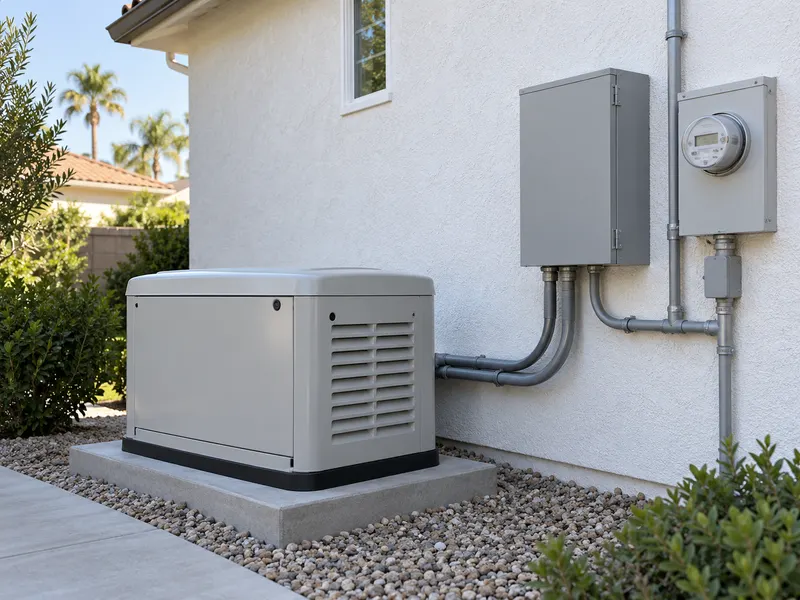
- 10 secondsEmergency system (NEC Article 700) must supply power within
- 60 secondsLegally required standby (NEC Article 701) must supply power within
- 2 hoursMinimum run time on stored fuel under the California Fire Code
- 6 hoursRun time for high-rise and certain care buildings above 75 feet
- 20 to 100 hoursAnnual test and maintenance hours for a diesel emergency engine, SCAQMD Rule 1470
Residential and commercial generators are different jobs
A house generator is mostly a transfer switch, a gas line and a city permit. The residential standby generator page covers that. A business generator adds a code class for each load, an air quality permit, a utility review of the transfer scheme, fire authority rules for fuel and testing, and a written test schedule. The same electrician may do both kinds of work, but the paperwork is heavier here.
The 2025 California Electrical Code took effect on January 1, 2026 and is based on the 2023 National Electrical Code, so the article numbers below are those of the 2023 NEC. The California Fire Code is a separate book, and Section 1203 sets the rules for emergency and standby power.
Three classes of backup power
The class decides how fast the power must arrive, how the wiring is kept apart, and how the system is tested.
Emergency, Article 700. These systems automatically supply light or power needed to preserve human life. Power must be available within 10 seconds of a loss of normal power. Emergency conductors may not share a cabinet, raceway or cable with non-emergency loads, except in the cases the code lists, and emergency circuits feed only emergency loads. Exposed emergency raceway is marked within 3 feet of each connection point and at intervals not over 25 feet.
Legally required standby, Article 701. A government agency classifies these systems. Power must be available within 60 seconds. Typical loads are smoke control, some elevators, and equipment named by the fire or building code.
Optional standby, Article 702. Here life safety does not depend on the system. This is the class for a store or office that wants to keep its refrigeration, registers and servers running. Transfer equipment is still required and must be listed. It must prevent the generator and the utility from ever being connected by accident.
Emergency and legally required systems must be commissioned and maintained under 700.3 and 701.3. Their overcurrent devices must be selectively coordinated under 700.32 and 701.32, and the study has to be redone when devices are replaced or the system changes. Optional standby has neither requirement. The California Fire Code lets an emergency system serve where a standby system is required, so some owners put everything on the stricter class.
What the California Fire Code adds
Section 1203 of the 2025 California Fire Code lists where emergency or standby power is required. The list includes elevators and platform lifts, emergency responder communication systems, smoke control, exit signs and egress lighting, hazardous materials occupancies, high-rise buildings and underground buildings. A stationary generator must be listed to UL 2200 and installed under the building code, the electrical code, NFPA 110 and NFPA 111. Engines and turbines also follow Section 442 of the building code and NFPA 37.
The system must run at least 2 hours without refueling. High-rise buildings, and certain care buildings with occupied floors over 75 feet above the lowest fire department access, need 6 hours. Exit signs need 90 minutes, which ties this job to the exit sign and emergency lighting page. Wiring for critical circuits needs a 1-hour fire-resistance rating through listed cable, a protective system or construction.
Fuel: diesel, natural gas or propane
Diesel stores on site, so it works where the gas supply may fail too, but the tank needs fire authority review and the engine faces the strictest air limits. Natural gas avoids storage and refueling, though the supply can be cut in a large quake, and the gas utility and plumbing trade must handle the line. Propane needs a tank on site and the same kind of fire review. The fire code ties run time to what is stored on site, which is why the 2-hour and 6-hour minimums matter for tank sizing.
The Orange County Fire Authority has its own plan review path for fuel tanks, and the size limits and forms depend on the tank and the code edition in force. This page does not repeat a gallon threshold. Ask OCFA which plan review path a permanent tank follows, and start from its guideline and bulletin index.
Air quality: the engine may need its own permit
An engine is an air pollution source, even one that only runs in emergencies. In the South Coast district, which covers Orange County and the urban parts of Los Angeles, Riverside and San Bernardino counties, two rules do most of the work.
Rule 1470, diesel engines. The district lists limits on testing and maintenance hours for emergency engines by particulate emissions. At more than 0.4 grams per brake horsepower hour the cap is 20 hours a year. It is 30 hours at 0.15 to 0.4, 50 hours at 0.01 to 0.15, and 100 hours at or below 0.01. The particulate limit for a new emergency engine depends on its size. For engines at or within 50 meters of a sensitive receptor, the rule sets 0.15 grams per brake horsepower hour only for engines of 50 to 175 horsepower. Engines from 175 to 750 horsepower must meet 0.01, and engines above 750 horsepower must meet 0.02. A new engine farther than 50 meters away must be certified and meet 0.15. Most commercial generator sets are larger than 175 horsepower, so plan on 0.01 or stricter. A new emergency engine within 328 feet (100 meters) of a school must meet 0.01. Engines within 500 feet of a school may not run during school hours except in an actual emergency. Operators keep records for emergency engines.
Rule 1110.2, gas engines. The rule applies to stationary and portable engines over 50 brake horsepower. In its current text, last amended November 1, 2019, emergency standby engines are exempt from the emission limits when their permit conditions limit operation to 200 hours a year or less, measured by an elapsed time meter. Engines that run more than that must meet the rule’s emission limits.
The state diesel rule, in Title 17 of the California Code of Regulations, section 93115, was amended in 2010. Section 93115.6 caps testing and maintenance of an emergency standby diesel engine above 50 horsepower at 50 hours a year. The 2010 rule lets the district allow up to 100 hours a year, site by site, when the engine’s diesel particulate emissions are 0.01 grams per brake horsepower hour or cleaner. For older in-use engines, the rule also sets lower caps and an extra allowance at health facilities, so read the section for the engine’s emission level. Other air districts, such as the San Diego and Mojave Desert districts, run their own permit or registration programs. Rules and limits have been under amendment, so ask the district for the permit conditions for your engine before you order.
The utility has to see the transfer scheme
SCE describes two ways to connect a business backup generator under its Rule 21 tariff. In the isolated mode the generator is never connected to SCE’s system, and the transfer switch opens one source before it closes the other. In the momentary parallel mode the generator can connect for a short time, one second or less. SCE reviews the transfer switch or operating scheme before the generator runs, so that it can never run in parallel with the grid by accident. SCE also says customers with backup systems file an application to meet its notice requirements, and may be asked for diagrams, manufacturer data and a commissioning test. Apply before the design is final. SDG&E, LADWP and city-owned utilities such as Anaheim Public Utilities have their own processes, so the utility named on the bill is the first call.
Permits, plan check and fees
The building department issues the electrical permit and checks the plans. It may also ask for structural review of the pad or roof platform, a mechanical or fuel gas permit, and the air district approval. Fire review comes in for fuel storage and for the testing schedule. Plan check for commercial work is usually charged on top of the permit line. The permit fee comparison shows what each city posts for the base permit and explains why plan check is separate.
After the generator is running
Section 1203 asks the owner to keep emergency and standby systems maintained under NFPA 110 and NFPA 111. An approved testing and maintenance schedule is set when the installation is complete. Records list the service date, the technician’s name, the conditions seen and the corrective action. Transfer switches are on the schedule, with contacts checked for wear, and a switch test runs the unit from normal to alternate and back. Systems are tested under load, and documented real use can stand in for a scheduled run. Many owners hand this to a maintenance agreement. A panel or service upgrade is often part of the same project, because a new transfer switch changes how the load is fed.
What to send for a quote
Send the building address and the electric utility, a list of the loads that must stay on with their size in kilowatts or amps, the main panel and service size, the fuel you prefer, and any air permit or fire notes already on file. A photo of the electrical room and the planned generator location speeds up the first visit.
What the work covers
| Item | What it involves |
|---|---|
| Class of system | Emergency (Article 700), legally required standby (Article 701) or optional standby (Article 702). The building and fire authority decide which loads fall in which class. |
| Generator and enclosure | A unit listed to UL 2200, a pad or roof platform, an enclosure, exhaust routing and clearances from openings, property lines and combustibles. |
| Transfer equipment | Listed automatic transfer switches sized for the load, with separate switches or sections for emergency, legally required and optional loads. |
| Feeders and branch wiring | Dedicated emergency circuits that carry only emergency loads, marked raceways, fire-rated protection where required, and short-circuit and coordination study. |
| Fuel | Diesel in a sub-base or separate tank, natural gas on a utility line, or propane. Fuel storage and piping are reviewed by the fire authority and the gas trade. |
| Air permit | A permit from the local air district for most engines above 50 brake horsepower, with limits on testing hours and a log. |
| Utility review | A Rule 21 application and utility approval of the transfer scheme, so the generator can never feed the grid by mistake. |
| Commissioning and testing | A load test at startup, a written test and maintenance schedule, and logs kept for the fire inspector. |
How the job goes
- List the loadssort them into life safety, legally required and optional, and total each group in kilowatts.
- Choose fuel and engineweigh run time, space, noise, fuel storage rules and the air district limits on that engine.
- Check the air districtask whether the engine needs a permit and what test hours it allows before anything is ordered.
- File the utility applicationsend the one-line diagram and the transfer switch scheme to the utility for review.
- Pull building and fire permitselectrical, structural for the pad or roof, fuel gas, and fuel tank review where it applies.
- Install, load test and logrun the commissioning test, set the maintenance schedule and hand the logs to the owner.
Send three things. Get a call.
Share the building, the job and a deadline. Your request goes to a licensed partner electrician, who contacts you about the building, the load and the permit path.
Commercial electrical work is available through the partner electrician.
- The buildingType of business, address and rough size.
- Who you areOwner, tenant, property manager or HOA board.
- The jobWhat is wrong or planned, and any deadline such as a lease date or inspection.
Commercial electricians by city
Questions people ask
What is the difference between emergency and standby power for a business?
Emergency systems under NEC Article 700 supply power that preserves human life, such as exit lighting and fire pumps, and must be available within 10 seconds. Legally required standby under Article 701 is classified by a government agency and must be available within 60 seconds. Optional standby under Article 702 protects business operations, and life safety does not depend on it.
Does my commercial generator need an air quality permit?
Most likely. South Coast AQMD says Rule 1110.2 covers gas engines over 50 brake horsepower and Rule 1470 covers stationary diesel engines, and a new engine over 50 horsepower normally needs a permit before installation. Other California air districts run their own permit or registration. Ask the district with the engine's rating and fuel in hand.
How many hours can a diesel generator run for testing?
For emergency diesel engines in South Coast AQMD, Rule 1470 caps testing and maintenance at 20 hours a year when the engine's particulate emissions exceed 0.4 grams per brake horsepower hour. The cap rises to 30, 50 or 100 hours as particulate emissions fall. The engine's own permit sets the limit that applies, so read the permit conditions.
Does the utility have to approve a standby generator?
Usually, yes. SCE describes two backup modes under its Rule 21: isolated, where the generator never connects to SCE's system and the switch opens before it closes, and momentary parallel. SCE reviews the transfer scheme before operation and wants an application on file. SDG&E, LADWP and city utilities such as Anaheim have their own processes.
Who inspects and tests a commercial generator after it is installed?
The building department inspects the installation, and the fire authority follows up on testing. The California Fire Code requires generators to be tested under load per NFPA 110, an approved written test and maintenance schedule, and records with dates, the technician's name and fixes. Transfer switches go on the schedule, and the owner keeps the logs.
Related
Commercial
Standby generator installation: the electrical work
A permanent standby generator needs an automatic transfer switch, a correctly sized circuit, a gas or…
Exit signs and emergency lighting for businesses
Exit paths must be lit to at least 1 footcandle, and emergency lights and exit signs must run at least 90…
Commercial panel and service upgrades
A commercial service upgrade has two jobs: the electrician's work inside the building and the utility's…
Electrical maintenance agreements for commercial buildings
A maintenance agreement is a written list of electrical checks, how often they happen and what happens…
Electrical work for restaurants and retail stores
A restaurant electrical job ends with two inspectors, not one: the city building inspector and the county…
Warehouse and industrial electrical work in Ontario and the Inland Empire
Warehouse electrical work is mostly about service size, lighting and charging capacity. In Ontario, SCE…
Commercial electrical work in Orange County
A business in Orange County deals with SCE in most cities, SDG&E in the south end, a city-run utility in…
Electrical permit fees by city
Panel and service permit fee lines for SoCal cities, sorted low to high, with sources.