Warehouse and industrial electrical work in Ontario and the Inland Empire
Warehouse electrical work is mostly about service size, lighting and charging capacity. In Ontario, SCE supplies the power, the city reviews the permit, and Title 24 sets the lighting controls. Check each before a lease or a retrofit.
- 277/480 VSCE standard distribution voltages in Rule 2 include
- at least 50 percentWarehouse aisle lighting must cut power when empty (2025 Energy Code manual)
- planned loading spacesCALGreen heavy-duty EV readiness applies to new warehouses with
- $300City of Ontario fee for repeat commercial permit extensions
Why warehouses are their own kind of electrical job
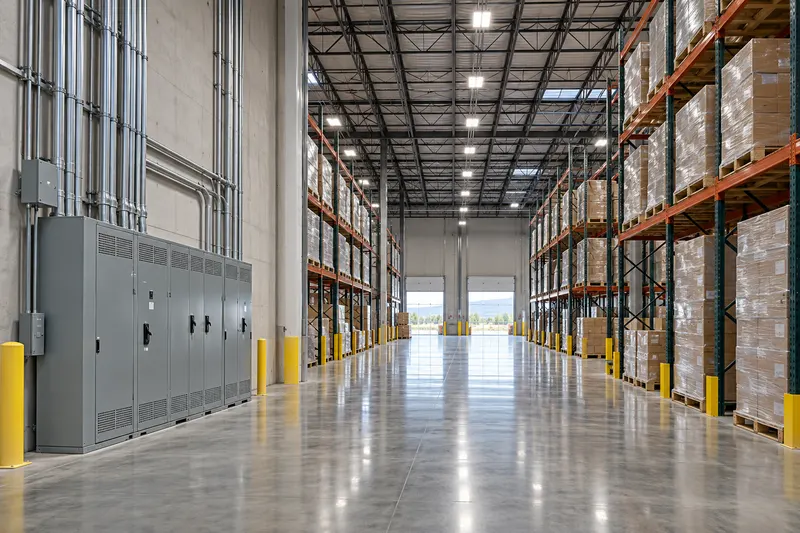
Ontario sits in the middle of the Inland Empire logistics belt. A building here can be hundreds of thousands of square feet with a few big electrical needs: a large service, a lot of lighting overhead, doors and docks that run on motors, and a growing need to charge trucks, yard tractors and forklifts. Each one runs through a different approver, so the order of the calls matters.
For the city itself, including fire alarm fees and fee tables, read the Ontario commercial page. This page covers the warehouse work that sits behind those permits.
Start with the utility
SCE supplies power in Ontario, and the utility sets the service before the building plan is final. SCE publishes an Electrical Service Requirements (ESR) manual for electrical contractors, engineers and architects. It covers the service connection equipment and wiring. Rule 16 says that, beyond the point where SCE delivers service, the applicant plans, installs, owns and maintains the facilities, and it points to Rule 2 for available voltages.
Rule 2 lists 277/480 volts among SCE’s standard distribution voltages. The voltage and size you can get depend on the lines and equipment at that address, so a given site may not offer every option. That is why the first call goes to an SCE service planner, with a load estimate and a site address. The panel and service upgrades page explains how the estimate is built.
Do not order switchgear before the utility confirms the service. A change in the service voltage or size changes the design.
High-bay LED and Title 24 controls
LED high-bay fixtures are the most common warehouse retrofit. Whether the work triggers Title 24 depends on how much of a space you change. The LED retrofit page lists the triggers and the exemptions.
When controls apply, warehouses get specific treatment. The 2025 Energy Commission compliance manual says aisle ways and open areas in warehouses need occupancy sensors that cut lighting power by at least 50 percent when the area is empty, and that each aisle must be its own control zone. Daylight controls can also apply where skylights let in enough light.
The 2025 Energy Code took effect on January 1, 2026, and the manual above is the 2025 edition. Ask the designer which edition the city is applying to your permit. Ask who signs the compliance forms.
Dock, door and equipment loads
Dock levelers, overhead door operators, dock fans and battery chargers for forklifts are many small loads that add up. They are also easy to leave off an early plan. Ask the tenant or operator for an equipment list with each item’s voltage, amps and whether it runs together with others. The load calculation uses that list. A missing item shows up later as a panel with no spare space.
Truck and fleet charging readiness
For new warehouses, CALGreen has a rule about future heavy-duty charging. Section 5.106.5.5 in the 2025 code, as summarized by the City of Santa Clarita’s checklist, requires construction that makes later installation of medium-duty and heavy-duty charging possible for new warehouses, grocery stores, retail stores, office buildings and manufacturing facilities with planned off-street loading spaces. It calls for spare raceways or busway and capacity for transformers, service panels and subpanels, sized by building size and the number of loading spaces. The goal is to avoid tearing out finished work later.
For a retrofit or tenant, charging is a separate project. SCE’s Rule 29 is an option for separately metered EV service. SCE designs, installs, owns and maintains the equipment between its distribution connection and the meter, and the applicant pays for everything on the customer side. SCE’s list of conditions includes separate metering, an EV time-of-use rate, and operating the charging equipment for at least five years. SCE offers a no-cost EV Readiness Study. Rule 29 is an alternative to Rule 16 and has no customer allowance. The commercial EV charging page covers load management and incentives.
Permits and the city counter
The City of Ontario Building Department reviews plans and inspects the work. Its page says submittals go through its online Citizen Portal Access, and the city’s resources page links an electronic submittal guide. Building permit fees are based on project valuation, and a plan review fee equal to 80 percent of the permit fee is collected when you submit. For commercial and industrial permits, the first extension request is free, and each added extension carries a $300 fee, per the city’s page. The Building Department lists 909-395-2023 for plan check and counter services.
A certificate of occupancy is issued by the city after an inspector confirms the building matches its permit and intended use, according to its FAQ. A new use or a new tenant often needs one, so put it on the schedule.
Emergency lighting and exits
A warehouse with a larger floor area and tall racks still needs exit signs and path lighting that work during an outage. The tests and the records are the owner’s job. See exit and emergency lighting for the code and the test schedule, and maintenance agreements for how owners schedule it.
What to send
Commercial electrical work in Ontario is available through the partner electrician. Send the building address and size, say if you are the tenant, owner or property manager, the existing service size if you know it, the equipment list, and what you plan to change. A photo of the main switchgear and the meter helps. Start from the commercial hub or the San Bernardino County overview.
Yard and truck court lights fall under the outdoor lighting controls on the parking lot lighting page, and sites that cannot lose power can read the commercial standby generator page. In Orange County, the Orange County commercial page lists each city’s utility and permit office.
What the work covers
| Item | What it involves |
|---|---|
| Service and switchgear | Main service size, 480-volt distribution, panels and transformers for lighting and 120/208-volt loads. Utility approval comes before the electrical plan is final. |
| High-bay lighting | LED high-bay fixtures, aisle controls, daylight sensors under skylights, and lighting circuits on lifts or poles. |
| Dock and door equipment | Circuits for dock levelers, overhead door operators, fans and charging stations for material handling equipment. Load depends on the equipment list. |
| Truck and fleet charging readiness | Spare conduit, space for gear and transformer capacity now, so chargers can be added later without opening the slab. |
| Emergency and exit lighting | Battery units and exit signs on a test log. See the exit and emergency lighting page. |
| Permits and inspections | City plan check and inspection, and a fire department review where alarms or lighting touch life safety. |
How the job goes
- Get the factsbuilding size, existing service rating, the equipment list and lease dates.
- Ask the utilityconfirm the available voltage and capacity with an SCE service planner.
- Designload calculation, one-line diagram, lighting layout and Title 24 forms.
- Permitsubmit through the city portal, then book the inspections.
- Close outfinal inspection and, for a new use, a certificate of occupancy.
Send three things. Get a call.
Share the building, the job and a deadline. Your request goes to a licensed partner electrician, who contacts you about the building, the load and the permit path.
Commercial electrical work is available through the partner electrician.
- The buildingType of business, address and rough size.
- Who you areOwner, tenant, property manager or HOA board.
- The jobWhat is wrong or planned, and any deadline such as a lease date or inspection.
Commercial electricians by city
Questions people ask
What voltage does a warehouse in Ontario run on?
Large warehouses use three-phase service. SCE's Rule 2 lists 277/480 volts among its standard distribution voltages, and 120/208 volts for secondary mains where SCE has four-wire wye service. What is available at a given address depends on the lines and equipment serving it, so ask an SCE service planner before design starts.
Who sets the electrical rules for a warehouse build-out in Ontario?
The City of Ontario Building Department reviews plans and inspects the work. SCE sets service requirements through its Electrical Service Requirements manual and its tariff rules. Title 24 sets lighting and energy rules. Applications go through the city's online portal, and the Building Department lists the plan check line at 909-395-2023.
Do I need Title 24 lighting controls for a warehouse LED retrofit?
Often yes, if the retrofit changes enough of the lighting. The 2025 Energy Commission manual says warehouse aisles need occupancy sensors that cut lighting power by at least 50 percent when empty, with separate zones per aisle. The 2025 Energy Code took effect January 1, 2026, so ask for the current text before you buy fixtures.
Do I have to install truck chargers if I build a new warehouse?
Not chargers, but the infrastructure. CALGreen section 5.106.5.5 requires construction that allows future medium-duty and heavy-duty charging at new warehouses, grocery stores, retail stores, offices and manufacturing buildings with planned off-street loading spaces. That means spare conduit and capacity for transformers and panels. The chargers themselves are optional.
Will SCE pay for the utility side of a fleet charging project?
Under Rule 29, SCE designs, installs, owns and maintains the equipment between its distribution point and the meter for separately metered EV service, and the applicant pays for everything after the meter. Rule 29 has conditions, including an EV rate and five years of EVSE operation. SCE offers a no-cost EV Readiness Study to help prepare.
Related
Commercial
Commercial panel and service upgrades
A commercial service upgrade has two jobs: the electrician's work inside the building and the utility's…
Commercial LED lighting retrofits and Title 24
Swapping a warehouse or office to LED is regulated work in California when the change touches 10 percent…
Commercial EV charger installation for workplaces and retail
A business charger project is mostly an electrical capacity question. The charger is the small part; the…
Tenant improvement electrical: what a build-out needs
In a lease build-out, the electrician works from the landlord's service up to the last outlet. The code…
Exit signs and emergency lighting for businesses
Exit paths must be lit to at least 1 footcandle, and emergency lights and exit signs must run at least 90…
Electrical work for Ontario warehouses and shops
Ontario's city booklet counts about 133 million square feet of industrial space, so much commercial…
Electrical work in San Bernardino County
San Bernardino County is mostly SCE territory, split between a valley along the foothills and a high…
Parking lot lighting for California businesses
A new or rebuilt parking lot in California needs a photocontrol or time switch, an automatic schedule, and…