Load calculation explained in plain English
A load calculation adds up what your house can draw at once, then divides by 240 volts to get amps. If the total plus a new charger or heat pump stays under the service size, you may not need a bigger panel.
A panel is a box that can pass only so much current. A load calculation answers one question: with everything the house runs, and the new thing, is there still room? Electricians do it for every service change and most EV charger or heat pump jobs.
Why the main breaker size misleads
Think of the main breaker as the top speed the panel allows, not the speed you drive. Most houses run far below it. The calculation estimates the load at its busiest and compares that to the service rating. Two houses with the same 200 amp panel can end up with very different answers.
The method for existing homes (NEC 220.83)
Section 220.83 is the “optional” method for an existing one-family home on a 120/240-volt, single-phase service. In plain English:
- General lighting and outlets: 3 volt-amps (VA) for every square foot of living area.
- Small-appliance circuits: 1,500 VA for each of the two kitchen circuits.
- Laundry circuit: 1,500 VA.
- Fixed appliances: add the nameplate rating of each one, such as a water heater, dryer, range, dishwasher and disposal.
- Apply the demand factor: count the first 8,000 VA at 100 percent and everything over that at 40 percent.
- Add heating and cooling: these are not part of the 40 percent step. Air conditioning is added at 100 percent. Electric heat has its own percentages in the code.
- Convert to amps: divide the total VA by 240.
The code splits this into two parts. Subsection (A) applies when no new air conditioning or electric heat is being added, and (B) applies when it is. The steps run in the same order, and the electrician applies the exact table for your equipment.
A worked example
This is an illustration, not a permit calculation. Take an 1,800 sq ft house with an electric water heater, electric dryer, electric range, dishwasher and a 4-ton AC.
| Item | VA |
|---|---|
| Lighting and outlets, 1,800 x 3 | 5,400 |
| Two small-appliance circuits | 3,000 |
| Laundry circuit | 1,500 |
| Water heater | 4,500 |
| Dryer | 5,000 |
| Range | 8,000 |
| Dishwasher | 1,200 |
| Subtotal | 28,600 |
The first 8,000 VA counts in full. The remaining 20,600 VA counts at 40 percent, which is 8,240. That makes 16,240 VA. Add the 4,800 VA air conditioner at 100 percent for 21,040 VA. Divide by 240 and you get about 88 amps.
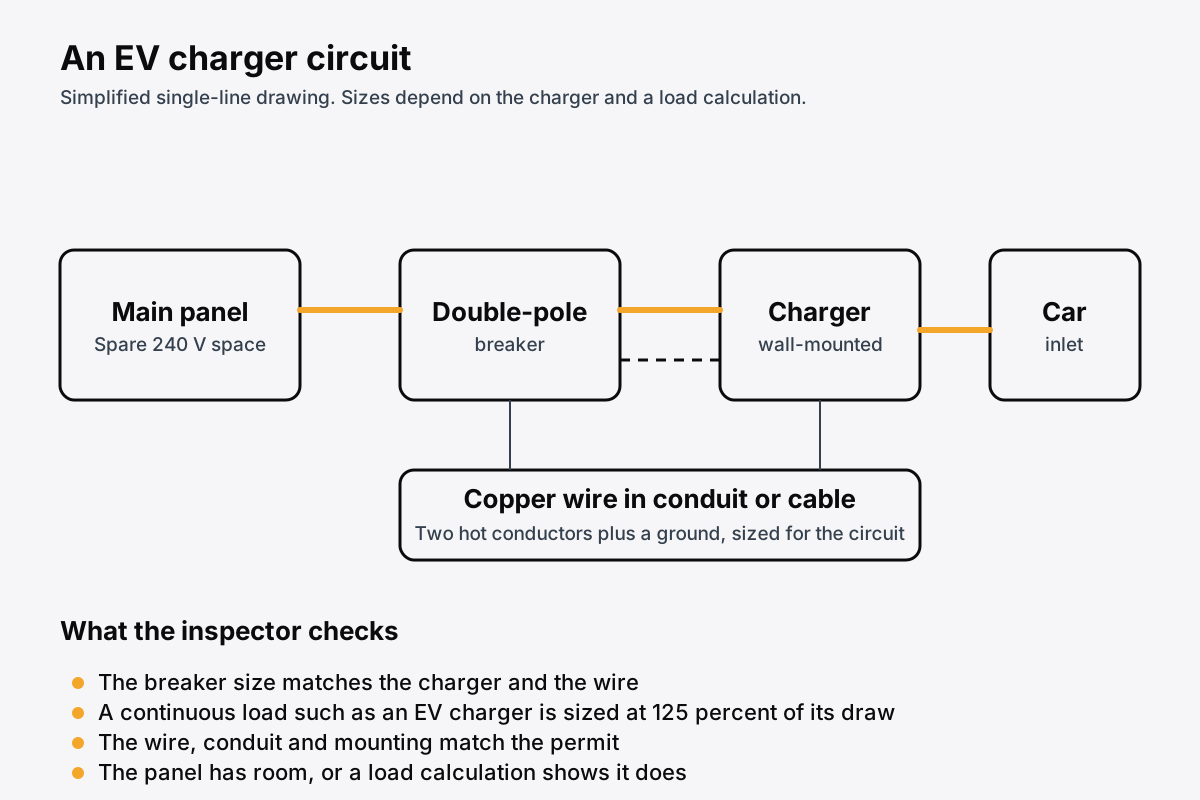
Now add a 48-amp Level 2 charger. Electricians count a continuous load like this with extra margin, often at 125 percent, which is 60 amps. The total is about 148 amps.
- On a 100 amp service, that does not fit. A bigger panel, or a load management device, enters the picture.
- On a 200 amp service, there is room left over.
The charger circuit is only one input. An electrician checks how each load is counted. See the EV charger load calculation page for charger-specific rules.
The shortcut: use real data (NEC 220.87)
Section 220.87 lets an electrician use measured demand instead of the formula. If you have a year of maximum demand data, the highest 15-minute average demand in that year is multiplied by 125 percent, and the new load is added to that. If a year of data is not available, a recording meter can log demand for at least 30 days. This often shows far more spare capacity than 220.83, because the formula assumes the worst day. Utilities keep this data for their smart meters. Ask your electrician which data they need and how to download it.
What you can do before the visit
- Find your home’s square footage.
- List every 240-volt appliance and its rating label.
- Photograph the panel door label and the main breaker.
- Download 12 months of usage from your utility account.
The panel reading guide shows what the labels mean. The EV charger calculator gives a quick estimate of cost and fit, but it is not a permit calculation.
When the answer is “no room”
You have three common paths: reduce what the new load asks for (a lower-amp charger), share the circuit with a management device, or increase the service. The do I need a panel upgrade guide compares them, and the 200 amp upgrade page covers the swap. For code editions, see the 2025 code changes.
Questions people ask
Is the main breaker size the same as my spare capacity?
No. A 200 amp main breaker does not mean 200 amps are free. The load calculation counts what your house already uses, then shows what is left. A home with electric heat, a spa and two ACs on a 200 amp service can have less room than a small home on 100 amps.
What is the difference between 220.83 and 220.87?
Section 220.83 calculates from square footage and appliance ratings. Section 220.87 uses real measured demand, such as 12 months of utility interval data, multiplied by 125 percent. The second often shows more spare room because most homes never use everything at once. An electrician picks the method that fits your records.
Can I do a load calculation myself?
You can estimate with the steps below and the online EV calculator, but only an electrician's calculation counts for a permit. The code has details, such as how a charger or an electric range is counted, that change the result. Use your estimate to ask better questions, not to skip the step.
Does the 2025 California Electrical Code change this?
The 2025 California Electrical Code, based on the 2023 NEC, took effect January 1, 2026. Section numbers and wording can shift between editions. The method here is the long-standing one, but your electrician works from the edition your city has adopted, so ask which one applies.
Keep reading
EV charger cost calculator
Check if your panel can carry a Level 2 charger and see the typical cost.
Do I need a panel upgrade for an EV charger?
How to tell if your panel can carry a Level 2 charger, when a load manager saves the upgrade, and what…
EV charger load calculation
Before a charger goes in, the electrician adds up your home's electrical load and checks that a new…
EV charger load management and circuit sharing
A load management device lowers the charger's draw when the rest of the house is busy. The code allows the…
How to read your electrical panel
A safe five-step read of your panel: main breaker, label, brand, free spaces and directory, plus when to…
200 amp panel upgrade: what changes and when you need it
A 200 amp panel upgrade swaps your old main panel for a new one and, usually, the wire from the meter to…
2025 California Electrical Code: what changed for homeowners
Which code edition applies in October 2026 and the 2023 NEC changes that most often touch a home project.