Who files, who pays and who to call in a service upgrade
Four parties touch a service upgrade: you, the electrician, the city and the utility. Each files something, pays something and answers a different phone. Knowing which is which saves the calls that go nowhere.
A panel or service upgrade looks like one job, but the paperwork runs through four different offices. This page is about who files what, who pays what and what to say when you call. For the order of the steps and the waits at each one, see the timeline guide.
The four parties at a glance
| Party | Files | Pays or collects | First person to call |
|---|---|---|---|
| Homeowner | Signs the contract and the owner’s or contractor’s statement on the permit; makes any phone request the utility limits to the account holder | The electrician, the permit if it is billed apart, utility line charges and any extra repair | The electrician, then the utility if it is quiet |
| Electrician | The permit, the load calculation, the utility request for a meter spot or disconnect, the inspection booking | Materials and labor, then bills you; carries the license and the permit under their name | Their office, for the schedule and the paperwork status |
| City or county | Issues the permit, inspects, releases the job to the utility | Collects permit and plan check fees | The building department counter or inspection line |
| Utility | Approves the meter location, sets or relocks the meter, reconnects power | Bills you for line work or a service change; states any allowance for its side | The service planner, a builder services desk or a customer line |
The homeowner: what you sign and what you pay
You are the customer on the contract and the account holder at the utility. Three things only you can do. First, read the written quote and confirm that it names the amperage, the permit and the inspection. Second, hold the utility account: some requests, such as asking for a meter lock to be removed, go through the account holder by phone. Third, pay the bills that do not go through the electrician, which are usually line work or a service change on the utility’s side.
SCE gives residential customers an allowance toward utility-side work, such as a service wire or transformer, and an SCE Service Planner states the amount for a given address. Burbank Water and Power lists Aid in Construction charges, which it says are generally about $500 to $4,000 for typical small upgrades. Ask the electrician early whether your job could trigger a utility charge, because it is the cost people most often learn about late.
What to say to the electrician: “Which requests do you file and which do I have to make? Who pays the permit and who pays the utility? What happens to the price if the utility asks for more?”
The electrician: the one who coordinates
A licensed contractor normally pulls the permit, files the request with the utility and books the inspection. The utility asks for exact details, and a mismatch between the permit and the utility request, such as a different main switch size, is a common reason for delay. An experienced electrician checks that every form shows the same number.
The electrician also decides, with a load calculation, whether the service size changes. That decision sets everything else, because a swap in place needs less from the utility than a larger service or a moved meter. Ask for the load calculation in writing and keep a copy for the city.
What to say: “Please send me the permit number as soon as it is issued, and tell me when the utility request goes in. Who will be on site for the disconnect?”
The city: permit, inspection, release
The building department issues the permit and inspects the finished work. In many cities the passed inspection is then released to the utility, and the utility does not set the meter without it. Fees depend on the city, and some cities put the permit fee on a published schedule you can check. A homeowner calls the city for two reasons only: to learn the fee and the plan check path before work starts, and to ask whether the inspection passed and was released. The electrician can do the first, but only the city can confirm the second.
What to say at the counter or on the inspection line: “I have permit number X for a service upgrade at this address. Has the inspection passed, and has the release gone to the utility?”
Each city has its own office and portal, so look at your city page, such as Los Angeles or Anaheim, and read the permits guide and the permit and inspection page.
The utility: meter, wires and power
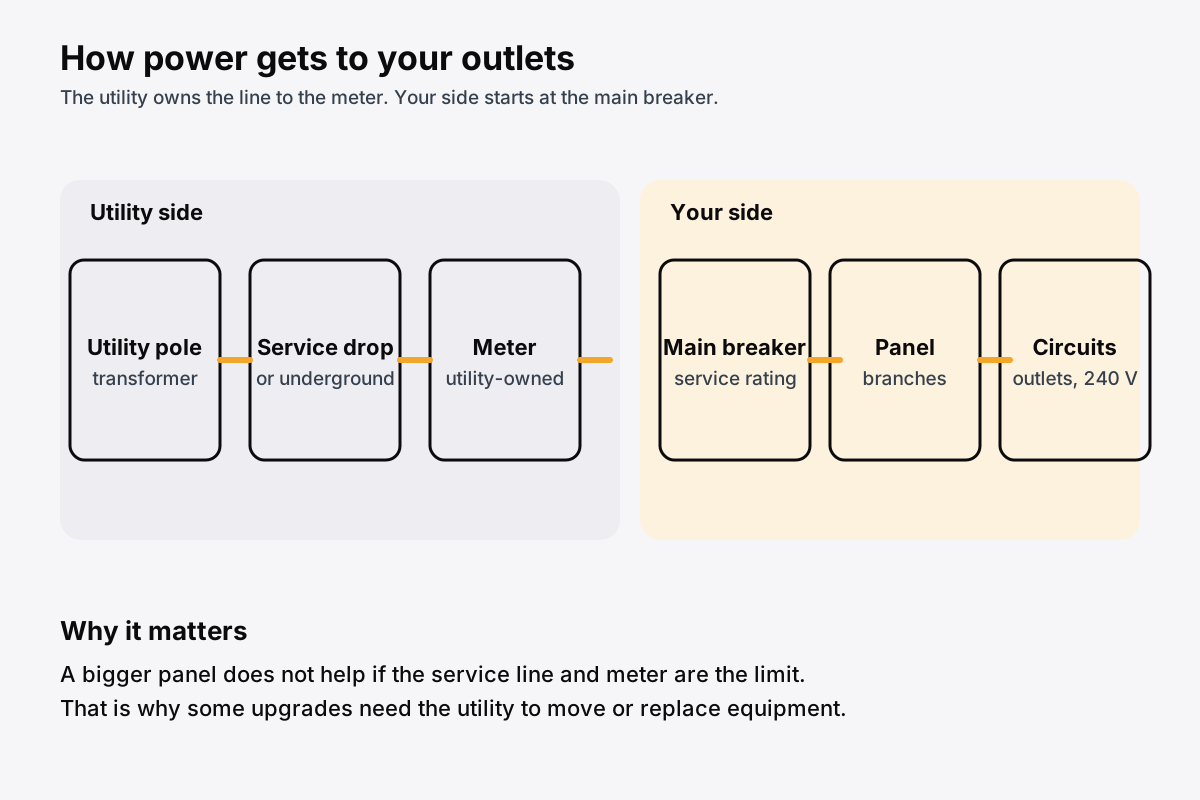
The utility owns the meter and the service wires up to the point of connection. You own the panel and, in most cases, the mast or conduit on your side. That is why a bigger service or a moved meter needs the utility’s approval and cannot be finished by the electrician alone. See the meter and service mast page for what moves.
Who you call depends on who sends the bill:
- SCE: the electrician asks SCE for a meter spot when the service is upsized or moved. SCE publishes targets for its own steps, and the city’s time comes on top, so expect weeks.
- SDG&E: a residential service or panel upgrade up to 400 amps with no added load can go through the Express Program in the Builder Services Portal. Jobs that add load go through My Project Center.
- LADWP: the electrician gets a Meter Spot Sheet before the building inspection, then the Los Angeles Department of Building and Safety sends the release electronically. See the LADWP guide.
- City-owned utilities: Anaheim, Burbank and Pasadena set and reconnect their own meters and publish their own steps. Pasadena’s panel rebate asks for a city electrical permit and final approval before you claim.
What to say on the utility line: “I am the account holder at this address. My electrician is upgrading the service, and the permit number is X. Has the request been received, and what do you need from me?”
Where it goes wrong
- Nobody owns a step. The electrician thinks the city is booking the inspection, and the city thinks the owner is. Ask for a one-line list of who does each step.
- Different numbers on different forms. The permit says 200 amps and the utility request says 150. Check all three documents.
- Calling too early or to the wrong office. The utility cannot reconnect before the city releases the job. Call the city first.
- Unplanned outage. Power is off from the disconnect until the utility reconnects. Plan food storage and medical equipment ahead.
- Surprise charges. Ask before the contract is signed which utility charges could apply to your address, and whether the quote includes them.
For a 400 amp service, ask early. The 400 amp page explains why the utility has more to review.
Questions people ask
Who files the utility request for a panel upgrade?
Usually the electrician, because the utility asks for details such as main switch size, panel location and meter position. At some utilities the account holder has to make a phone request, such as a lock removal on an SCE meter. Ask the electrician in writing which requests they file and which one you must make yourself.
Who pays the utility and the city?
The homeowner pays in the end, but the bill reaches you in different ways. The electrician often lists the permit fee in the quote. The utility bills you directly for line work, and some city utilities quote fees up front. Ask the quote to say which charges are included and which would come as extra.
Why does the power stay off after the electrician is done?
The city inspection has to pass first. Then the city releases the job to the utility, which sets the meter or reconnects. Each step has its own queue. Ask the electrician who books the inspection and who confirms the release, then call the utility with the permit number if a day passes with no news.
Is the process different in a city with its own utility?
Yes. In places such as Anaheim, Burbank or Pasadena, the city-run utility sets the rules, the contacts and the timing, not SCE. SCE rebate programs do not apply to those customers. Check who sends your electric bill before you plan the job, since that decides which phone number to call.
Keep reading
Panel upgrade timeline: permit, meter spot, disconnect, inspection, reconnect
The step-by-step sequence of a panel upgrade, and where SCE, SDG&E, LADWP and city utilities each add…
Electrical permits in Southern California: what needs one and who pulls it
What needs an electrical permit, who pulls it, what the inspector checks, and what happens if the work was…
Meter, meter socket and service mast
The mast and meter socket are yours, and the meter and the wires to it belong to the utility. Moving or…
Panel upgrade permit and inspection
A panel upgrade needs a city electrical permit and a passed inspection before the utility reconnects…
400 amp electrical service: who needs it
Most homes do not need 400 amp service. It fits large houses or all-electric homes whose load calculation…
LADWP EV charger rebate and home programs: the terms and the order of steps
LADWP's charger rebate, meter rebate and EV rate discount, who qualifies, and how the city permit and…