Commercial panel and service upgrades
A commercial service upgrade has two jobs: the electrician's work inside the building and the utility's work outside it. The utility side usually sets the schedule.
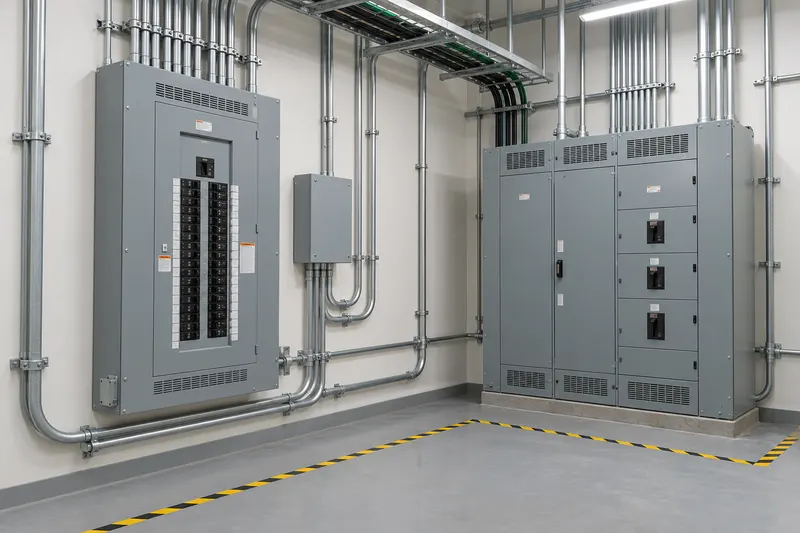
- Required on non-dwelling service equipment, with the calculation date (NEC 110.24)Fault-current label
- Like-for-like only, 600 V or 400 A maximum, no upgradesLong Beach express service work
- Customer work done 4 to 6 weeks before building completionLADWP underground service
- Treated by LADWP as a commercial service upgrade480 V three-phase fast chargers
Voltage and phase come first
Every upgrade starts with what the building has and what the new equipment needs. Small commercial spaces are usually single-phase or three-phase at 120/208 volts. Larger buildings and heavy equipment often use 277/480-volt three-phase. The choice drives the panel, the breakers, the transformers and the price, and it cannot be swapped later without new gear.
Single-phase is fine for lights, outlets and small equipment. Motors, compressors, large kitchen equipment and DC fast chargers are the usual reasons to move to three-phase. LADWP’s service guide describes a Level III charger as typically 480 volts three-phase and treats its installation as equal to a commercial service installation or upgrade. If a landlord owns the building service, the landlord may need to approve the change.
What forces an upgrade
The usual triggers are a tenant improvement that adds kitchen or process equipment, a charger installation, a second floor of equipment, or a panel that has no spare breaker spaces. The tenant improvement page covers build-outs, and the restaurant and retail page covers the equipment-heavy case. Chargers are on the commercial EV charging page. A new LED system usually lowers load, so it rarely forces one. See the LED retrofit page.
The 2025 California Energy Code took effect January 1, 2026 for new buildings and major renovations. The Energy Commission says it replaces certain end-of-life rooftop HVAC units on stores, schools, offices and libraries with high-efficiency systems, including heat pumps, and sets electric-ready rules for commercial kitchens. Those can add electrical load. Ask the building department whether the change you plan pulls them in.
The load calculation
The load calculation is the paperwork that decides the size. It follows Article 220 of the electrical code, which sets how to add lighting, receptacle, motor and equipment loads. For a building that already runs, NEC 220.87 allows the electrician to use real demand instead of a calculated number, if conditions are met. One condition is one year of maximum demand data, which usually exists only as utility billing data. The other path is a load study of at least 30 days on the service, averaged over 15-minute periods, taken while the space is occupied. In both cases, 125 percent of the measured maximum plus the new load must not overload the service.
Ask the electrician which method is used and who supplies the numbers. The load calculation guide explains the home version.
Short-circuit rating and labels
Bigger services bring more fault current, which means breakers and panels must be rated for it. NEC 110.24 requires service equipment in non-dwelling occupancies to be field marked with the maximum available fault current and the date of the calculation. If a change raises the available fault current, the calculation and the marking are redone. Industrial installations with qualified-only maintenance are excepted.
NEC 110.16 covers a separate arc-flash warning label for equipment such as switchboards, panelboards, industrial control panels, meter socket enclosures and motor control centers in non-dwelling units that are likely to be worked on while energized. The label helps workers pick protective gear. The two labels are not the same thing.
How the utility side works
Each utility has its own request path, forms and lead times. LADWP’s guide says a commercial request needs the project address, a site plan, a one-line diagram showing service voltage and switch ratings, and a load schedule that names the air handling load and the largest motor. Then the steps run in order: the customer applies and pays fees, the Los Angeles Department of Building and Safety inspects and releases the meter, LADWP inspects the service equipment and energizes. LADWP does not publish a fixed time. It says completion depends on the complexity of the service and the number of services already scheduled. Underground work by the customer should finish 4 to 6 weeks before the building is complete, so cables and transformers can be installed.
SCE and SDG&E run similar request processes, but their commercial pages could not be opened during research on October 30, 2026, so this page states no step or time for them. The utility coordination guide covers who files what. A transformer or meter lead time is not stated here because none was found on a primary page.
Permit, plan check and inspection
Panel and service work needs a permit. A commercial job often goes to plan check with the one-line diagram and load schedule. Cities keep short lists for simple work. Long Beach allows an express electrical permit for replacing an existing service at the same ampere rating, wires, phase and location, up to 600 volts or 400 amps, and says that item does not cover upgrades. San Diego requires a permit for electrical work and has a no-plan track for nonresidential projects, with plans required outside it. The service and repair page lists the symptoms that lead to these jobs.
What to send
For a quote, send the building type, address, whether you are the tenant, owner or property manager, the current panel size and voltage, the new equipment list and what is planned, through the quote form. Photos of the panel label and the meter help.
What the work covers
| Item | What it involves |
|---|---|
| Load calculation | Adds existing and planned loads and compares them to the service size, under NEC Article 220. |
| Panelboard or switchboard | New or larger equipment, with room for breakers and a short-circuit rating that fits the available fault current. |
| Service conductors and meter | New feeders, a meter socket or CT cabinet, and utility connection when the service size changes. |
| Labels | Available fault current marking and arc-flash warning labels on the equipment. |
| Permit and plan check | One-line diagram, load schedule and equipment data sent to the building department. |
| Utility coordination | Service request, meter release after inspection, utility inspection and energizing. |
Send three things. Get a call.
Share the building, the job and a deadline. Your request goes to a licensed partner electrician, who contacts you about the building, the load and the permit path.
Commercial electrical work is available through the partner electrician.
- The buildingType of business, address and rough size.
- Who you areOwner, tenant, property manager or HOA board.
- The jobWhat is wrong or planned, and any deadline such as a lease date or inspection.
Commercial electricians by city
Questions people ask
How do I know if my shop needs a three-phase service?
Look at the equipment nameplates and the panel. Larger motors, compressors, walk-in coolers, commercial ovens and fast chargers are often three-phase. Single-phase service runs small loads well. The electrician can check what you have, then compare the new equipment's voltage, phase and amps against it before you buy anything. A load calculation settles the question.
Does adding an EV charger mean a new commercial service?
Not always. A few Level 2 chargers may fit on spare capacity, and the calculation decides. LADWP treats a 480-volt three-phase fast charger as equal to a commercial service installation or upgrade. Ask the electrician to run the load calculation with the chargers added, and see the commercial EV charging page for the program status.
What is the available fault current label?
It is a field marking on commercial service equipment that shows the maximum fault current and the date it was calculated. NEC 110.24 requires it for service equipment in other than dwelling units. If a change raises the fault current at the service, the calculation is redone and the marking updated. It is separate from the arc-flash warning label.
How long does a utility take to upgrade a commercial service?
It varies by project, and published numbers are rare. LADWP states that installation time depends on the complexity of the service and the number of jobs already scheduled. For underground service, its guide asks that the customer's work be finished 4 to 6 weeks before the building is complete. Ask the utility planner for a date in writing.
Can the electrician replace my panel without a permit?
No. Panel and service work needs a permit, and a commercial job often goes to plan check. Long Beach, for example, allows express permits only for like-for-like service replacement up to 600 volts or 400 amps, and says that category does not cover upgrades. Ask your building department which path your job takes.
Related
Commercial
Commercial electrical service and repair
A business electrical problem is either inside your meter, where an electrician fixes it, or outside it…
Tenant improvement electrical: what a build-out needs
In a lease build-out, the electrician works from the landlord's service up to the last outlet. The code…
Commercial EV charger installation for workplaces and retail
A business charger project is mostly an electrical capacity question. The charger is the small part; the…
Electrical work for restaurants and retail stores
A restaurant electrical job ends with two inspectors, not one: the city building inspector and the county…
Commercial LED lighting retrofits and Title 24
Swapping a warehouse or office to LED is regulated work in California when the change touches 10 percent…
Who files, who pays and who to call in a service upgrade
The four parties in a panel or service upgrade, what each files, what each pays and what to say when you call.
Load calculation explained in plain English
The 220.83 method step by step with a worked example for a 1,800 sq ft home, and the 220.87 option based…
Warehouse and industrial electrical work in Ontario and the Inland Empire
Warehouse electrical work is mostly about service size, lighting and charging capacity. In Ontario, SCE…