Standby generator installation: the electrical work
A permanent standby generator needs an automatic transfer switch, a correctly sized circuit, a gas or propane line run by a gas-licensed trade, and city permits. The electrician handles the switch, wiring, grounding and labels.
- Electrical labor: $1,500 to $3,000
- Generator unit: Priced separately
- Gas line: Separate gas-licensed trade
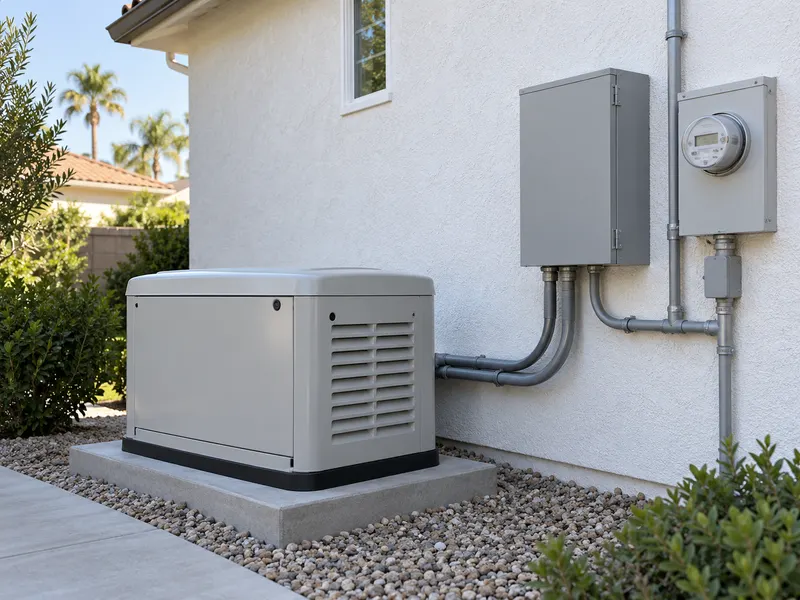
Who does which part
A standby generator is a three-trade job. The pad and the unit are set by the installer. The electrician handles the transfer switch, the wire and conduit between the unit and the house, the grounding and bonding, the labels and the panel work. A gas or plumbing contractor runs the fuel line. CSLB’s plumbing class, C-36, lists gas piping and gas connections, while the C-10 electrical class covers wires, raceways and conduits. Ask every bidder to write down who does what, so nothing falls between the two.
The typical SoCal range for the electrical hookup is about $1,500 to $3,000 as of October 2026, with the generator extra (see the standby generator hookup cost page). The gas line is a separate bid.
Transfer switch: automatic, and why
An automatic transfer switch (ATS) watches the utility voltage. When power drops, it signals the generator to start. It then moves the chosen circuits to the generator and keeps the grid and the generator from ever being connected at the same time. When the grid returns, it moves back and the generator shuts down.
That lockout matters. Ameren’s safety notice warns that a generator connected the wrong way can re-energize power lines and put utility crews, first responders and the public at risk. An ATS removes the step where a person could make that mistake.
If you run a portable generator by hand, a manual setup is enough. The interlock kit page and the inlet box page cover that route, and the transfer switch page compares manual and automatic units.
Whole house or chosen circuits
Two layouts are common. A whole-house switch passes the entire service through the ATS. A circuits-only setup puts the loads you care about, such as the refrigerator, furnace fan, lights and internet, on a critical loads subpanel and feeds only that panel.
The choice drives the size of the generator, the switch and the wire. It also changes the price. A smaller generator can run a circuits-only layout. Air conditioning, electric ovens and dryers are what push a whole-house layout to a larger unit.
Sizing the generator
Sizing follows NEC Article 702, which covers optional standby systems. In the 2025 EC&M explainer of the article, a manual connection should be sized for all the loads meant to run at once. For automatic connection, the system must carry the full load that is connected automatically, unless an approved energy management system limits the load.
In plain terms, the electrician adds up the running watts, then checks the starting surge of the biggest motors, such as an air conditioner compressor or a well pump. The load calculation guide shows the method. Pick the loads first, then the generator, not the other way around.
Gas and fuel handoff
The electrician does not sign off the fuel side. Three points from city handouts show how much it matters to the schedule:
- Riverside County’s handout says the first inspection covers setbacks, conduit and the gas line, and the gas line is pressurized to 10 psi for that inspection.
- A new propane tank can require a fire department permit before the building permit is issued, per the same handout.
- Gas pipe size comes from the generator maker’s installation guide, which both handouts ask you to submit.
Ask the gas contractor early whether the existing meter and line can carry the added generator load. The handouts do not cover that question or how long a utility review takes, so ask the gas company directly.
Permits and what the city asks for
Standby generators are a plan-check item in the cities that published handouts. Expect these at submittal:
- A site plan showing the generator, transfer switch, conduit runs and fuel line
- Spec sheets and installation instructions for the generator and the switch
- A single-line electrical diagram with wire and conduit sizes, and grounding and bonding for a separately derived system
- The fuel type and gas pipe sizing
- A statement that 811 will be called before digging (Riverside County)
Fontana lists a disconnect on the generator for service, and signs at the service equipment that show the type and location of the standby source. Riverside County calls for a placard at the main panel and for new equipment to be listed for its use. Both are electrician items. Rules on which permits you need differ by city, so see electrical permits in Southern California.
Setbacks and noise
Fontana says generators may not sit in side yard setbacks or easements and may not be placed in hazardous locations. It sets exhaust outlet clearances of at least 10 feet to the property line, 3 feet to exterior walls or roofs and 10 feet to building openings. Riverside County asks for 5 feet to the property line, buildings and operable windows, and 5 feet of overhead clearance.
Those are two different answers for two nearby jurisdictions. Treat them as examples, not as your city’s rule. Noise is set locally as well: Fontana points to the property-line sound limits in its noise ordinance, and Riverside County asks the site plan to show barriers and refers to its noise ordinance. Ask the planning or building counter for your city’s handout before the site plan is drawn.
Panel limits and the 120 percent rule
If the generator feeds the house through a breaker in the panel, Fontana’s handout reminds applicants that the new breaker and the main breaker together may not exceed 120 percent of the bus rating. A panel that is full, old or already near its limit can fail this check. In that case a subpanel or a panel upgrade comes first.
Inspection
Riverside County’s handout describes two inspections. The first covers setbacks, conduit and the gas test. The second covers disconnects, wiring methods, grounding and bonding, the grounding electrode and labels. Other cities may split them differently.
When a battery fits better
A standby generator suits long outages and large loads, but it needs fuel, space and a neighbor-friendly spot. If you want quiet and automatic backup for a few essentials, compare it in the generator vs battery guide. For outages caused by wind and fire risk, see PSPS power shutoffs explained.
Businesses, multifamily common areas and sites with life safety loads follow different rules, including NEC Articles 700 and 701, air district permits and fire authority testing. They are covered on the commercial standby generator page.
How the job goes
- Pick the loadsdecide whether the generator carries the whole house or chosen circuits.
- Size itthe electrician adds up the loads and the largest motor starts.
- Check the sitesetbacks, windows, noise rules, the gas meter and the panel location.
- Permitselectrical and fuel gas permits, often one building permit with a site plan.
- Install and inspectthe pad, the switch, the wiring, the gas line, then the city inspections.
Questions people ask
Do I need an automatic transfer switch with a standby generator?
Yes, in practice. A permanent generator that starts by itself needs a transfer switch that moves the house from the grid to the generator and back, and keeps the two apart. The switch also blocks backfeed onto the utility lines, which can hurt line workers. A plain interlock kit suits a portable generator that you start and plug in by hand.
Can the electrician run the gas line to my generator?
Usually not. Under CSLB's classifications, gas piping and gas connections fall under the plumbing contractor class, C-36, and the electrical class, C-10, covers wires, raceways and conduit. So a C-10 electrician sets the switch and wiring, and a plumbing or gas contractor runs and tests the gas line. Ask each bid who is responsible for what.
How far must a generator sit from my house and fence?
It depends on the city and on the unit's installation manual. Riverside County's handout asks for 5 feet to the property line, buildings and operable windows. Fontana's handout asks for exhaust outlets at least 10 feet from the property line and from building openings. Check your city's handout and the maker's clearances, and follow the stricter one.
Does a standby generator need a permit in Southern California?
Yes, expect permits. City handouts from Riverside County and Fontana list a site plan, equipment spec sheets and manufacturer instructions at submittal, and the work is inspected. A new propane tank can also need a fire department permit. Your electrician or gas contractor files, and the exact set of permits depends on your city.
Will my existing panel handle a generator and transfer switch?
Often, but check. Fontana's handout notes a limit for a backfed breaker: the new breaker plus the main breaker cannot top 120 percent of the panel bus rating. That rule applies when the generator connects through a breaker in the panel. A full or old panel may need a subpanel or an upgrade first. A load calculation settles it.
Keep reading
Backup power for a Southern California home
Pick the backup setup by outage length and by what must stay on. An interlock or transfer switch lets a…
Transfer switches for generators: manual vs automatic
A transfer switch connects your generator to selected house circuits and cuts them off from the grid while…
Generator interlock kit: how it works
An interlock kit is a metal plate on your main panel that stops the main breaker and the generator breaker…
Generator inlet box (power inlet) installation
An inlet box is a weatherproof outdoor plug wired to your panel. You connect the generator cord to it…
Critical loads subpanel for a battery or generator
A critical loads subpanel is a small second panel that holds only the circuits you want during an outage…
Standby generator electrical hookup cost
The electrical work to connect a standby generator typically costs $1,500 to $3,000 in SoCal, as of…
How much does a transfer switch cost installed?
A transfer switch installed in SoCal typically costs $400 to $2,500. A manual switch runs $400 to $1,300…
Generator vs battery backup
A decision guide for outages and wildfire shutoffs: runtime, typical cost, fuel, permits, noise and…
Load calculation explained in plain English
The 220.83 method step by step with a worked example for a 1,800 sq ft home, and the 220.87 option based…
Send a photo, get a range.
Share your ZIP and a photo of your panel. Your request goes to a licensed partner electrician, who contacts you.
Get this quoteAurion Electric is a referral service operated by Roviq LLC. Electrical work is done by a licensed partner electrician.
