EV charging for multifamily buildings and HOAs
In a California HOA, the board cannot unreasonably block an owner's EV charger, and in many rentals the landlord must approve one. The harder questions are how much power the building has, who pays and how the charger is billed.
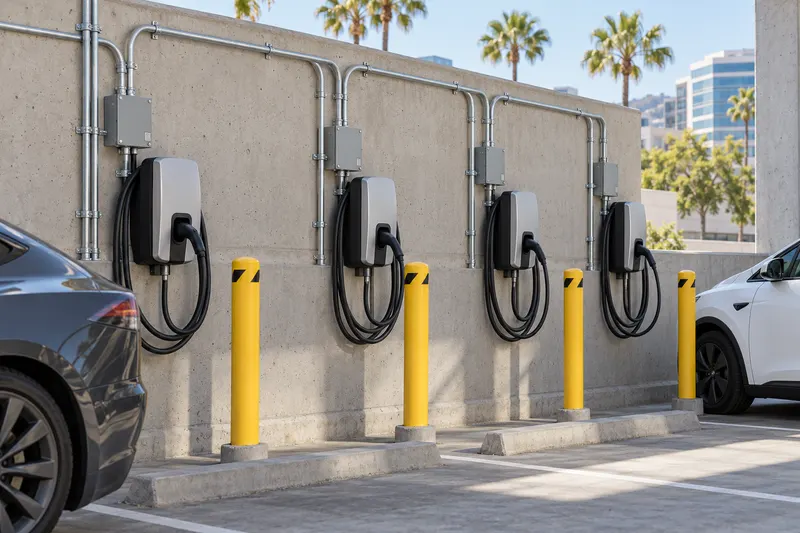
Start with who is asking
The legal path depends on who wants the charger and where the parking space is. There are three common cases.
| Who asks | Statute | What it says |
|---|---|---|
| Owner in an HOA or condo | Civil Code 4745 | Rules that effectively prohibit or unreasonably restrict a charger are void. Reasonable rules are allowed. |
| Tenant in a residential rental | Civil Code 1947.6 | The landlord must approve a written request for a charger at the tenant’s assigned space, with conditions. |
| Tenant in a commercial lease | Civil Code 1952.7 | Lease terms that unreasonably restrict a charger in a leased space are void. Not for properties with fewer than 50 parking spaces. |
The HOA EV charger law guide walks through 4745 in more detail. The HOA and condo charger page covers it from the owner’s side.
How an HOA request works
Civil Code 4745 tells the board to treat the request like an architectural change. Approval cannot be willfully avoided or delayed. A denial must be in writing. If the board does not deny the request in writing within 60 days, it is deemed approved, unless the delay comes from a reasonable request for more information.
For a charger in a common area or an exclusive-use common area, the owner agrees in writing to follow the association’s architectural standards, hire a licensed contractor, provide a certificate of insurance within 14 days of approval, and pay for installation and electricity. The owner keeps liability coverage and renews the certificate each year. The association can allow a charger for one owner in general common area only when installing it at the owner’s own space is impossible or unreasonably expensive. In that case a license agreement is required.
An association can also install shared chargers for all members and set the terms of use. A board that willfully violates the section can be liable for damages, and a prevailing homeowner can recover reasonable attorney’s fees.
What CALGreen requires in new buildings
CALGreen sets EV infrastructure for new construction and for some additions and alterations. It uses three levels: EV capable (conduit and panel space for a later charger), EV ready (a receptacle or circuit in place) and EV charging stations (installed equipment).
The 2022 edition, in force through December 31, 2025, set these shares for new multifamily projects: 10 percent of parking spaces EV capable and 25 percent EV ready, with 5 percent Level 2 chargers added at projects with 20 or more dwelling units. The 2025 edition took effect January 1, 2026 and changed the EV provisions. Confirm the current percentages with the design team or the building department before you budget a new building. Chargers at shops, offices and workplaces follow a different table, covered on the commercial EV charging page.
Retrofits to an existing building are a different test. CALGreen only reaches existing parking when the work adds panel capacity to a parking facility, adds solar over parking or meets another trigger in the code.
Shared panels, load management and billing
Many multifamily buildings cannot give every space a full-power charger. There are four ways to fit chargers in.
- Use spare capacity. A load calculation may show room, especially because cars often charge overnight, when building demand is low. The load calculation page shows the method.
- Share the load. Load management software divides the available power across chargers.
- Upgrade the service. If the main service is full, the electrician and utility plan a larger service, which may include a new meter room.
- Add EV meters. A separate meter per charger or per owner makes billing simple, but costs more per space and needs room.
Billing methods differ. Options include a dedicated meter on the owner’s account, a submeter with a bill from the HOA or landlord, or a networked charger that bills the user per kilowatt-hour. A networked charger adds a software fee. Check how the building department treats submeters and what the lease or the CC&Rs say about resale of electricity.
Permits, accessibility and the crew
Charger permits in many cities follow AB 1236 streamlining. See the AB 1236 guide. Accessible parking is governed by Chapter 11B of the California Building Code. When chargers are for common use in a multifamily building, Section 11B-228.3 sets how many must be accessible.
Public Utilities Code 740.20 requires an EVITP-certified electrician on each crew when the charging equipment is funded or authorized by the CPUC, the Energy Commission or the Air Resources Board. A privately funded project is not covered unless one of those agencies funds or authorizes it. The commercial EV charging page explains the crew rule in full. Ask any program you apply to which rule it uses.
Utility and state money
Programs change. As of October 30, 2026, the status checked on each program’s page is:
- SCE Charge Ready: SCE says it no longer takes new applications, and agreements must be signed by December 31, 2026. Its turn-key option for multifamily sites in disadvantaged communities is also closed to new applications.
- SDG&E Power Your Drive: SDG&E says the workplace program is fully subscribed and not taking applications. The page for apartments and condos should be checked directly with SDG&E.
- LADWP: the commercial EV charger rebate program is closed to new applications. LADWP says a new enrollment with revised terms is planned for November 2026. The last published terms paid up to $5,000 per Level 2 charger at multifamily properties (5 or more units) or public sites in a disadvantaged community, and up to $4,000 elsewhere. Its dashboard, updated August 19, 2026, shows $45 million for Level 2 and $20 million for DC fast stations for fiscal year 2026-27 as pending release. Terms and amounts may change.
- California Energy Commission: its new fast charger incentive is for publicly accessible DC fast chargers, so it does not fit most multifamily parking.
- Federal 30C credit: it ended for property placed in service after June 30, 2026.
Confirm the status with the utility before you design around a rebate. Never buy equipment before a program confirms in writing that it will pay. If the building also serves shops or offices, see the commercial hub for the other pages.
Send three things. Get a call.
Share the building, the job and a deadline. Your request goes to a licensed partner electrician, who contacts you about the building, the load and the permit path.
Commercial electrical work is available through the partner electrician.
- The buildingType of business, address and rough size.
- Who you areOwner, tenant, property manager or HOA board.
- The jobWhat is wrong or planned, and any deadline such as a lease date or inspection.
Commercial electricians by city
Questions people ask
Can an HOA say no to my EV charger?
Not outright. Civil Code 4745 voids rules that effectively prohibit or unreasonably restrict a charger. The board may set reasonable rules that do not significantly raise the cost or lower the performance. If the board does not deny your request in writing within 60 days, it is deemed approved, unless the delay comes from a reasonable request for more information.
Who pays for a charger on an HOA common area?
The owner who asks for it. Under Civil Code 4745(f), the owner agrees in writing to pay for installation, electricity, damage, maintenance, removal and restoration, to use a licensed contractor, and to carry liability insurance. The owner must also give the association a certificate of insurance within 14 days of approval and disclose the station to a future buyer.
Can a renter in an apartment get a charger?
Often yes. Under Civil Code 1947.6, a landlord must approve a tenant's written request for a charger at the tenant's assigned space on leases signed, extended or renewed on or after July 1, 2015. It does not apply with fewer than five parking spaces or where chargers already serve 10 percent of designated spaces. The old rent-control exception ended for leases signed, extended or renewed on or after January 1, 2019. The tenant pays the installation and electricity costs.
What is load management for EV chargers?
Load management is software that shares a fixed amount of electrical capacity among several chargers, slowing some while others run. It lets a building add many chargers without upgrading its service. CALGreen allows automatic load management systems to reduce the required electrical capacity for EV charging stations. Ask the electrician which method the building department accepts.
Does my condo building need a new service for EV chargers?
Not always. A load calculation decides it. Many buildings have spare capacity at night when chargers run. Load management and a dedicated EV meter can avoid a service upgrade, but older buildings with small meter rooms or full panels often need work. Start with the main panel size, the meter count and a recent electric bill.
Related
Commercial
Commercial EV charger installation for workplaces and retail
A business charger project is mostly an electrical capacity question. The charger is the small part; the…
What a property manager needs from an electrician
A property manager gets better electrical work by sending a complete request, knowing who pays, giving…
EV chargers in an HOA, condo or rental
In California an HOA cannot ban an EV charger in your parking space, and a landlord must approve a written…
EV charger load management and circuit sharing
A load management device lowers the charger's draw when the rest of the house is busy. The code allows the…
EV charger load calculation
Before a charger goes in, the electrician adds up your home's electrical load and checks that a new…
HOA EV charger law in California: Civil Code 4745 and how to ask
How Civil Code 4745 works, the 60-day clock, common-area conditions, and the steps to send an HOA a…
AB 1236 and EV charger permits: what California cities must offer
What Government Code 65850.7 requires of cities for EV charger permits, and how a few SoCal cities put it…