EV charger load management and circuit sharing
A load management device lowers the charger's draw when the rest of the house is busy. The code allows the service to be sized to that cap, which can avoid a panel upgrade.
- Code basis: NEC 625.42, 750.30
- Replaces: Some panel upgrades
- Tradeoff: Slower charging at peaks
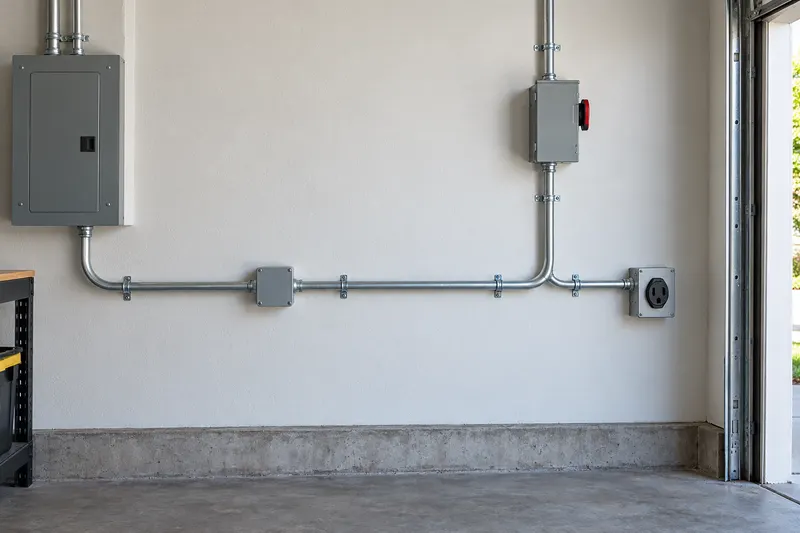
The problem it solves
Your electrician runs the load calculation and finds the panel is about 3 kW short for a full-speed charger. A new service costs thousands. A cheaper fix is to tell the charger to back off when the oven, dryer and air conditioner are all running. That is load management.
What the code says
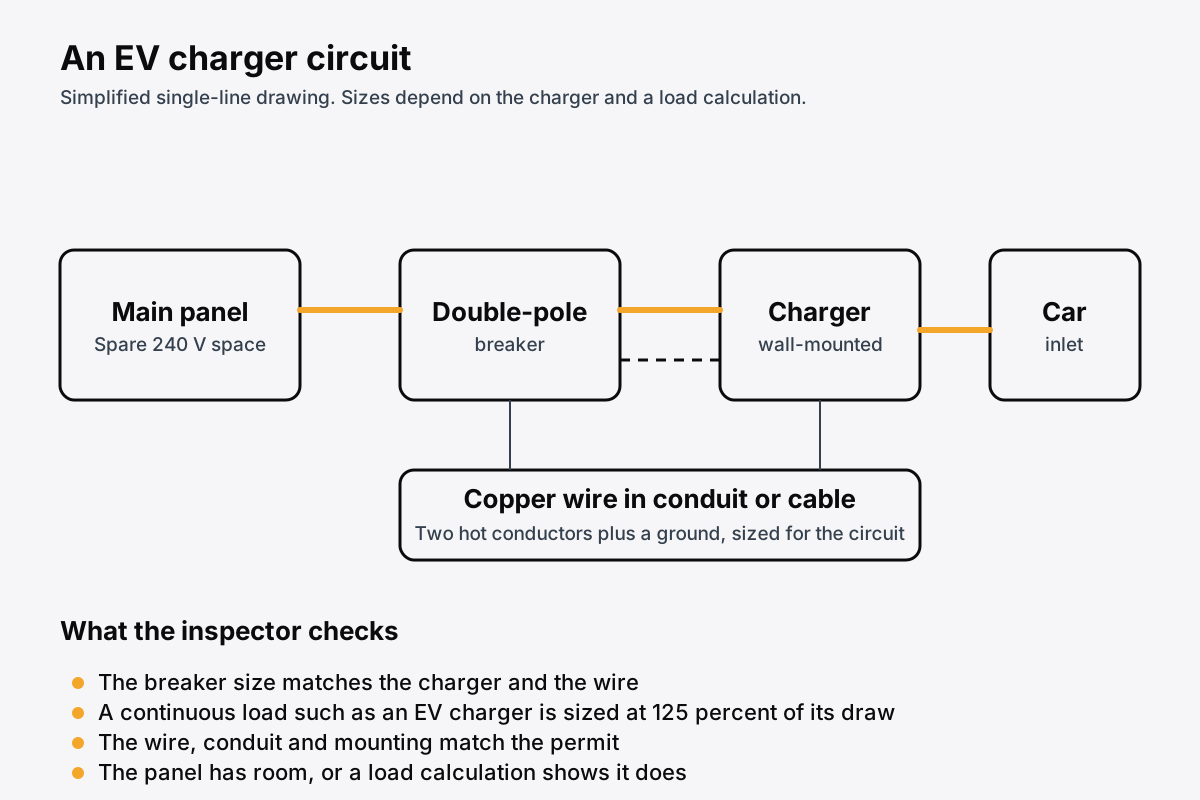
NEC 625.42 covers the rating of EV charging equipment. The charging load counts as continuous, and that where an automatic load management system is used, the maximum equipment load on a service and feeder is the maximum the system allows. The system must meet NEC 750.30. Also, load management helps the service and feeder calculation, but the branch circuit is sized to the charger’s full output.
Sharing one circuit between chargers is also covered. NEC 625.40 asks for an individual branch circuit for each charging outlet. A 2023 revision permits more than one charger on a circuit when an energy management system controls them. Your city must be on a code edition that includes that, so ask the building department.
Four ways to manage the load
| Method | How it works | Fits |
|---|---|---|
| Charger set to a lower amp level | You choose 32 A instead of 48 A once | Simple, no extra hardware |
| Charger with built-in sharing | Units talk to each other or to a meter and lower amps as needed | One to a few chargers |
| Load control device in the panel | A meter or switch watches the load and cuts the charger or other big loads | One charger, small panel |
| Smart panel | Panel with breakers that monitor and switch circuits | Whole-home control, solar, battery |
Tesla’s installation manual lists Dynamic Power Management and Group Power Management for the Gen 3 Wall Connector, and says that unit adjusts its maximum output to fit the existing supply. The breaker size is set during commissioning. Other brands have their own versions, so check the charger’s manual before you buy.
Pros and tradeoffs
Benefits. A smaller or no panel upgrade, and the ability to add a second charger on the same feeder.
Costs. Extra hardware such as a meter or controller, and setup time. Charging slows at busy times. For most overnight charging that is invisible, because the house load drops at night.
Limits. The device must be listed and meet NEC 750.30 where load management is used to size the service. A basic timer is not the same thing. If the calculation relies on the cap, the inspector may ask to see the settings, and the settings should be locked so a user cannot change them later.
Shared parking: condos and multifamily
Buildings with limited power can add several chargers on one feeder by sharing the amps among them. Several chargers can share one feeder, with each car getting the most power when it is the only one plugged in. See the HOA and condo page for the rights side.
Smart panels and solar
If you plan solar, a battery or a heat pump, a smart electrical panel can manage all of them together and handle the EV charger as one of its loads. Homes with solar and batteries add other limits on busbar loading. The solar and battery tie-in hub covers those rules.
What it costs
A plain install is the typical SoCal range of $1,000 to $2,000 as of October 2026. Load management hardware adds to the install, and a smart panel adds more. Compare against the panel-plus-charger range of roughly $3,600 to $7,500, shown on the cost page. Ask the electrician to price the cap option and the upgrade side by side, so you can see what you save.
Questions for your electrician
- Does the calculation pass with a cap, and what is the cap in amps?
- Which device does the capping, and is it listed for that use?
- What happens to charging when the cap kicks in?
- Can a second charger share the circuit later?
When to skip it
Load management is not always cheaper. If the house is already far over its limit, a cap will not rescue the calculation. If the car must charge fast during the day, a cap that slows it will annoy you. And if you plan to add a heat pump, a battery and a second EV, a larger service may be the cheaper path in the long run. Ask the electrician to price both so you can choose.
Questions people ask
Can load management let me skip a panel upgrade?
Sometimes. If the load calculation fails only by a small amount, a listed energy management system can cap the charger so the service total stays under the limit. If the house is far over the limit even without the charger, a service upgrade is still needed. The electrician can show which case you are in.
Do I still need a full-size breaker for the charger?
Yes. Load management helps the service and feeder calculation, but the branch circuit for the charger is still sized to the charger's full output. A 48 amp charger still gets a 60 amp breaker. The cap changes how much the charger draws, not what the wire and breaker must carry.
Can two chargers share one circuit?
Yes, with an energy management system. NEC 625.40 normally wants each charger on its own branch circuit, and a 2023 change allows more than one charger on a circuit when an energy management system controls them. The system splits the available amps. Both cars still charge, just not both at full speed.
Is a smart panel better than a charger with built-in load sharing?
It depends on the job. A charger with built-in sharing, such as Tesla's power management, is the cheapest choice for one or two chargers. A smart panel watches the whole house and can manage chargers, a heat pump and a battery together. It costs more, so it makes sense when you plan several large electric loads.
Keep reading
Home EV charger installation: circuit, panel and permit
A home Level 2 charger runs on its own 240 volt circuit, usually 40 to 60 amps. Whether the panel has room…
EV charger load calculation
Before a charger goes in, the electrician adds up your home's electrical load and checks that a new…
Smart electrical panels
A smart panel is a main panel with built-in monitoring and remote-controlled breakers. It can cap total…
EV chargers in an HOA, condo or rental
In California an HOA cannot ban an EV charger in your parking space, and a landlord must approve a written…
Solar and battery tie-in at the electrical panel
A tie-in is the wiring that connects solar panels, inverter, battery and your main panel. Owners need it…
EV charger plus panel upgrade: what the whole job costs
When your panel cannot carry a charger, the combined job typically costs $3,600 to $7,500 in SoCal, as of…
Send a photo, get a range.
Share your ZIP and a photo of your panel. Your request goes to a licensed partner electrician, who contacts you.
Get this quoteAurion Electric is a referral service operated by Roviq LLC. Electrical work is done by a licensed partner electrician.
