AB 1236 and EV charger permits: what California cities must offer
AB 1236 requires every California city and county to run a fast, checklist-based permit process for EV chargers and to approve compliant applications without a discretionary hearing. Local details differ, so each city's checklist is the one to follow.
Before AB 1236, a homeowner who wanted a charger might wait through plan check queues, bounce between counters and pay for hearings. AB 1236, signed in 2015, set a statewide standard. AB 970 in 2021 added review timelines through Government Code 65850.71. This page covers what the law says and how it shows up at the counter.
What the statute says
Government Code 65850.7 declares that charger standards are a statewide concern, so it covers every city, including charter cities. As summarized from the code text, it requires the following:
- Administrative approval. The building official approves charger applications through a building permit or similar nondiscretionary permit, and review is limited to health and safety.
- Use permits only on evidence. A use permit can be required only if the building official finds, based on substantial evidence, a specific adverse health or safety impact. A denial needs written, evidence-based findings that the impact cannot feasibly be mitigated.
- Appeal. Decisions can be appealed to the planning commission.
- Lowest-cost conditions. Conditions must reduce the specific impact at the lowest possible cost.
- Technical standards. Stations must meet applicable state and local health and safety rules and electrical and testing standards.
- Expedited ordinance and checklist. Local governments must adopt an ordinance that creates an expedited, streamlined process, with a checklist for review. The checklist must be available online. The statute set adoption dates in 2016 and 2017 for EV stations. Applications are deemed complete or get a correction notice, and electronic submittal and signatures are generally required.
- No HOA condition. A permit cannot be conditioned on approval by a homeowners association.
As the section reads now, it is set to be repealed on January 1, 2030, unless the legislature extends it. The summary comes from a legal reference site, so check the current text on leginfo.legislature.ca.gov for exact wording.
The state does not override the Coastal Act. Cities with a certified Local Coastal Program decide whether a coastal permit is also required.
What it does not do
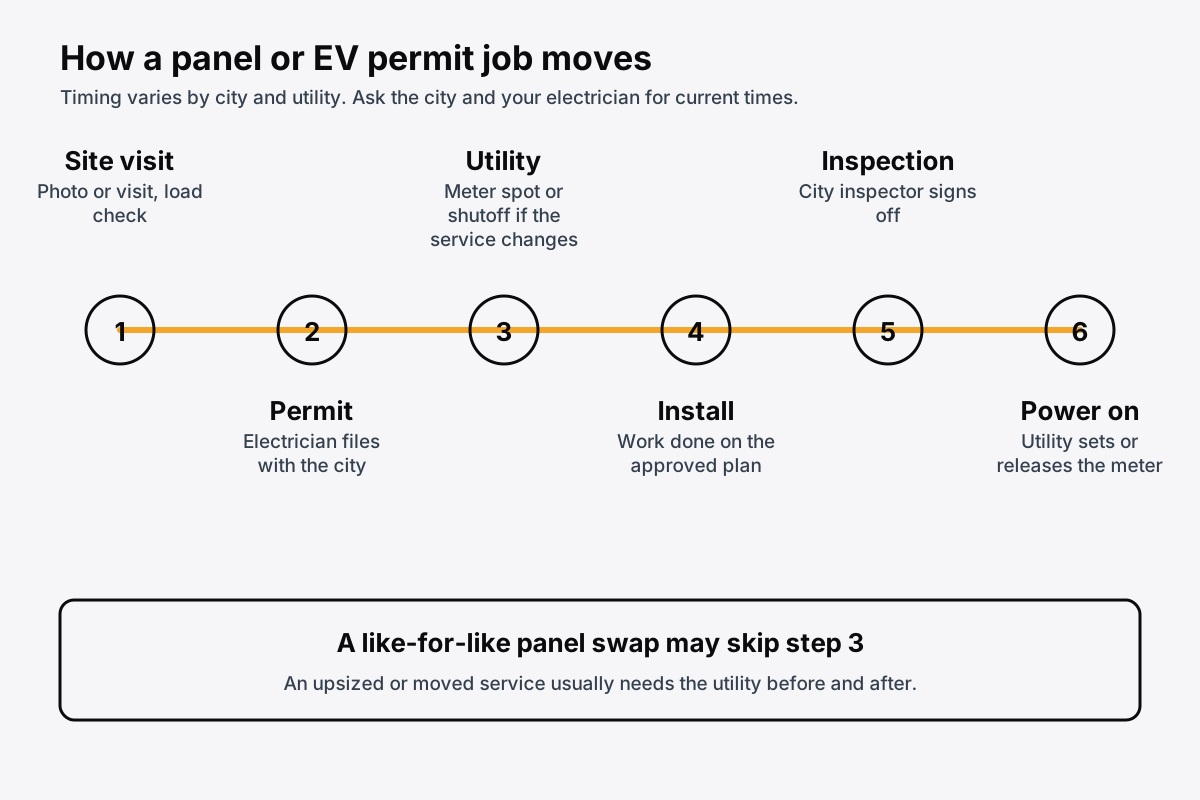
The statute does not set fees, and it does not say a charger is exempt from inspection. It also does not touch your utility. A big charger on an old panel may still need a service upgrade, and that conversation is with the utility, not the building department. For the load side, see EV charger load calculation.
How cities handle it
Cities follow the same law and still look different at the counter. A few examples from the city pages on this site:
Long Beach. One or two chargers on an existing one- or two-family home can use an Express Permit. The electrician fills out an express checklist, and if every answer is yes, the permit can be issued the same day at the Permit Center. One- and two-family jobs with no more than 2 chargers can also be applied for and paid online with automatic issuance. Anything else goes to plan review. See the Long Beach page.
Poway. The electrician applies in the city portal with a title page, an electrical diagram (main panel information, circuit size, wire and conduit sizes), load calculations and manufacturer specs. Poway’s handout cites AB 970 streamlining: a completeness check within 5 days and a review within 20 business days for up to 25 chargers. See the Poway city page for local detail.
Escondido. Under its Guideline 30 (August 2017), Level 1 charging on an existing outlet needs no permit, while a new outlet or any 240-volt Level 2 charger needs an electrical permit and inspection. Applicants submit the expedited review checklist, manufacturer instructions, a site plan and any load calculations.
Anaheim. The city’s municipal code requires a permit for each charger, and it publishes an EV Charger Checklist. If the load calculation shows an upgrade is needed, a meter spot report from Anaheim Public Utilities is required. See the Anaheim page.
Santa Clarita. The city’s expedited process covers single-family homes and duplexes. A hard-wired charger needs the manufacturer’s spec sheet. A Level 2 charger on a service under 200 amps needs a residential load calculation by a C-10 contractor or an electrical engineer. Outdoor chargers or outlets need Planning approval first.
Irvine. The city requires online submittal through its permit portal, a single-line diagram and manufacturer specs, and a charger in the garage cannot block the required parking space.
What this means for your quote
- Ask the electrician which checklist the city uses and whether the job qualifies for the express path.
- Expect to supply the charger model, the panel make and rating, and the circuit and wire sizes.
- Some cities require a load calculation even when a Level 2 charger looks simple, and a service under 200 amps often triggers it.
- Permit fees vary by city and change each fiscal year. This guide does not quote them.
If the home is in an HOA, work the two tracks in parallel. Civil Code 4745 governs the association. The city permit does not wait for it.
The general permit guide explains how permits, inspection and owner-builder rules fit together for all electrical work, and the EV charger services page shows the types of install.
Questions people ask
How fast must a city approve an EV charger permit?
The statute requires an expedited, streamlined process with a checklist, and administrative approval of compliant applications. The exact days come from the city's rules and from AB 970 (Government Code 65850.71). Poway, for example, cites a completeness check within 5 days and review within 20 business days for up to 25 chargers. Check your city's checklist.
Can my city require a hearing or a use permit for a home charger?
Only in narrow cases. A use permit can be required only if the building official finds, on substantial evidence, a specific adverse health or safety impact. A denial needs written findings that the impact cannot feasibly be mitigated. A routine home charger should go through the checklist and a building permit.
Does AB 1236 require the city to waive permit fees?
No. The statute does not set or waive fees. Cities set their own fees, and they change each fiscal year. Ask the permit office or check its current fee schedule. Your electrician can include the permit fee in the quote.
Does the permit need my HOA's approval first?
No. Government Code 65850.7 says a permit cannot be conditioned on approval by a homeowners association. The HOA's own architectural rules and Civil Code 4745 still apply to the install, and they run on a separate track from the city permit.
Keep reading
HOA EV charger law in California: Civil Code 4745 and how to ask
How Civil Code 4745 works, the 60-day clock, common-area conditions, and the steps to send an HOA a…
Electrical permits in Southern California: what needs one and who pulls it
What needs an electrical permit, who pulls it, what the inspector checks, and what happens if the work was…
Home EV charger installation: circuit, panel and permit
A home Level 2 charger runs on its own 240 volt circuit, usually 40 to 60 amps. Whether the panel has room…
EV charger load calculation
Before a charger goes in, the electrician adds up your home's electrical load and checks that a new…