240-volt and dedicated circuits: breaker size, wire gauge and permit
A dryer usually needs a 30-amp circuit on 10-gauge copper, a range 50 amps on 6-gauge, and an EV charger often 50 amps on 6-gauge. The breaker, the wire and the plug must all match, or the circuit is a fire risk.
- Dryer: 30 A, 10 AWG
- EV (40 A charger): 50 A, 6 AWG
- Permit: Required
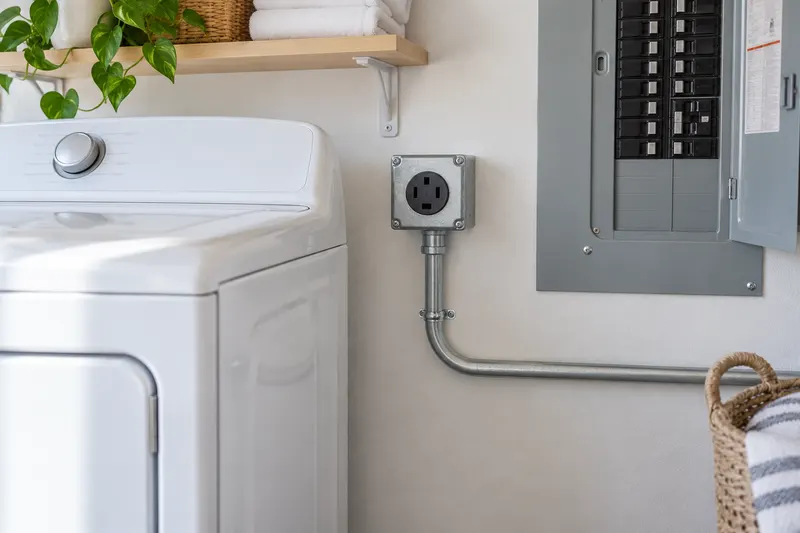
Match the breaker, the wire and the plug
A circuit is safe when three parts agree. The breaker trips at a set current. The wire can carry at least that much. The outlet is rated at or above the breaker. Break any link and the weakest part overheats. Section 210.21 says a single receptacle must be rated at least as high as its breaker.
For copper wire in a house, the 60-degree column of NEC Table 310.16 usually applies to equipment rated 100 amps or less. These are the values:
| Wire (copper) | Table ampacity | Common breaker | Typical use |
|---|---|---|---|
| 12 AWG | 20 A | 20 A | Dedicated 120 V line, bathroom, small appliance |
| 10 AWG | 30 A | 30 A | Electric dryer, water heater |
| 8 AWG | 40 A | 40 A | Some ranges, small EV charger on a short run |
| 6 AWG | 55 A | 50 A | Range, EV charger, subpanel feeder |
Small wire also has a hard cap under 240.4(D): 15 amps for 14 AWG, 20 for 12 AWG and 30 for 10 AWG, whatever the table says. A long run may need a heavier wire because of voltage drop, and aluminum wire is sized differently.
Common 240-volt jobs
Dryer. A 30-amp, two-pole breaker with 10-gauge wire and a 14-30 receptacle is the usual choice. Check the dryer’s label.
Range. Most electric ranges use a 50-amp circuit on 6-gauge wire, but the label rules. A cooktop and wall oven may be separate, each with its own circuit.
EV charger. Charging counts as a continuous load, so the breaker is at least 125 percent of the charger rating. A 40-amp charger means a 50-amp breaker. Each charging outlet gets its own branch circuit with no other outlets. For brand and load details see EV chargers, the Tesla Wall Connector page, and load calculation explained.
Mini-split or heat pump. The outdoor unit label states the minimum circuit ampacity and the maximum breaker. The wire and breaker follow it, with a disconnect in sight. See heat pump electrical requirements.
Four wires or three
New range and dryer circuits use four wires: two hots, a neutral and a separate ground. The old three-wire setup connects the case to the neutral. The code allows that only on an existing circuit that has no ground wire, so a replacement appliance on an old circuit may stay three-wire. When a new cable is run, it is four-wire, and the dryer’s bonding strap comes off. Match the cord: a 14-30 plug is four-prong, and an old 10-30 plug is three-prong.
Is there room in the panel
A 240-volt breaker takes two slots, and each load adds to the total the service must carry. The electrician checks the number of free slots first. For bigger additions, such as a charger plus a heat pump, a load calculation shows whether the service can take it. The result may be a subpanel, a load manager or a panel upgrade. A full panel is the usual reason a $459 to $1,388 circuit becomes a bigger job.
Permit and cost
A new 240-volt circuit needs an electrical permit, and the city inspects the wire, breaker and receptacle before you use it. See the permit guide.
Cost depends on distance, wall finish and panel space. As of October 2026 no neutral guide prices a full dedicated 20-amp circuit (Fixr lists $100 to $150 for a 20-amp outlet), and a Level 2 charger circuit runs $1,000 to $2,000 on the EV charger cost page. The heat pump circuit page gives $1,500 to $6,000 as a desk estimate that swings with panel capacity. No sourced price range exists yet for a dryer or range circuit alone, so ask for a written quote.
Long runs, aluminum and old panels
Three things change a 240-volt quote more than people expect.
- Distance. A charger at the far end of a long garage or a detached building may need a heavier wire to keep voltage drop low. The table above gives the minimum for current, not the best choice for distance.
- Aluminum. Aluminum cable is sized differently from copper and needs terminals made for it. Homes with older aluminum branch wiring are a separate issue, covered under aluminum wiring.
- Old panels. A panel that is full, rusted or a brand with a poor record may need replacing before a new circuit goes in. See Zinsco and Federal Pacific panels.
Ask the electrician to write down the breaker size, the wire gauge, the receptacle and the route. That four-line list is the quickest way to compare two quotes.
For a first conversation, bring the appliance model number or the charger spec sheet, a photo of the panel and a rough distance from the panel to the spot. That is enough for an electrician to name a breaker size and a likely price range before a visit. See how to prepare for the visit.
Questions people ask
Does a dryer need 3-wire or 4-wire?
A new dryer circuit uses four wires: two hots, a neutral and a separate ground. The older three-wire hookup, which uses the neutral as the ground, is allowed only on existing circuits that meet the code conditions. When you buy a new dryer, check which cord it needs. The electrician matches the plug to the wire in the wall.
Can I put a bigger breaker on my circuit to stop it tripping?
No. The wire sets the limit, and a larger breaker lets a thin wire overheat. A 10-gauge copper wire is limited to a 30-amp breaker. If a breaker trips, the circuit is overloaded or has a fault. The fix is a new circuit or a repair, not a bigger breaker.
What size circuit does a Level 2 EV charger need?
EV charging counts as a continuous load, so the breaker must be at least 125 percent of the charger's rating. A 40-amp charger needs a 50-amp breaker. Many homes use 6-gauge copper on a 50-amp circuit. Check the charger nameplate, since smaller chargers need less. See the EV page for load limits.
Will my panel handle a new 240-volt circuit?
It depends on free breaker space and the total load. A 240-volt circuit takes two slots. If the panel is full or near its rating, an electrician runs a load calculation. The result may be a load manager, a subpanel or a panel upgrade. Do not assume the main breaker rating alone answers the question.
Does a mini-split need its own circuit?
Yes, a mini-split normally runs on its own breaker, sized to the label on the outdoor unit, with a disconnect nearby. The label gives the minimum wire size and the maximum breaker. An electrician reads it and matches the circuit. Heat pump hookups are covered on their own page.
Keep reading
Outlets and circuits: adding, protecting and upgrading them
Most outlet jobs fall into four kinds: a GFCI where water is near, a new outlet in a room, a 240-volt line…
How to add an outlet to a room, and what it takes
Adding an outlet usually means extending a nearby circuit, and a simple outlet runs $120 to $200 in Fixr's…
Home EV charger installation: circuit, panel and permit
A home Level 2 charger runs on its own 240 volt circuit, usually 40 to 60 amps. Whether the panel has room…
Load calculation explained in plain English
The 220.83 method step by step with a worked example for a 1,800 sq ft home, and the 220.87 option based…
What a heat pump needs from your electrical system
Circuit size, breaker, disconnect, permit and panel room for a heat pump or heat pump water heater, with…
How much does it cost to install a Level 2 EV charger at home?
A Level 2 EV charger install in Southern California typically costs $1,000 to $2,000 for the new 240-volt…
How much does a heat pump or 240V circuit cost?
Wiring a heat pump or another new 240V appliance typically costs $1,500 to $6,000 in SoCal. That is an…
Subpanel installation: when it fits and how it is wired
A subpanel is a second breaker box fed from your main panel, and it adds circuit space for a garage, ADU…
Send a photo, get a range.
Share your ZIP and a photo of your panel. Your request goes to a licensed partner electrician, who contacts you.
Get this quoteAurion Electric is a referral service operated by Roviq LLC. Electrical work is done by a licensed partner electrician.
