Electrical permits in Southern California: what needs one and who pulls it
Most electrical work beyond a like-for-like swap needs a permit from your city or county building department. A licensed electrician normally pulls it, the building inspector signs it off, and unpermitted work can come back at resale.
A permit is the city’s or county’s record that electrical work was planned, done to code and looked at by an inspector. In Southern California, each city and county runs its own counter, portal and fee list. The principle is the same everywhere. If you add, move or replace wiring that carries load, a permit is expected.
Jobs that almost always need a permit
These are the jobs a building department will ask about:
- Replacing a main panel or upgrading the service (100 A to 200 A, 200 A to 400 A)
- Adding a subpanel for a garage, ADU or addition
- A new 240-volt circuit for an EV charger, dryer, range, heat pump or spa
- Rewiring part or all of a house, including knob-and-tube and aluminum branch circuit replacement
- Generator inlets, interlock kits and transfer switches
- Home battery and solar tie-ins
- New lighting circuits, recessed lights in a new ceiling or any run of new cable
Riverside Public Utilities states it plainly on its EV rebate page: a hard-wired charger or a new 240-volt circuit needs an electrical permit. Pasadena Water and Power attaches the same condition to its panel rebate. Rebate programs often ask for proof of a passed inspection, so the permit paper trail is worth keeping.
Jobs that are often exempt
Many departments let you swap a switch, outlet, light fixture or ceiling fan on an existing circuit without a permit. Others do not. Do not assume. A 5-minute call or a look at the department’s handout answers it, and the answer for your city is the only one that counts.
Who pulls the permit
A licensed contractor with the right classification (a C-10 electrical contractor, or a general contractor working with one) pulls the permit under their license. Cities check this. Glendora, for example, asks for either a valid contractor license with a declaration or an owner-builder declaration, plus proof of ownership.
Check the license before you sign. The guide to verifying an electrician’s license walks through the state lookup.
The owner-builder option and its limits
Business and Professions Code 7044 lets an owner work on their own property without a contractor license, with conditions:
- The work cannot be built or improved for sale.
- You do the work yourself, or your employees do it and are paid wages.
- Selling or offering the property within one year of completion creates a presumption that it was built for sale. You then have to show it was not.
- A separate path covers your main home if you lived in it for the 12 months before the work was finished, with a cap of two structures and one use in any three-year period.
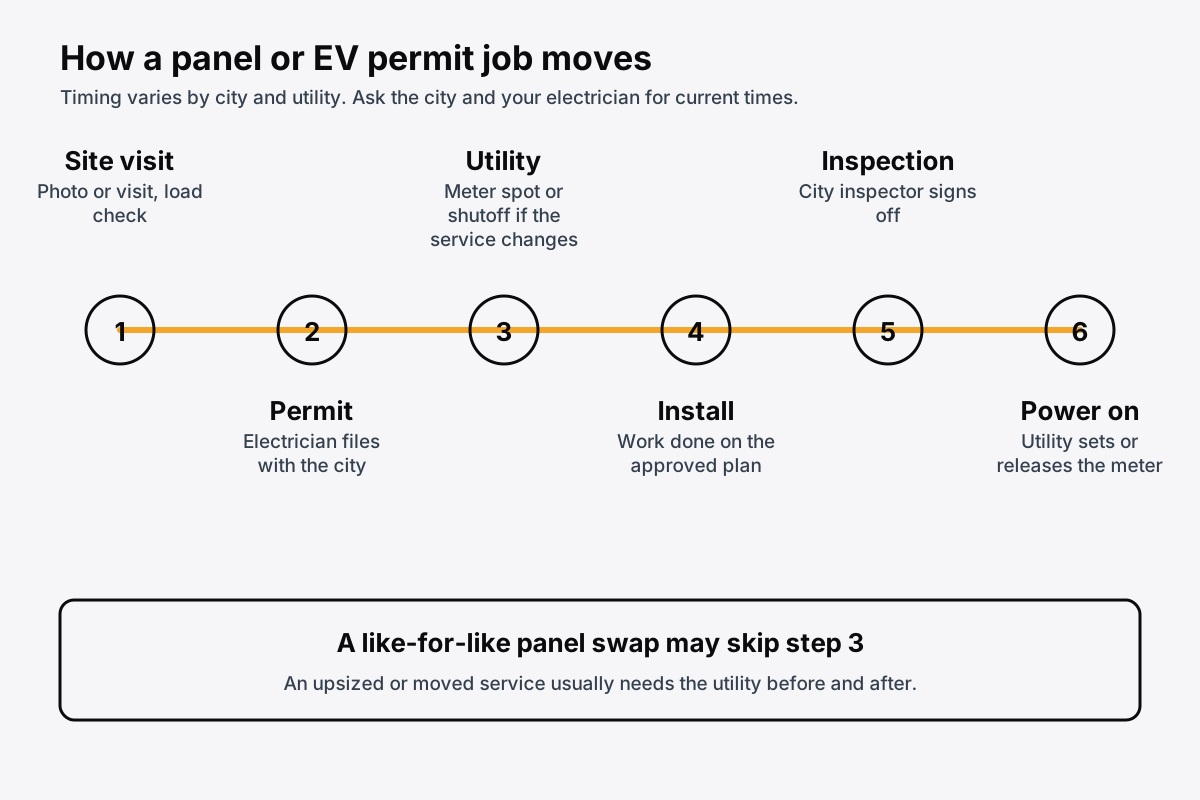
The permit office will have you sign a form stating you are exempt. The inspector holds owner work to the same code as contractor work. For service upgrades there is a second hurdle: the utility needs a meter spot, a disconnect and a reconnect, which are covered in the panel upgrade timeline.
What the inspector checks
For a panel, the inspector typically looks at the grounding and bonding, breaker sizes against wire sizes, working clearances around the panel, labeling, and arc-fault and ground-fault protection where the code requires it. For a charger, expect a look at the circuit, the disconnect and the conductor size. The 2025 California Electrical Code, based on the national electrical code with California changes, took effect on January 1, 2026, so permits filed now are reviewed under that edition.
Work often needs more than one inspection. Rough-in comes first if walls are open. The final comes last. On a service upgrade the final is also the trigger that releases the job to the utility.
Fees and timing differ by city
Permit fees and review times vary from one department to the next, and fee schedules change each fiscal year. This guide does not quote individual fees. Your city’s page on the electrician area index lists the permit office for each city on this site, and the county hubs for Los Angeles, Orange and San Diego counties explain how offices differ across the county.
For EV chargers, state law requires a streamlined permit process. That is covered in the AB 1236 guide.
What unpermitted work can cause
Unpermitted work does not always cause trouble, but it tends to surface at three moments.
- A sale. A seller who knows about unpermitted work generally has to disclose it, and the duty cannot be waived in an as-is sale (Civil Code 1102). Buyers often ask for a permit, a price cut or a repair.
- A building department visit. If an agency finds a condition that endangers people or property, it can require repair or removal after notice. Missing paper alone does not make a building substandard, but unsafe wiring does.
- A claim. Ask your insurer in writing how it treats a loss that starts in unpermitted work. The answer varies by carrier.
If you inherit unpermitted work, many departments will let an owner apply for a permit after the fact. The inspector may need to see inside walls or boxes first.
Questions people ask
Do I need a permit to replace an electrical panel?
Yes. Cities and counties in Southern California treat a panel replacement or service upgrade as permitted work, and the utility will not reconnect the meter until the building department passes the inspection. Pulling the permit is part of a licensed electrician's job. Ask your building department for its current rules before work starts.
Can I pull an electrical permit myself as the homeowner?
Often yes, as an owner-builder, but you sign a declaration that you are doing the work yourself on your own home and not for sale. You must pass the same inspections. Many homeowners still hire a licensed electrician for panel and service work because the utility steps are hard to manage alone.
What happens if I sell a house with unpermitted electrical work?
If you know about it, you generally have to disclose it, even in an as-is sale. A buyer may ask you to get the work permitted, lower the price or walk away. A building department can also require the work to be opened up, corrected or brought up to code.
How long does an electrical inspection take to schedule?
It depends on the city. Many building departments let you book inspections online, and some warn of delays after major events, as Pasadena's did after the January 2025 fires. Your electrician or the permit card will list the booking method. Plan for the inspection to be a separate visit from the install.
Keep reading
Electrical panel upgrades in Southern California: when and how
A panel upgrade replaces the main breaker box, and most SoCal homes that need one are moving from 60 to…
Panel upgrade permit and inspection
A panel upgrade needs a city electrical permit and a passed inspection before the utility reconnects…
Panel upgrade timeline: permit, meter spot, disconnect, inspection, reconnect
The step-by-step sequence of a panel upgrade, and where SCE, SDG&E, LADWP and city utilities each add…
AB 1236 and EV charger permits: what California cities must offer
What Government Code 65850.7 requires of cities for EV charger permits, and how a few SoCal cities put it…
How to verify an electrician's license in California
A five-minute CSLB check: license status, C-10 class, bond, workers' comp, and the contract terms the law…
Electrical work in Los Angeles County
Los Angeles County has more electric utilities, permit offices and housing eras than any other SoCal…
Electrical work in Orange County
Most Orange County cities are on Southern California Edison. Anaheim runs its own utility, San Clemente is…
Electrical work in San Diego County
Every San Diego County city on this site gets its wires from SDG&E, so the big local difference is…