Subpanel installation: when it fits and how it is wired
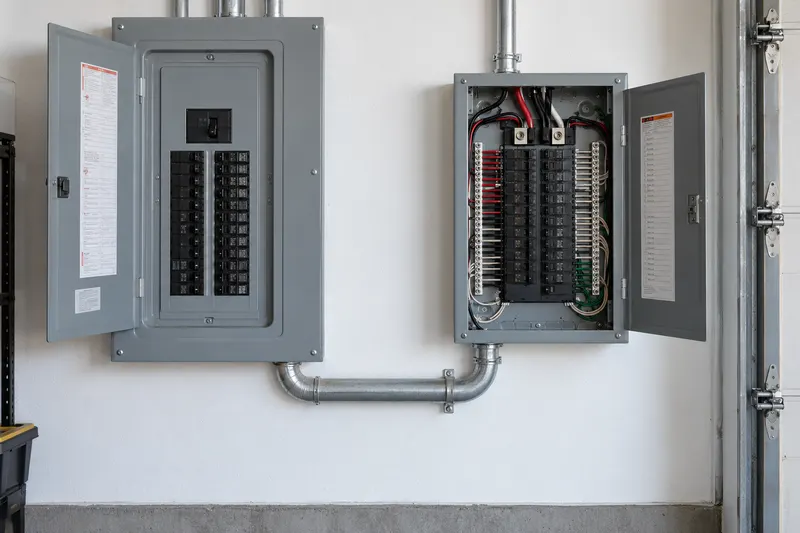
A subpanel is a second breaker box fed from your main panel, and it adds circuit space for a garage, ADU, addition or workshop. The electrician sizes the feeder from a load calculation, and the city inspects it.
- Typical SoCal range: $1,200 to $2,800
- Feeder: 4 wires
- Permit: Required
Subpanel or new panel?
A subpanel makes sense when the main service has room but the main panel does not have the breaker spaces, or when the new loads sit far from the main panel. Running one heavy feeder to a garage or ADU and branching from there costs less than running many circuits from the house.
A subpanel does not add power. It divides what the main service already provides. If your main panel is a 100 amp box that is near its limit, the real fix is the panel upgrade, and the subpanel might come after it.
Common reasons to add one
- Detached garage or workshop. Lights, outlets, a compressor, welder or EV charger. See EV charger in an outdoor or detached garage.
- ADU, converted garage or room addition. The new space needs its own breakers close at hand. The ADU electrical guide covers when an ADU needs its own meter and service as well.
- Full main panel. Old boxes with no open spaces force the choice between tandem breakers and a subpanel.
- Backup power. A subpanel for essential circuits is the usual way to run a generator or battery. See critical loads subpanel.
- Hot tub or pool equipment. Often sits in its own panel near the yard.
How the electrician sizes it
The electrician starts with a load calculation for the new space and checks it against the capacity left on the main service. The load calculation guide shows the method. Then the feeder is sized: the breaker in the main panel, the wire gauge and the conduit all have to match. Many garages and small ADUs land in the 60 to 100 amp range, but your calculation decides.
What the feeder looks like
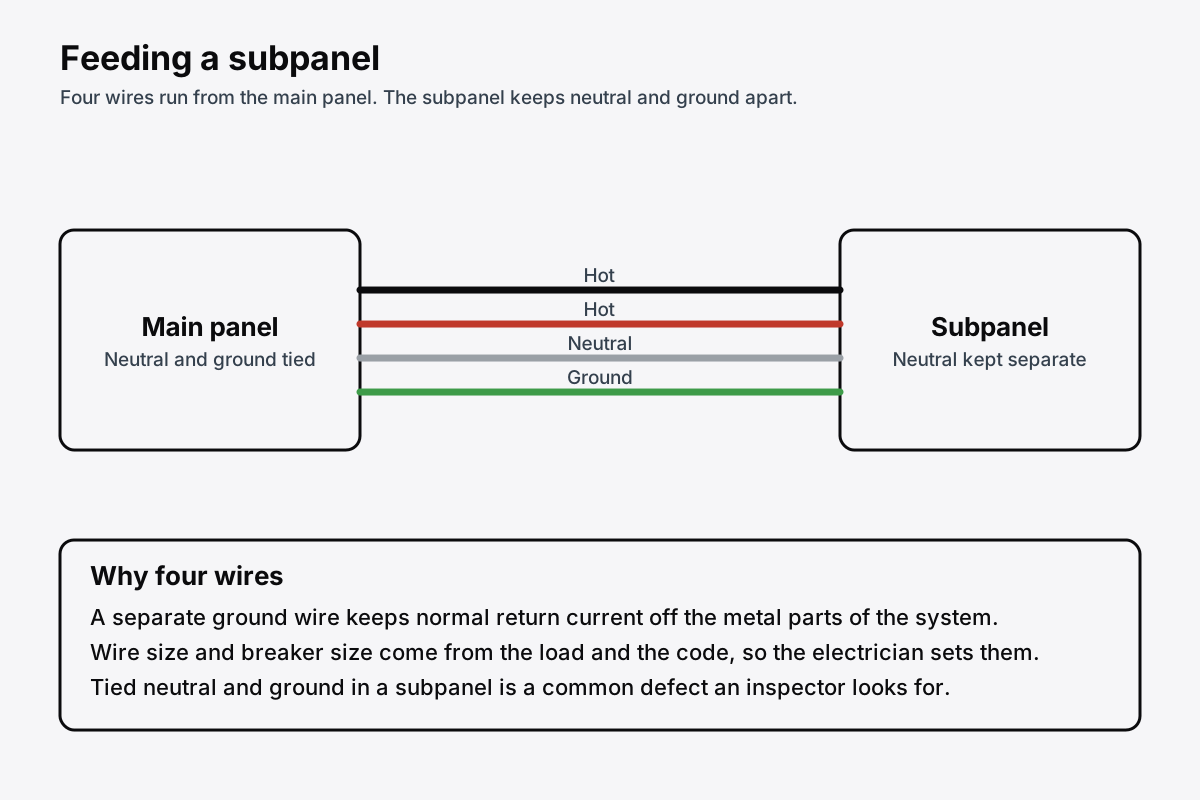
The feeder runs from a breaker in the main panel to the subpanel, in conduit or approved cable. It has four conductors: two hots, a neutral and a ground.
- Neutral and ground are separated in the subpanel. They are tied together only in the main panel. A city checklist wording is: neutrals and grounds landed on their own lugs, one conductor per lug as the panel is listed.
- A detached building usually gets its own grounding electrode too.
- Depth and protection. Underground runs need the right cable or conduit and burial depth, which the permit plans show.
- Labels. Each circuit is labeled on the panel door, and the main panel marks the feeder breaker.
Cities also ask for 36 inches of clear space in front of a panel and 30 inches across, and for no open knockouts. Laguna Niguel’s checklist is one example, and your city’s will be close.
Permit and inspection
A subpanel needs an electrical permit in most cities, because it adds a feeder and new circuits. The inspector looks at the feeder, the grounding and the panel interior before the walls close if the panel sits in a wall. A detached structure may need a separate inspection stop for the trench. Ask the city building department which stops it requires.
Cost
The typical SoCal range is $1,200 to $2,800 as of October 2026. This is a desk estimate, since no published price list covers subpanel jobs. Material alone is much less. The price is mostly labor and the length of the feeder. The subpanel cost page lists what moves the price. These push it up:
- a long feeder, or trenching through concrete or landscape,
- a larger panel with many spaces,
- a main panel that needs rework to receive the feeder,
- stucco or drywall patching,
- a panel upgrade that has to come first because the main service is full.
What to ask
- Is there enough capacity on my main service for this load? Show the calculation.
- How many amps is the feeder, and what size is the wire?
- Is the quote for a surface run or a buried run?
- Is trenching, patching and permit included?
Questions people ask
What size subpanel do I need for a garage?
For a garage with outlets, lights and a Level 2 EV charger, 60 to 100 amps is common. The right size comes from a load calculation on that space and a check that the main panel can feed it. A larger subpanel on a full main panel does not create new capacity.
Can a subpanel give me more capacity than my main panel has?
No. A subpanel only splits the capacity you already have. If the main service is at its limit, the subpanel cannot add power. You would need a service upgrade first, or a load management device that limits what the new loads can pull at once.
Why does a subpanel need four wires?
A subpanel feeder carries two hot wires, a neutral and a separate ground. In the subpanel, neutral and ground are kept apart. Only the main panel ties them together. This prevents normal load current from flowing on the ground path, which is a shock and fire risk. A three-wire feeder is an old method that no longer passes.
Does a detached garage need a ground rod?
Usually yes. A subpanel in a separate building generally needs its own grounding electrode, a rod or a Ufer ground, connected to the panel ground bar. The feeder also carries a ground wire from the house. Your city inspector confirms the exact grounding setup for the permit.
Keep reading
Electrical panel upgrades in Southern California: when and how
A panel upgrade replaces the main breaker box, and most SoCal homes that need one are moving from 60 to…
What does a subpanel cost for a garage, ADU or addition?
A subpanel installed in SoCal typically costs $1,200 to $2,800, including the feeder, breakers and permit…
ADU and remodel electrical work
Most ADUs get power from a subpanel fed by the main house panel, and a load calculation sets its size. A…
Critical loads subpanel for a battery or generator
A critical loads subpanel is a small second panel that holds only the circuits you want during an outage…
ADU electrical requirements
Subpanel or new service, feeder, meter choice, EV and heat pump loads, and typical cost for a backyard or…
Load calculation explained in plain English
The 220.83 method step by step with a worked example for a 1,800 sq ft home, and the 220.87 option based…
Outdoor and detached garage EV charger installs
A charger on an outside wall or in a detached garage needs weather-rated gear, ground-fault protection and…
Send a photo, get a range.
Share your ZIP and a photo of your panel. Your request goes to a licensed partner electrician, who contacts you.
Get this quoteAurion Electric is a referral service operated by Roviq LLC. Electrical work is done by a licensed partner electrician.
