Home charging for a Rivian R1T or R1S
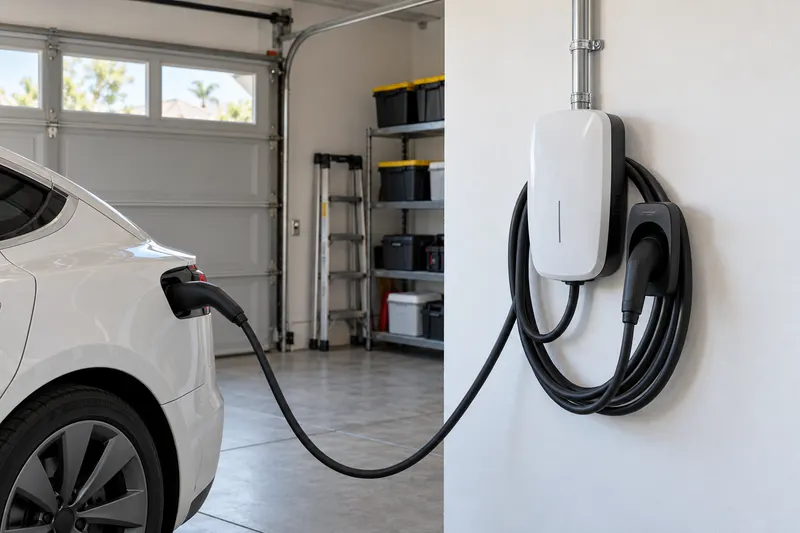
Rivian's own Wall Charger is rated 48 amps and 11.5 kW on 240 volts. That points to a hardwired charger on a 60 amp breaker, with the connector type matched to your truck's port.
- Wall Charger: 48 A, 11.5 kW
- Circuit implied: 60 A breaker
- Cable: 24 ft
Why a Rivian points to a 60 amp circuit
Rivian’s product page for its Wall Charger lists a maximum current of 48 amps, a charging speed of 11.5 kW and a single phase 240 volt AC connection. The cord is 24 feet. Those numbers set the circuit.
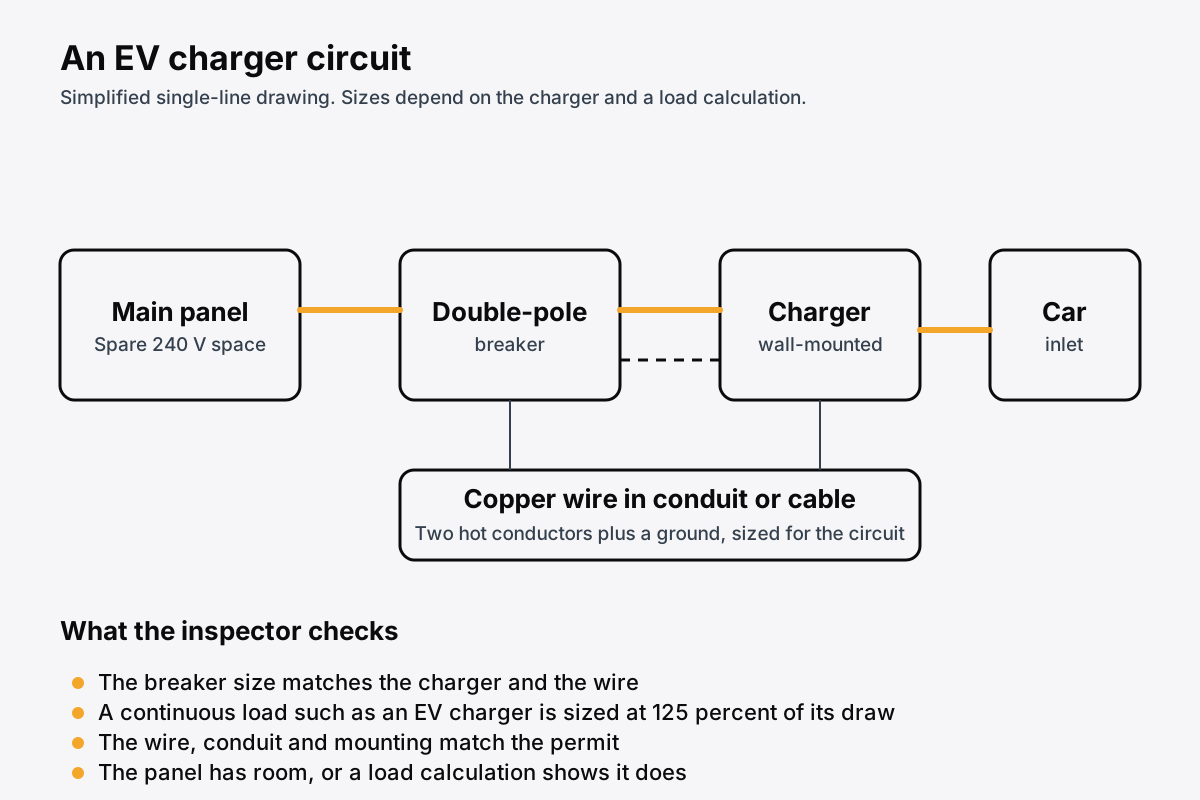
The National Electrical Code counts EV charging as a continuous load, meaning it runs three hours or more. A continuous load is limited to 80 percent of the breaker rating. That is the same as saying the breaker must be 125 percent of the charger. For 48 amps, that is 60 amps. Tesla’s table for its own 48 amp charger pairs it with a 60 amp breaker, which shows the same math in a different product.
So the working answer for most R1T and R1S owners is a hardwired Level 2 charger on a 60 amp double pole breaker, wired in copper sized by the electrician for the distance.
Hardwire it
A 14-50 outlet sits on a 50 amp breaker, which supports about 40 amps of charging. That leaves about a fifth of the Wall Charger’s rate unused. Read your install guide for what Rivian allows. The simpler path is a direct connection to the circuit.
Check the port before you order
Rivian sells the Wall Charger with two connector styles. The J1772 version states on its page that it needs a separate adapter for a NACS port. The truck you drive decides which one you want, so read your model year’s port and confirm with Rivian before the electrician orders the unit. If you already own a third-party charger, make sure its plug fits the inlet or that you own the correct adapter.
Where a Rivian usually parks
R1T and R1S owners often park in driveways, side yards or detached garages because of the vehicle’s size. That changes the job more than the charger does.
- A driveway or side wall run needs weatherproof conduit and a mount rated for the weather. See the outdoor and detached garage page for trenching depth, GFCI and subpanel rules.
- A tight garage may need a charger mounted on the side wall so the 24 foot cord reaches both port locations.
- A long run from the panel pushes up wire size and cost. A garage subpanel can help.
Does your panel have the room?
A 60 amp charger circuit plus an air conditioner, an electric range and a dryer can overload a 100 amp service on paper. The electrician runs the load calculation and either confirms there is room or offers other choices: load management that limits the charger when the house is busy, a lower-amp setting, or a bigger service. The page on panel upgrades for EV chargers covers the last option.
Cost range
As of October 2026, the typical SoCal range for a Level 2 charger circuit is $1,000 to $2,000, with the charger often priced separately. A truck that parks far from the panel or outside lands toward the high end. If the panel needs work as well, the range moves to roughly $3,600 to $7,500. The cost page lists the factors. Another truck with its own circuit limits is covered on the Ford F-150 Lightning page.
Charging time and rates
On 48 amps, a Rivian will refill most of a depleted battery overnight. Exact time depends on the pack size and starting level, so look at your own truck’s numbers rather than a general chart. Pair the charger with a time-of-use plan to get cheaper kilowatt-hours at night. The time-of-use guide explains the common SoCal plans.
Tips for the visit
- Photograph the charge port and write down where it sits on the truck, so the electrician can mount the charger where the cord reaches.
- Bring the Wall Charger box or order number if you already bought one, since Rivian sells J1772 and NACS versions.
- Say whether you want the charger on the house wall, a post or inside the garage. Each choice changes the conduit.
- Ask whether the quote includes a second outlet or conduit stub for a later charger.
Check the Tesla page if you also have a second EV at home. Two 48 amp chargers on one panel is a good case for load management.
Questions people ask
What breaker does a Rivian Wall Charger need?
The charger is rated 48 amps, and EV charging counts as a continuous load, so the breaker is 48 times 1.25, which is 60 amps. Rivian's product page gives the rating but not the breaker size, so your electrician should confirm it against the install guide that comes in the box and local code.
Can I charge a Rivian from a 14-50 outlet?
Yes, but slowly. A 50 amp outlet circuit limits charging to about 40 amps at best, which is less than the 48 amps the Wall Charger delivers. For the full rate, plan on a hardwired charger and check Rivian's install guide for what it allows.
Do I need a J1772 or a NACS charger for my Rivian?
Match the charger to the truck's inlet. Rivian sells its Wall Charger in J1772 and NACS versions, and the J1772 version says it needs a separate adapter to work with a NACS port. Look at the charge port on your truck, then ask the electrician to order the version that fits.
Is a Rivian harder to wire for than a Tesla?
The circuit is almost the same: both top out near 48 amps on a 60 amp breaker. The extra work comes from the truck, since an R1T or R1S often parks outdoors or in a long driveway. That can mean trenching or a weatherproof mount. The electrician prices the run, not the brand.
Keep reading
Home EV charger installation: circuit, panel and permit
A home Level 2 charger runs on its own 240 volt circuit, usually 40 to 60 amps. Whether the panel has room…
Outdoor and detached garage EV charger installs
A charger on an outside wall or in a detached garage needs weather-rated gear, ground-fault protection and…
Tesla Wall Connector installation: the circuit it needs
The Gen 3 Wall Connector is hardwired, with no plug. A 60 amp breaker gives the full 48 amps (11.5 kW)…
EV charger load calculation
Before a charger goes in, the electrician adds up your home's electrical load and checks that a new…
How much does it cost to install a Level 2 EV charger at home?
A Level 2 EV charger install in Southern California typically costs $1,000 to $2,000 for the new 240-volt…
Time-of-use rates for EV owners
Plan names, peak hours and sign-up rules for SCE, SDG&E and LADWP EV owners, with no price claims that go…
Send a photo, get a range.
Share your ZIP and a photo of your panel. Your request goes to a licensed partner electrician, who contacts you.
Get this quoteAurion Electric is a referral service operated by Roviq LLC. Electrical work is done by a licensed partner electrician.
