Home batteries: what the electrician does and where one can go
The electrician mounts the battery, connects it to the panel or a backup subpanel, and gets it permitted and inspected. The battery itself is priced separately by capacity, brand and installer.
- Electrical labor: $1,500 to $4,000
- Battery hardware: Priced by kWh and brand
- Federal 25D credit: Ended for 2026
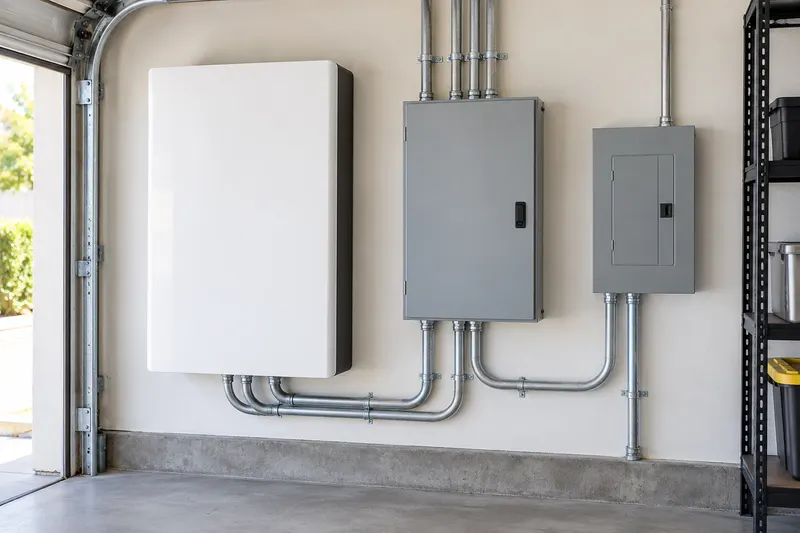
What you are paying for
A home battery quote has two parts. One is the battery hardware, which is the larger part. The other is the electrical work to connect it. The hardware price varies with capacity in kWh, brand and installer, so no SoCal range is given for the whole system. As of October 2026, the electrical side is a desk estimate of $1,500 to $4,000. Treat it as a planning number, not a quote. See the home battery cost page for how it compares.
If you only want power for a few hours, a battery with a critical loads subpanel is the usual setup. If you want long outages covered, a battery plus a generator inlet is common. The generator vs battery guide compares them.
What the electrician does
- Reviews the panel. The panel needs room and enough capacity. An old or full panel may need an upgrade first. See panel upgrades.
- Chooses the connection. Options are a backup subpanel, a whole-home gateway, or an AC-coupled battery tied to existing solar.
- Mounts the unit. Wall brackets or a floor pad, in a spot the code allows.
- Runs the wiring. Conduit, breakers, a disconnect and communications cables.
- Labels and commissions. Required labels go on the panel and battery, and the system is tested.
- Handles permit and inspection. Most cities require both.
Where the battery can go
A 2024 city handout based on the 2022 California Residential Code gives these limits. The 2025 code took effect January 1, 2026, so confirm the current rules locally.
- Allowed: detached garages and accessory structures, attached garages that meet the fire separation rules, outdoor exterior walls at least 3 feet from doors and windows, and enclosed utility spaces with 5/8 inch Type X drywall.
- Not allowed: sleeping rooms and spaces that open into them.
- Each unit has a 20 kWh limit, and the total in each location is capped. For example, 80 kWh inside an attached garage.
- Units need 3 feet between them unless the maker says otherwise.
- Where a vehicle could hit the unit, bollards are required. A unit mounted at least 48 inches above the floor does not need them.
These rules explain why a battery gets mounted on the garage wall at chest height rather than the floor.
Permit and license
The battery is a listed product under UL 1741 or UL 9450 and installed to the maker’s instructions by a qualified person. The permit and inspection are the city’s check. The state contractor board has proposed a rule about which license classes can install storage. Ask for a C-10 electrician or confirm who is doing the electrical connection when a solar company sells the battery. The license guide explains the lookup.
Money back
- Federal credit. The 25D credit ended for property placed in service after December 31, 2025. See federal tax credits status 2026.
- SGIP. The state’s Self-Generation Incentive Program ratepayer budgets closed to new applications at the end of 2025. As of October 29, 2026, the SGIP equity budget is on a waitlist in most areas (SDG&E, LADWP and SoCalGas; SCE’s non-municipal area), with SCE’s municipal-utility area open. Check the program page before relying on it.
- Riverside Public Utilities. Riverside offers $500 per kWh, up to $10,000, for storage bought on or after July 1, 2026, with conditions like a time-of-use rate. It is subject to funds. It applies only in Riverside’s service area.
Other utilities and cities may have their own programs. Use the utility rebate finder for your address.
Before you sign
- Ask for the usable kWh and the continuous kW, not the brand’s headline number.
- Ask whether the quote includes the subpanel, the permit and the inspection.
- Ask what happens if the main panel needs work.
- Ask where the unit goes and which code rule allows it.
If the solar installer that put in the panels has gone out of business, read the solar installer bankrupt guide before adding a battery.
Sizing in plain numbers
Battery size is measured in kilowatt-hours (kWh), which is the amount of energy stored. Power output is in kilowatts (kW), which is how much the battery can supply at once. A fridge uses little energy over a day but a central air conditioner draws several kW whenever it runs. A battery with plenty of kWh and low kW will last long but trip off when you start a big motor.
Write down the loads you want, and ask the electrician to add them up. If the answer is more than one battery can carry, you can add a second unit, cut the list or add a generator inlet as a backup to the backup.
Questions people ask
Where can a home battery go?
Common spots are a garage, an outside wall or a detached structure. The residential code limits indoor locations. A 2024 city handout based on the 2022 California Residential Code allows garages, outdoor walls and enclosed utility spaces with fire-rated walls, and bars bedrooms. Check the 2025 code with your building department before you pick a spot.
Is there a federal tax credit for a home battery?
Not for 2026 installs. The IRS says the residential clean energy credit, 25D, is not available for property placed in service after December 31, 2025. Check with a tax professional about any business or lease options. Some utilities and state programs offer rebates instead, as covered below.
Will a battery run my whole house in an outage?
Sometimes, but usually not for long. Many batteries cannot start large loads such as central air or an electric dryer. Most homes limit backup to essential circuits through a critical loads subpanel so the battery lasts longer. Ask for the continuous watts and the kWh, not just the brand name.
Does the installer need a certain license?
The California contractor board has been working on which license classes can install battery storage. A C-10 electrical contractor is the safe choice because its license covers the electrical work. Confirm the license on the state board lookup, and ask who does the electrical connection if a solar company sells the battery.
Keep reading
Backup power for a Southern California home
Pick the backup setup by outage length and by what must stay on. An interlock or transfer switch lets a…
Critical loads subpanel for a battery or generator
A critical loads subpanel is a small second panel that holds only the circuits you want during an outage…
Solar and battery tie-in at the electrical panel
A tie-in is the wiring that connects solar panels, inverter, battery and your main panel. Owners need it…
How much does a home battery installation cost in Southern California?
The electrical work to connect a home battery is typically $1,500 to $4,000 in SoCal. The battery itself…
Federal tax credits for home electrical work: status in 2026
What each federal credit covered, the dates it ended, who might still claim, and where to look for money…
Generator vs battery backup
A decision guide for outages and wildfire shutoffs: runtime, typical cost, fuel, permits, noise and…
How to verify an electrician's license in California
A five-minute CSLB check: license status, C-10 class, bond, workers' comp, and the contract terms the law…
Send a photo, get a range.
Share your ZIP and a photo of your panel. Your request goes to a licensed partner electrician, who contacts you.
Get this quoteAurion Electric is a referral service operated by Roviq LLC. Electrical work is done by a licensed partner electrician.
