Panel upgrade timeline: permit, meter spot, disconnect, inspection, reconnect
A panel swap takes one day of electrical work, but the whole job runs weeks because the utility and the building department each have a step. The order is meter spot, permit, install, inspection, then the utility reconnects.
A panel upgrade looks like a one-day job from the outside. The electrician’s work is one day. The rest of the timeline is the utility and the building department passing the job back and forth. Knowing the order lets you ask the right question at each step.
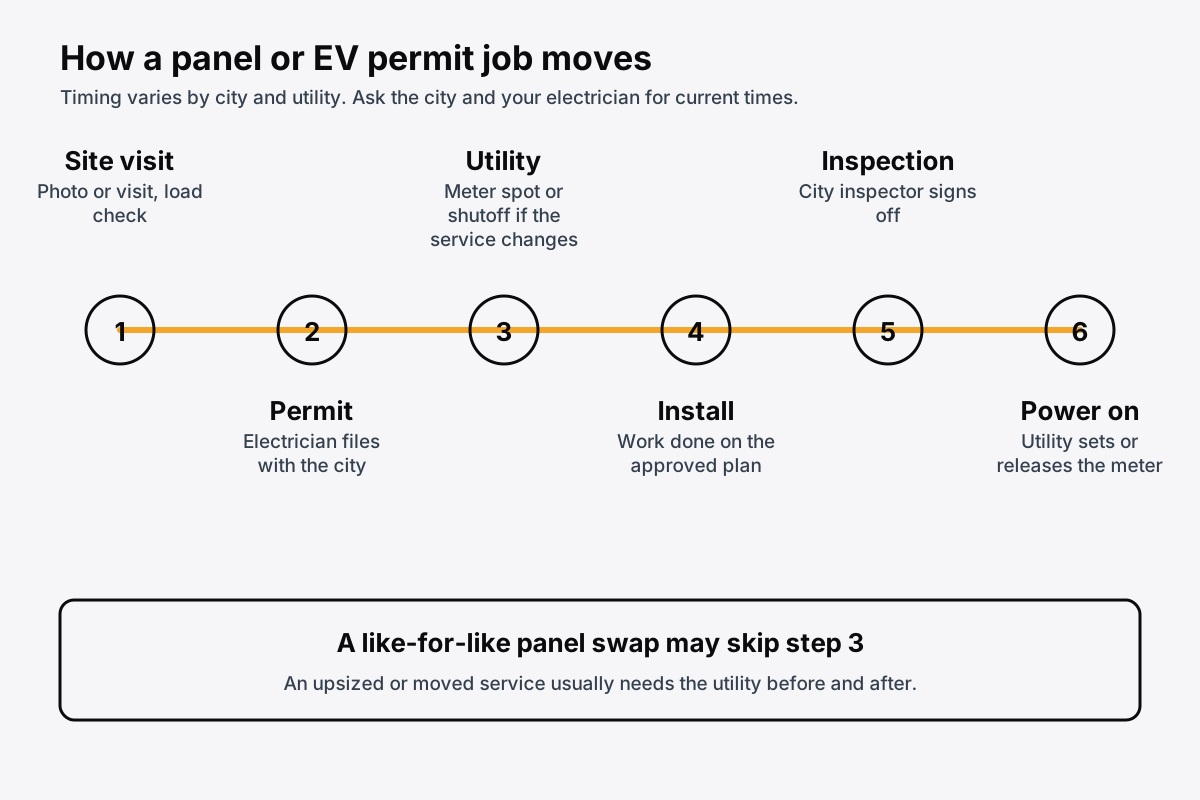
The sequence in plain steps
- Check the load. The electrician adds up what the house runs now and what you plan to add. This decides whether you need a 200-amp swap or a larger service. See load calculations explained for how it works.
- Request a meter spot, if needed. A meter spot is the utility’s sign-off on where the meter and service connection go. You need one when the service size changes or the meter moves.
- Pull the permit. The city or county issues an electrical permit. The permit guide covers who can pull it.
- Schedule the disconnect. The utility cuts power at the meter or pole so the old panel can come out.
- Install. New panel, meter socket if required, breakers, grounding and bonding.
- Inspect. The building inspector checks the work.
- Release and reconnect. The city passes the inspection to the utility, and the utility sets or relocks the meter and restores power.
SCE territory
SCE owns the service wires and meter. Every residential customer gets an allowance toward utility-side work, such as a service wire or transformer, and an SCE Service Planner states the amount for a given address. Panel upgrades and meter spots for an existing service are their own request type, and lockring removal or reinstall goes by phone to 1-800-655-4555 through the account holder.
SCE publishes targets for its own steps in a panel upgrade, and those targets leave out permitting and any other third-party time. The city’s plan check and inspection booking come on top, and a job that changes the service or moves the meter takes longer than a swap in place. Plan for weeks, not days, and ask the Service Planner or your electrician for the date SCE gives you rather than counting on an average.
A city guide from Rancho Palos Verdes says SCE sets and locks the meter within 14 working days after the building department clears the job. Long Beach follows the same rule: SCE sets the meter only after the building department says the work passed. Corona’s city procedure describes a morning disconnect and an afternoon reconnect once the city inspection passes. That pattern comes from city sheets, not from SCE itself.
SDG&E territory
SDG&E has an Express Program for a residential service or panel upgrade up to 400 amps with no added load. The electrician files it in the Builder Services Portal as “Service Upgrade - No Added Load,” puts “Express Program” in the description and attaches photos of the existing panel. The meter panel needs a clear, level work space of 3 feet by 3 feet, and a relocation must stay overhead on the same wall. An underground relocation does not qualify. Jobs that add load or upsize the service line go through SDG&E My Project Center instead, which takes longer.
SDG&E also lists meter socket adapters and load management as ways to add an EV charger without a full panel upgrade. Read more in load management for EV chargers.
LADWP territory
LADWP’s Guide to Electric Service sets an order that differs from SCE’s:
- Get a Meter Spot Sheet from the LADWP Electrical Service Representative before the building inspection.
- The electrician pulls the Los Angeles Department of Building and Safety permit and passes the inspection.
- LADBS electronically sends a release to LADWP. The address, main switch size, phase and voltage on the release must match the permit.
- LADWP inspects, then schedules the meter and any line work.
The guide says to allow several days for the release to reach LADWP. For a single-family service of 320 to 400 amps, LADWP asks for a Residential Service Planning Information Form. See the Los Angeles city page for permit office details.
City-owned utilities differ again
In Burbank, Burbank Water and Power gives a meter spot by email (allow up to 5 business days) that lists any Aid in Construction charges, which BWP says are generally about $500 to $4,000 for typical small upgrades. After the city permit and BWP fees, the electrician calls with the permit number to unlock the meter, and BWP says services are generally connected within 10 business days after final inspection. Anaheim Public Utilities describes a location check within 2 to 3 business days and an energize crew 3 to 5 business days after both inspections. In Pasadena, PWP sets and reconnects the meter, not SCE. See the Burbank page for local detail.
These city-utility steps come from the utilities’ published pages. Confirm the current rule with your utility before you schedule.
Where the time goes
| Step | Who controls it | Typical risk |
|---|---|---|
| Meter spot | Utility | Backlog in busy months |
| Permit | City or county | Plan check if the service grows |
| Install | Electrician | Hidden wiring problems in old panels |
| Inspection | City or county | Booking window |
| Reconnect | Utility | Waits for city release |
Ask the electrician which of these they handle and which you must start yourself. For cost, see the panel upgrade cost page. A meter relocation or new service run raises both cost and timeline, which the meter and service mast page explains.
Questions people ask
How long is the power off during a panel upgrade?
For a panel swap in place, the power is usually off for part of a working day. The electrician plans the disconnect and reconnect around the utility and the inspection. In SCE territory, city procedure sheets describe a morning disconnect and an afternoon reconnect once the inspection passes, but timing is not guaranteed.
What is a meter spot?
A meter spot is the utility's approval of where the meter and service connection will sit. It is needed when the service size changes or the meter moves. Burbank Water and Power says to allow up to 5 business days to receive it by email. Other utilities use a portal or a phone request.
Why can't the electrician just finish the job in one day?
The install can be done in a day. The wait comes from three outside steps: the utility's meter spot, the city's inspection, and the utility's reconnect. Each party runs its own calendar, so the total timeline depends on those handoffs more than on the electrical work.
Do I need to be home for the disconnect?
Usually someone should be reachable, and the electrician needs access to the meter and panel. Riverside Public Utilities says no one has to be home for its meter spot site check. Ask your electrician and utility what access they need for the disconnect and reconnect on your date.
Keep reading
Electrical panel upgrades in Southern California: when and how
A panel upgrade replaces the main breaker box, and most SoCal homes that need one are moving from 60 to…
200 amp panel upgrade: what changes and when you need it
A 200 amp panel upgrade swaps your old main panel for a new one and, usually, the wire from the meter to…
Meter, meter socket and service mast
The mast and meter socket are yours, and the meter and the wires to it belong to the utility. Moving or…
How much do breaker box replacement and electrical panel replacement cost?
Replacing a breaker box with a new electrical panel typically costs $2,500 to $4,500 installed, including…
Electrical permits in Southern California: what needs one and who pulls it
What needs an electrical permit, who pulls it, what the inspector checks, and what happens if the work was…
Who files, who pays and who to call in a service upgrade
The four parties in a panel or service upgrade, what each files, what each pays and what to say when you call.