Smart electrical panels
A smart panel is a main panel with built-in monitoring and remote-controlled breakers. It can cap total load so a home fits more equipment on its existing service, if the inspector and utility accept the setup.
- Code: NEC 750, 220.70, 625.42
- Standard swap range: $2,500 to $4,500
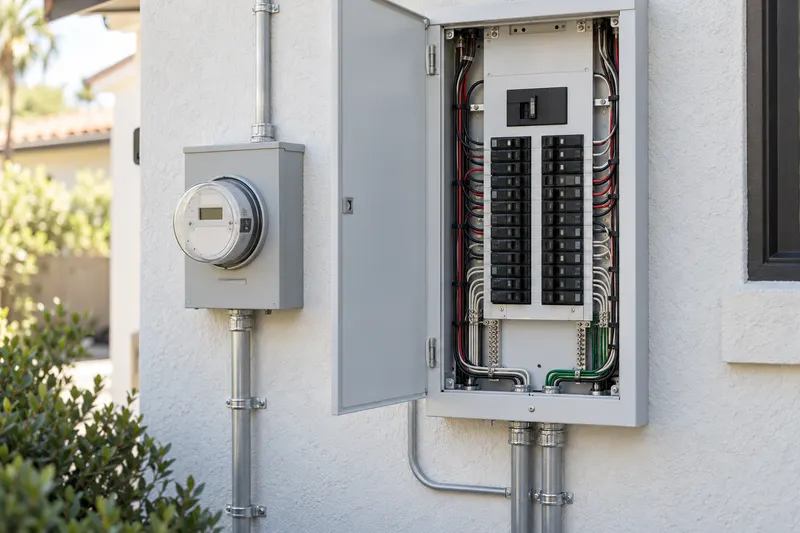
What makes a panel smart
A standard panel is passive. Breakers trip when a circuit overloads, and that is all. A smart panel adds three things:
- Metering on each circuit, so you see what the house uses and when.
- Breakers that can be switched or limited from a controller, locally or by app.
- A programmable limit on total load, which the system enforces by shedding lower-priority circuits.
The third item is the one that matters for the service. If a smart panel guarantees the house never pulls more than a set number of amps, then the electrician can argue the service does not need to be bigger.
How the code treats it
Energy management systems (EMS) have their own article, Article 750, in the 2023 NEC. California’s 2025 Electrical Code took effect January 1, 2026 and is built on the 2023 NEC. Three points matter for homes:
- The system cannot cause an overload. Under 750.30, an EMS must not overload a branch circuit, feeder or service.
- Some loads cannot be shed. Emergency systems, legally required standby systems, critical operations power systems and fire pumps are off the list, and so are some life-safety loads like elevators. Few of these appear in a house.
- The setpoint can count in the calculation. A new section, 220.70, allows the maximum amp setting of an EMS to stand in for the connected load when sizing a feeder or service. Section 625.42 does the same for EV charging load.
The section numbers above are from the 2023 NEC as reported by trade sources, not from the California text, so confirm them with your building department. Whether the setting counts depends on the product being listed for the job, on the way it is installed and on whether the local building department agrees. Interpretation of 625.42 is unsettled among code officials. Treat any promise of “no upgrade needed” as a question for your inspector, and your utility.
Where a smart panel fits
An EV charger on a full 100 amp service. Load management keeps the charger from running at the same time as the dryer and range. See EV charger load management. A charger with its own sharing feature can do part of this without a smart panel.
Battery and solar homes. A smart panel can choose which circuits the battery backs up. See home battery installation.
Tight spaces. Where there is no room for a bigger panel or a trench for new service, a smart panel makes a swap possible at the existing size.
Not a fit. If the load calculation passes 200 amps even with limits, or if the panel is a known problem brand, go for a regular 200 amp panel or 400 amp service.
What to ask before you buy
- Does the product have a listing for use as service or panel equipment?
- Will the city and utility accept the load limit in the plan? Ask for it in writing.
- What does the panel do if its internet connection drops? Local control matters.
- Who sets and labels the limit? The code expects the equipment to carry a marking of the setting.
- Can I override it, and does the override defeat the safety purpose?
- What is the price difference compared with a plain panel of the same size?
Cost
No published SoCal price range covers smart panels, so none is given here. A standard panel swap runs $2,500 to $4,500 as of October 2026, and a smart panel adds equipment cost on top of it. The panel upgrade cost page explains the base range. A smart panel can reduce the cost of a bigger service, but the savings depend on your utility, so compare the two quotes.
Permit
A smart panel installs under the same electrical permit as any panel swap, plus the paperwork the building department wants for the load management plan. Expect to submit the load calculation with the limit shown. The 2025 code changes guide lists other updates, and the load calculation guide explains how the limit enters the math.
Questions people ask
Can a smart panel let me skip a service upgrade?
Sometimes. The 2023 NEC lets an energy management system limit the load on a service, and the limit can be used in the load calculation. Local inspectors and utilities decide whether they accept a given product and setup, so get their answer in writing before you build around it.
Does a smart panel cost more than a normal panel?
Yes. The equipment costs more than a standard main panel, and no published range covers smart panels in SoCal. A standard 100 to 200 amp swap runs $2,500 to $4,500 as of October 2026. Ask for the smart panel as a separate line so you can compare.
What happens to my loads when the panel limits power?
The panel turns off or slows lower-priority circuits, such as an EV charger or water heater, when total demand nears the limit. Safety loads cannot be shed under Article 750. You pick the priorities, and the electrician sets and labels the limit on the equipment.
Do smart panels work during a power outage?
Only with a battery or generator connected. A smart panel by itself does nothing when the grid is down. When paired with a home battery it can choose which circuits stay on. Without storage, it still measures and controls loads, but the whole house goes dark in a shutoff.
Keep reading
Electrical panel upgrades in Southern California: when and how
A panel upgrade replaces the main breaker box, and most SoCal homes that need one are moving from 60 to…
200 amp panel upgrade: what changes and when you need it
A 200 amp panel upgrade swaps your old main panel for a new one and, usually, the wire from the meter to…
EV charger load management and circuit sharing
A load management device lowers the charger's draw when the rest of the house is busy. The code allows the…
Home batteries: what the electrician does and where one can go
The electrician mounts the battery, connects it to the panel or a backup subpanel, and gets it permitted…
Load calculation explained in plain English
The 220.83 method step by step with a worked example for a 1,800 sq ft home, and the 220.87 option based…
2025 California Electrical Code: what changed for homeowners
Which code edition applies in October 2026 and the 2023 NEC changes that most often touch a home project.
How much do breaker box replacement and electrical panel replacement cost?
Replacing a breaker box with a new electrical panel typically costs $2,500 to $4,500 installed, including…
Send a photo, get a range.
Share your ZIP and a photo of your panel. Your request goes to a licensed partner electrician, who contacts you.
Get this quoteAurion Electric is a referral service operated by Roviq LLC. Electrical work is done by a licensed partner electrician.
