How to read your electrical panel
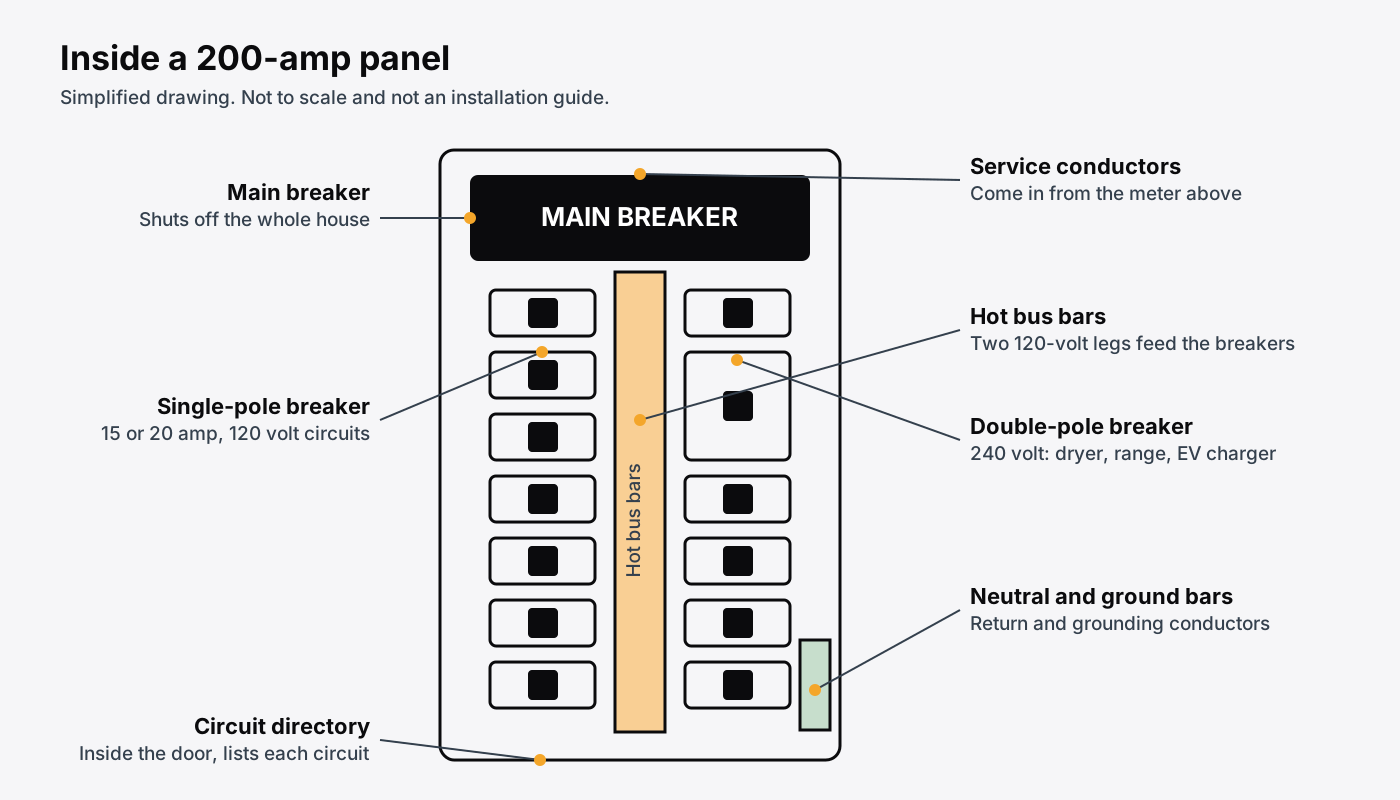
You can learn four things from the outside of your panel: the main breaker size, the panel brand, how many spaces are free and whether the labels are current. Do it with the outer door only. Never remove the metal cover behind the breakers.
Most people have never looked at their panel with the door open. It is worth five minutes. The panel tells you how much power your house can use, who made it and whether there is room for an EV charger or a heat pump.
Safety rules first
- The outer door is safe to open. It hangs on hinges and carries no power.
- The metal sheet behind the door is the dead-front. It is held on by screws, and the bars behind it are live even with the main breaker off, because the wires from the meter feed the top of the panel. Do not remove it.
- Stand on a dry floor. Do not touch the panel with wet hands or a wet floor.
- Keep the space in front clear. The code calls for a clear area at least 30 inches wide and 36 inches deep in front of a panel.
- If you see scorch marks, melted plastic, rust, water or hear buzzing, stop and call an electrician.
Read the main breaker
The main breaker is the biggest one, usually at the top, with a number on the handle: 60, 100, 125, 150 or 200. This is the size of your service. A 100 amp main means the house is limited to 100 amps total. Older homes often have 100 amps or less. Newer homes more often have 200.
Two things can confuse you:
- No main breaker in the panel. The main may be outdoors in a meter-main box, or this is a subpanel fed by another panel.
- Bus rating higher than main. The panel can be built for 225 amps and still have a 200 amp main. The main is the limit.
Find the label and the brand
Inside the door or on the side wall there is a sticker with the brand, model number, voltage and a maximum amp rating. Common names are Square D, Eaton, Siemens, Cutler-Hammer, GE, Murray and Leviton. Two older brands matter for safety: Zinsco and Federal Pacific (Stab-Lok). Electricians commonly replace both. A federal review in 1983 found Federal Pacific breakers failed some lab tests, and Zinsco breakers are reported to overheat. If your label says either one, read about Zinsco and Federal Pacific panels and plan a replacement.
The label also lists which breaker types the panel accepts. Breakers are not interchangeable between brands, and a wrong one can overheat at the bus.
Count the spaces
A residential panel is built with a set number of spaces, often 20 to 40. Count the slots that are empty or covered by a small plate. Each 120-volt circuit uses one space. Each 240-volt circuit, such as a dryer, range or EV charger, uses two.
“Tandem” or “twin” breakers fit two circuits in one space, but only where the panel label allows them. If every space is used, you may still have power left. That is a job for a load calculation, and the fix may be a subpanel rather than a new panel.
Check the directory
The directory is the paper list of what each breaker feeds. An out-of-date one is common. Look for “kitchen,” “dryer,” “AC” and any breaker with no label. Unknown circuits are worth tracing before a project, because an electrician needs to know what is on each breaker.
Also look at the handles. A breaker in the middle position has tripped. If one trips repeatedly, see breaker keeps tripping.
What to photograph
Take clear photos of:
- the open door with all breakers visible
- the label and any model number
- the meter and the wall around the panel
- the garage or yard wall where a charger or new circuit would go
These photos let an electrician judge a job before a visit. See how to prepare for the electrician visit.
When reading the panel means a bigger job
| What you saw | What it may mean |
|---|---|
| 60 or 100 amp main with electric heat or dryer | A load calculation, then maybe a 200 amp upgrade |
| Zinsco or Federal Pacific label | Replace the panel |
| No free spaces | Subpanel or swapped breakers |
| Scorch, rust or buzzing | Stop, call an electrician now |
As of October 2026, a typical SoCal 200 amp panel swap runs $2,500 to $4,500. Start at the panel upgrades hub if your panel is the limit.
Questions people ask
Is it safe to open my electrical panel door?
Yes, the outer door is made to be opened. It is hinged and has no live parts on it. The metal cover behind it, called the dead-front, is not made for homeowners. It is held by screws and hides live bus bars that can kill. Read the breakers and labels, and leave the cover to a licensed electrician.
How do I know if I have a 100 amp or 200 amp panel?
Read the number on the main breaker handle. It is the biggest breaker, usually at the top, and says 100, 125, 150 or 200. If there is no main breaker in the panel, it may be in a meter-main combination outdoors, or the panel may be a subpanel fed from another box.
What does it mean if my panel is full?
It means there are no empty breaker spaces left. That does not always mean the panel is out of power. A full panel can still have electrical capacity, and an electrician can often add spaces with a subpanel or by swapping breakers. A load calculation tells you which one applies.
Can I just add a breaker myself?
Adding a breaker means working inside the live panel and often requires a permit, so it is a job for a licensed electrician. The breaker must also be the type the panel is listed for. A wrong or loose breaker can overheat. Photograph the panel and ask an electrician what fits.
Keep reading
Electrical panel upgrades in Southern California: when and how
A panel upgrade replaces the main breaker box, and most SoCal homes that need one are moving from 60 to…
Zinsco and Federal Pacific panels: how to spot one and what to do
If your panel says Zinsco, Sylvania or Federal Pacific, or has Stab-Lok breakers, have an electrician look…
200 amp panel upgrade: what changes and when you need it
A 200 amp panel upgrade swaps your old main panel for a new one and, usually, the wire from the meter to…
Load calculation explained in plain English
The 220.83 method step by step with a worked example for a 1,800 sq ft home, and the 220.87 option based…
Subpanel installation: when it fits and how it is wired
A subpanel is a second breaker box fed from your main panel, and it adds circuit space for a garage, ADU…
How to prepare for the electrician's visit
A ten-minute checklist: panel photos, clear work space, utility data, appliance list, HOA papers and the…
Why your breaker keeps tripping
A breaker trips to stop too much current. The cause is an overload, a short circuit, a ground fault or a…