Outdoor and detached garage EV charger installs
A charger on an outside wall or in a detached garage needs weather-rated gear, ground-fault protection and a protected wire run from the main panel. A subpanel is often the cleanest answer.
- Run type: Conduit or trench
- Protection: GFCI per NEC 210.8
- Common fix: Garage subpanel
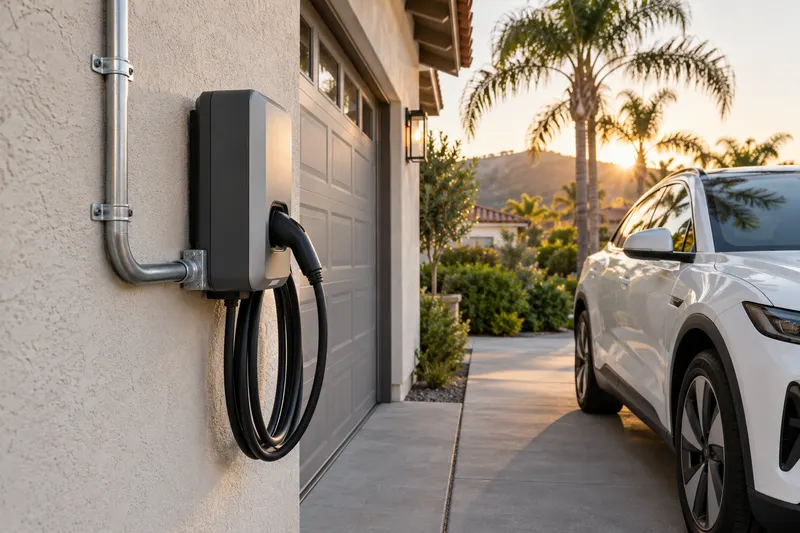
What changes when the charger is not in the house garage
Inside an attached garage the run to the panel is short and dry. Outside, the electrician has to deal with weather, distance and soil. Each adds a line to the quote.
Weatherproof gear
Pick a charger listed for outdoor use. Check the enclosure rating on its label and the manual. Tesla’s installation manual, as one example, calls for watertight fittings where the feeder wires enter the wirebox. Sun, salt air near the coast and sprinklers all test the seals, so mount the unit above splash height and away from spray heads.
GFCI and code points
- NEC 625.40 requires each charging outlet to be on its own branch circuit, with limited exceptions.
- NEC 625.42 treats EV charging as a continuous load, so the circuit is sized at 125 percent of the charger.
- NEC 210.8 requires ground-fault protection on many outdoor outlets at dwellings. How that applies to a hardwired charger depends on the code edition and the amp rating, so the electrician checks the edition your city enforces.
- NEC 625.54 adds ground-fault protection for receptacles that feed EV chargers.
Ask the electrician which edition applies and whether the charger has built-in protection that the inspector accepts. Do not guess; the inspector decides.
Running the wire
| Route | How it works | What drives cost |
|---|---|---|
| Surface conduit along a wall | Metal or PVC conduit on stucco or siding | Distance, number of turns, paint or patching |
| Attic or crawlspace | Cable in framing, then conduit outside | Access, insulation, fire blocking |
| Trench to a detached garage | Conduit buried to the depth in NEC Table 300.5 | Length, concrete or pavers, landscaping, utilities |
Trenching can double the labor on a job. Call 811 before anyone digs so underground lines are marked. A trench under a driveway may mean saw-cutting concrete, and under a patio may mean lifting pavers.
Feeder, subpanel or direct circuit
For a detached garage there are two usual layouts.
- Direct circuit. One run from the main panel to the charger. Good when the charger is the only load and the distance is short.
- Feeder to a subpanel. One larger run to a subpanel in the garage, then short circuits for the charger, lights and outlets. Good when you want more than one load or a second charger later. See the subpanel installation page.
A detached building normally needs its own disconnect where the feeder arrives, and the grounding rules differ from an attached garage. The electrician follows the code for the building.
Large vehicles and long driveways
Trucks and SUVs, including the Rivian R1T and R1S, often park outside, so these installs come up often. The Rivian page covers the 24 foot cord and the 60 amp circuit.
Permit and inspection
A new feeder to a detached building and a new charger circuit are both permitted work. The city may inspect the trench before it is covered, the subpanel and the final. Read the permit guide to see how Southern California cities handle it.
What it costs
As of October 2026, the typical SoCal range for a Level 2 install is $1,000 to $2,000. Outdoor and detached-garage jobs usually fall at the top or above it, because of the trench, conduit and subpanel. If the main panel also needs work, the combined range is about $3,600 to $7,500. Ask for trenching, subpanel and charger circuit as three separate lines, and check the load calculation first so you know the main panel can feed the new load.
Planning checklist
- Measure the straight-line distance from the main panel to the charger spot, then ask the electrician for the real route.
- Note what is on the route: stucco, concrete, tree roots, irrigation, pavers.
- Decide on the mount: wall, post or pedestal.
- Ask whether the run passes under a driveway that carries vehicles.
- Confirm where the feeder will enter the detached building and where the disconnect will go.
- Ask for the permit and the inspection list in writing.
Short runs on a back wall often take a day. Trenches and subpanels add days and a second inspection.
Questions people ask
Can an EV charger be mounted outside in the rain?
Yes, if it is rated for outdoor use. Look for a weatherproof enclosure rating on the label, and use watertight fittings where wire enters the box. Tesla's manual, for example, calls for watertight fittings on outdoor installs. A listed outdoor charger can sit on a driveway wall in California weather.
Do I need a subpanel for a detached garage?
Often, yes. A detached garage needs a feeder from the house, and a subpanel there gives you a disconnect and room for the charger plus lights and outlets. For a single charger with no other loads, the electrician may run a direct circuit instead. The right choice depends on distance, load and the city.
How deep does the conduit have to be buried?
It depends on the wiring method and whether the ground is under a driveway. NEC Table 300.5 sets minimum cover depths, and the electrician picks the depth from the table for the conduit type. Rigid metal and some PVC need less depth than direct-buried cable. Your inspector checks it before the trench is closed.
Does the charger itself need GFCI protection?
Sometimes. NEC 210.8 requires ground-fault protection on many outdoor outlets at homes, and NEC 625.54 requires it for receptacles that supply EV chargers. The rules for hardwired chargers have shifted between code editions, so the electrician follows the edition your city enforces and the charger maker's instructions.
Keep reading
Home EV charger installation: circuit, panel and permit
A home Level 2 charger runs on its own 240 volt circuit, usually 40 to 60 amps. Whether the panel has room…
Subpanel installation: when it fits and how it is wired
A subpanel is a second breaker box fed from your main panel, and it adds circuit space for a garage, ADU…
Home charging for a Rivian R1T or R1S
Rivian's own Wall Charger is rated 48 amps and 11.5 kW on 240 volts. That points to a hardwired charger on…
EV charger load calculation
Before a charger goes in, the electrician adds up your home's electrical load and checks that a new…
How much does it cost to install a Level 2 EV charger at home?
A Level 2 EV charger install in Southern California typically costs $1,000 to $2,000 for the new 240-volt…
Electrical permits in Southern California: what needs one and who pulls it
What needs an electrical permit, who pulls it, what the inspector checks, and what happens if the work was…
Send a photo, get a range.
Share your ZIP and a photo of your panel. Your request goes to a licensed partner electrician, who contacts you.
Get this quoteAurion Electric is a referral service operated by Roviq LLC. Electrical work is done by a licensed partner electrician.
