ADU electrical requirements
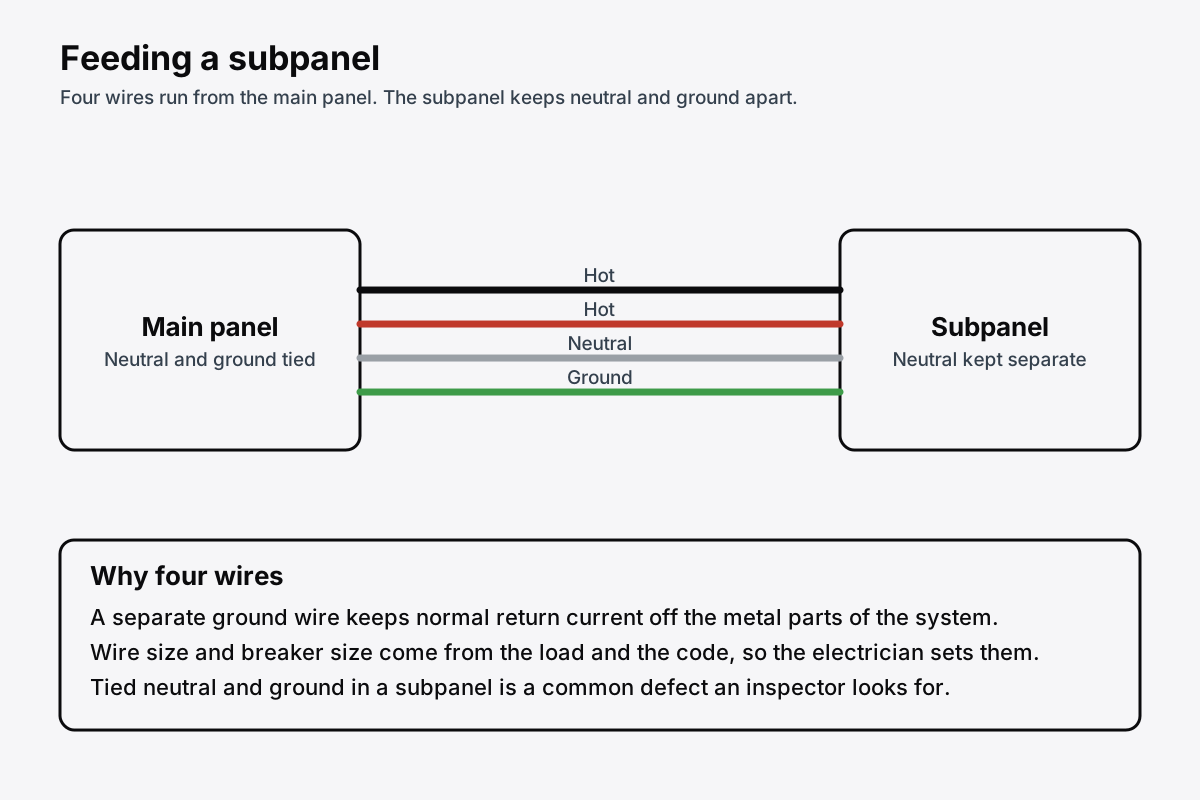
Every ADU needs its own panel, sized by a load calculation, and a feeder from the main house or a new service. A separate utility meter is often a choice, not a state requirement, but your city and utility have the final word.
Plan the electrical before you pour the slab. A garage conversion and a backyard cottage look different on paper, but the electrical questions are the same: how much load, where does power come from, and who is billed.
Start with the total load
An ADU is a second dwelling. It brings a kitchen, a water heater, heating and cooling, and often a charger or a laundry pair. A licensed electrician adds those loads to the main house on a load calculation and compares the total with the service size. The load calculation guide shows the math in plain words. If the total fits inside the service, a subpanel is enough. If not, the main service goes up first. A 200 amp swap is the common step, and the 200 amp upgrade page covers it.
Los Altos puts it simply in its ADU FAQ: utilities have to be sized to meet the added load. That is true everywhere, not just there.
Three layouts
| Layout | What it needs |
|---|---|
| Garage or room conversion inside the house | A subpanel in or near the unit, fed from the main panel. Often no new utility connection |
| Detached cottage | A feeder trench or overhead run, a subpanel, and a disconnect at the main building where the code asks for one |
| Detached with its own meter | A new service from the utility, a meter socket, a main panel, and utility paperwork |
The meter decision
California ADU rules say a utility connection can be required for new detached units but not for conversions inside existing space. HCD has written that an ADU inside an existing home or accessory structure should not be forced into a separate direct connection, and local codes repeat that idea. In practice, a separate electric meter is often optional. Moreno Valley, for example, says one is not required but is recommended if you want separate bills.
Why choose one? A separate meter lets a tenant or a family member pay their own usage. Why skip it? A new service means a new meter socket, utility fees, longer lead time, and in some places a trench. Ask the city, then the utility. The utility coordination guide lays out who does what in SCE, SDG&E and LADWP areas.
Feeder size and route
The feeder is the wire between the main building and the ADU subpanel. Its size follows the ADU load from the calculation, not a rule of thumb. The number depends on the appliances, the heating and the length of the run. A longer run can need a larger wire to keep voltage drop in check. An electrician also checks depth, conduit type and clearances for the trench route, and calls for inspection before it is backfilled. If you can, keep the ADU close to the existing panel.
Plan for the loads you may add later
A new ADU is the cheapest time to run heavy circuits. Consider:
- a 240-volt circuit for an EV charger, see the EV charger hub
- a dedicated circuit for a heat pump or heat pump water heater
- a spare conduit to a future battery or subpanel
- space in the panel for added breakers
Adding them later means opening finished walls and possibly upsizing the service twice.
Permits and utility steps
The ADU electrical is part of the building permit set, with its own electrical plan and inspections. Panel rough-in is inspected before drywall. Final inspection happens before the unit is occupied. If you add a meter or upsize the service, the utility has its own steps. In SDG&E territory a service upgrade up to 400 amps with no added load can use its Express Program, and it asks for a clear 3 ft by 3 ft work space at the meter. In LADWP territory, the electrician starts with a Meter Spot Sheet from LADWP before the city inspection. See the permits guide.
Typical cost
As of October 2026, a typical SoCal range for ADU electrical (subpanel, feeder and circuits) is about $1,500 to $8,000. This is a desk estimate. The ADU electrical cost page lists the factors. A separate meter, a trench, stucco repair and a main panel upgrade move you toward the top. A subpanel alone in a garage conversion can sit near the low end.
For the broader picture of remodels, the ADU and remodel electrical hub links to every related service.
Questions people ask
Does an ADU need its own electric meter?
Not always. Cities such as Moreno Valley say a separate meter is not required but is recommended if you want separate bills. Local rules and utility rules differ, and a detached unit may be treated differently from a conversion. Ask your building department and your utility before you design the feeder.
Can my existing 100 amp panel feed an ADU?
Often not. A new unit adds its own range, water heater, heating and cooling, and maybe an EV charger. An electrician runs a load calculation on the whole property. If the total passes 100 amps, the main service needs to go up, commonly to 200 amps, before a subpanel in the ADU is added.
Do ADU wires have to be underground?
A detached ADU needs a feeder from the main house or the meter, and that run is usually in conduit underground or on the building. The route, depth and any overhead clearances come from the electrical code and your utility. A trench adds cost, so plan the shortest path before you site the ADU.
How much does ADU electrical work cost?
As of October 2026, a typical SoCal range for a subpanel, feeder and circuits is about $1,500 to $8,000. This is a desk estimate, not a quote. A trench, a long run, a new meter or a main service upgrade moves the price to the high end. Get itemized bids.
Keep reading
ADU and remodel electrical work
Most ADUs get power from a subpanel fed by the main house panel, and a load calculation sets its size. A…
How much does ADU electrical work cost?
Electrical work for an accessory dwelling unit typically costs $1,500 to $8,000 in SoCal, an estimate for…
Subpanel installation: when it fits and how it is wired
A subpanel is a second breaker box fed from your main panel, and it adds circuit space for a garage, ADU…
Load calculation explained in plain English
The 220.83 method step by step with a worked example for a 1,800 sq ft home, and the 220.87 option based…
200 amp panel upgrade: what changes and when you need it
A 200 amp panel upgrade swaps your old main panel for a new one and, usually, the wire from the meter to…
Who files, who pays and who to call in a service upgrade
The four parties in a panel or service upgrade, what each files, what each pays and what to say when you call.
Electrical permits in Southern California: what needs one and who pulls it
What needs an electrical permit, who pulls it, what the inspector checks, and what happens if the work was…