Whole-home surge protection
A whole-home surge protector mounts at your panel and clamps voltage spikes before they reach your outlets. Since January 1, 2023, California's code has required one on any new or replaced dwelling service.
- Code section: NEC 230.67
- Device types: Type 1 or Type 2
- Typical range: $200 to $800
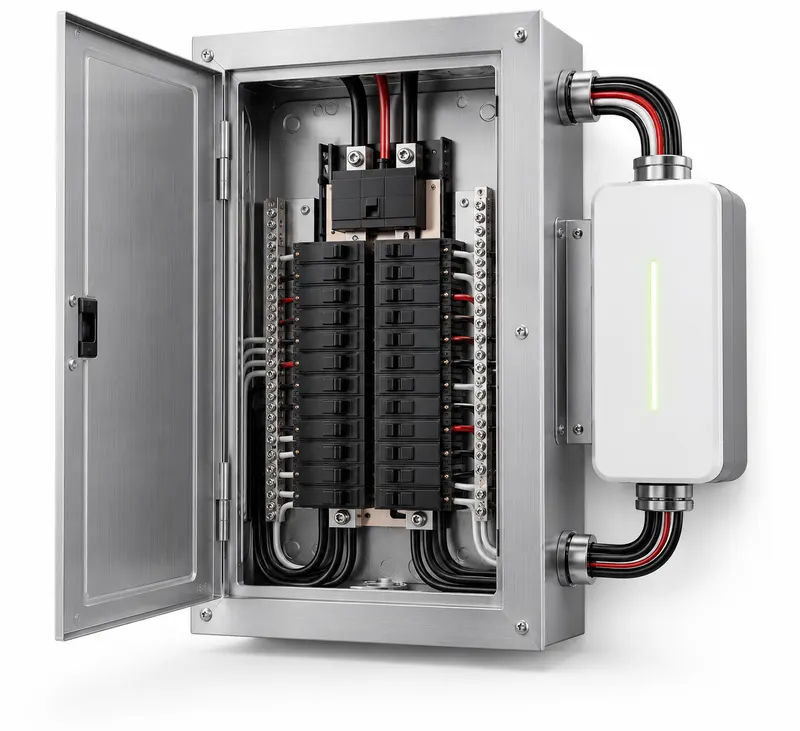
The rule
NEC section 230.67 says all services supplying dwelling units must have a surge protective device (SPD). Three details decide most real jobs:
- Type. The device must be Type 1 or Type 2. Both are hardwired into the electrical system. Plug-in strips do not count.
- Location. The SPD is part of the service equipment or sits immediately adjacent to it. An exception lets it go at the next downstream distribution equipment instead.
- When it applies. It covers new services and replaced service equipment. The 2023 NEC text, as summarized by IAEI Magazine, applies it to all services and replacements of service equipment.
A home with an older panel that is not being replaced does not trigger the rule. But a panel swap does, which is why a 200 amp panel upgrade includes one.
Which code edition applies
Check the edition, because both of these are true on the same day.
2022 California Electrical Code. Based on the 2020 NEC, it put 230.67 into force in California on January 1, 2023, along with the outdoor emergency disconnect in 230.85.
2025 California Electrical Code. Effective January 1, 2026 and based on the 2023 NEC. The 2023 NEC widened 230.67 from dwelling units to also cover dormitory units, hotel and motel guest rooms and suites, and nursing home patient sleeping rooms. For a single-family house nothing about the main requirement changed. A city may adopt local amendments, and a state pause on new residential building standards is in effect (AB 130), so ask your building department if you have a question about a specific rule.
The section numbers here follow the NEC and the 2022 California memo above, so confirm the 2025 California wording with your building department.
What a whole-home device does
Voltage spikes come from the utility grid, from nearby lightning and from large motors switching inside the house, such as an air conditioner compressor. A panel-mounted SPD gives the spike a path to ground before it spreads through the wiring. It reduces the stress on televisions, computers, appliance boards, EV chargers and heat pumps.
It does not stop everything. It cannot promise to survive a direct strike, and it does not clean up voltage that stays high or low for long periods. Pair it with point-of-use strips for sensitive gear if you want a second stage.
Type 1 or Type 2
| Type 1 | Type 2 | |
|---|---|---|
| Where | Ahead of the main breaker, at the service entrance | After the main breaker, at the panel |
| Protects against | External surges and lightning | Internal surges and indirect lightning |
Some new panels come with the SPD built in. For others, the electrician adds a stand-alone unit next to the panel and wires it to a breaker. Your electrician picks the type, and the inspector checks the label.
Cost
The typical SoCal range for a panel-mounted device, installed, is $200 to $800 as of October 2026. That figure is from Angi’s HomeAdvisor-sourced page, and a different Angi article shows $70 to $700, so quotes vary. The price rises with the device rating, with a hard-to-reach panel, and with a panel that needs a new breaker space. When the SPD comes with a panel swap, it is part of the job. See the surge protector cost page and the panel upgrade cost page.
Adding one to an older panel
Nothing in 230.67 forces you to add one to a panel that stays in place. It is still a reasonable add-on, especially in homes with a heat pump, an EV charger, a home office or a lot of electronics. The electrician checks that the panel has room, that the grounding is in good shape, and that the device has a rating that fits your service. A device that sits next to a Zinsco or Federal Pacific panel does not fix those panels, since replacing the panel is the usual advice.
During a panel upgrade
If you are replacing the panel, ask whether the quote lists a Type 1 or Type 2 SPD by name. The inspector expects to see it. The permit and inspection page covers the other checks, and the 2025 code changes guide lists the rest of what changed.
Reading the status light
Most devices show a green light when protection is active. A red or dark light means the protection modules have worn out or the unit lost power, and the device needs replacing. Check it after storms, and note its location when you read your panel with the panel reading guide.
Questions people ask
Is a surge protector required when I replace my panel?
Yes. Under section 230.67, all services supplying dwelling units need a Type 1 or Type 2 surge protective device, and the rule covers replaced service equipment as well as new services. California's 2022 code enforced this from January 1, 2023. If your panel swap skips it, the inspector can hold the job.
Do I need a whole-home surge protector if I already use power strips?
They do different jobs. A plug-in strip protects what is plugged into it, from surges that come through the outlet. A whole-home device cuts down large spikes at the panel, so every circuit gets some protection, including hardwired items like a heat pump or EV charger. Many homes use both.
Will a surge protector stop damage from a direct lightning strike?
No device can promise that. A direct strike carries far more energy than a residential surge protector is designed for. What the device does is limit the smaller spikes that arrive on the wires from utility switching and nearby strikes. It also protects the electronics that use sensitive circuit boards.
How long does a whole-home surge protector last?
It wears down with each surge it absorbs, so there is no fixed lifespan. Most models have a status light that shows when protection is lost, and some also send an alert. Check the light a couple of times a year and after a major storm. Replace the unit if the light shows a fault.
Keep reading
How much does a whole-home surge protector cost?
A whole-home surge protector typically costs $200 to $800 installed in SoCal as of October 2026. One cost…
Electrical panel upgrades in Southern California: when and how
A panel upgrade replaces the main breaker box, and most SoCal homes that need one are moving from 60 to…
200 amp panel upgrade: what changes and when you need it
A 200 amp panel upgrade swaps your old main panel for a new one and, usually, the wire from the meter to…
Panel upgrade permit and inspection
A panel upgrade needs a city electrical permit and a passed inspection before the utility reconnects…
2025 California Electrical Code: what changed for homeowners
Which code edition applies in October 2026 and the 2023 NEC changes that most often touch a home project.
How to read your electrical panel
A safe five-step read of your panel: main breaker, label, brand, free spaces and directory, plus when to…
Send a photo, get a range.
Share your ZIP and a photo of your panel. Your request goes to a licensed partner electrician, who contacts you.
Get this quoteAurion Electric is a referral service operated by Roviq LLC. Electrical work is done by a licensed partner electrician.
