Flickering lights: harmless, annoying or dangerous?
One flickering bulb is usually the bulb or the dimmer. Lights that flicker across several rooms, flicker with a burning smell, or dim when the AC starts point to a loose connection or a service problem.
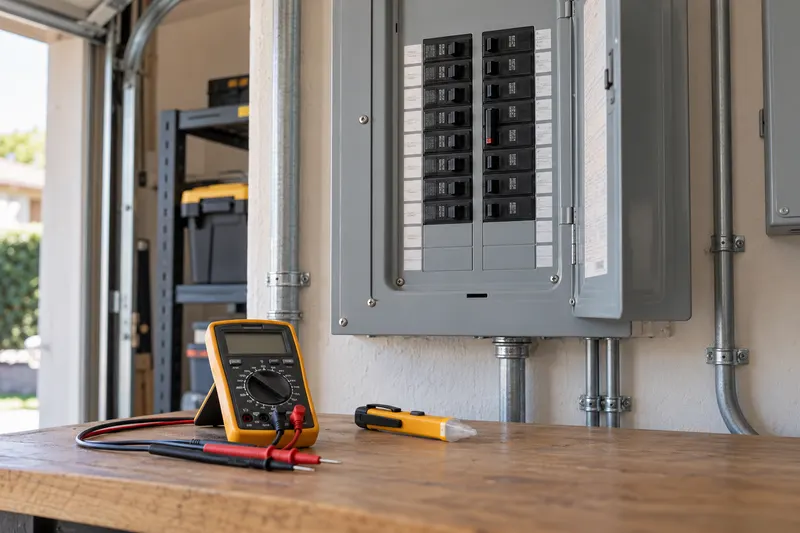
Where does the flicker show up?
The pattern tells you more than the symptom. Before touching anything, answer these:
- One bulb or one fixture. Almost always a loose or failing bulb, a bad socket or a fixture problem.
- One room or one circuit. A loose wire connection on that circuit, a bad switch or a bad dimmer.
- Whole house, all lights. A service-level problem, such as a loose neutral at the panel or meter. This can also damage electronics, so treat it as urgent.
- Only when a big appliance starts. Voltage drop from a surge. Often a normal dip, but a strong dip means a connection or wire size issue.
Safety: when to shut it off
Turn off the breaker for the affected circuit and call an electrician if a flickering light comes with any of these:
- A burning smell
- A hot switch, dimmer or ceiling fixture
- Buzzing, sizzling or crackling
- Brown or black marks on a plate or around a fixture
- Lights that go very bright and then dim
Bright then dim at the same time across the house can mean a failed neutral connection. That sends the wrong voltage to some outlets and can destroy electronics within seconds. If you see it, turn off the main breaker. Call your utility if the problem might be at the meter or service lines, and call an electrician for the inside of the house.
Bulbs, sockets and fixtures first
The cheapest checks come first. Turn off the switch. Let the bulb cool, and screw it in firmly. Try a new bulb of the right type. If you use LEDs in an enclosed fixture, heat can make them flicker. Check the box for “enclosed fixture rated.” If a new bulb still flickers, the socket tabs may be worn or dirty, or the fixture may have a loose wire at the ceiling box.
Dimmers and LED bulbs
A common cause of flicker now is an old dimmer paired with LED bulbs. Dimmers made for incandescent bulbs expect a high load. LEDs draw so little that the dimmer cannot hold a steady output. The fixes are an LED-rated dimmer, a dimmable bulb, or both. A dimmer with a minimum load adjustment helps if the room has only one or two bulbs. The smart switches and dimmers page covers what to buy and why older boxes sometimes limit the choice.
Cheap non-dimmable LED bulbs on a dimmer will buzz or flicker no matter what dimmer you use. Check the bulb box.
Loose connections inside the house
A loose wire can flicker without tripping a breaker. Typical places are:
- Switch and outlet terminals. Many outlets and switches use push-in “backstab” holes. Over time they can loosen.
- Wire nuts in ceiling boxes. Old or poorly twisted splices work loose with house vibration or heat cycles.
- Panel lugs and breakers. A loose connection at the panel can flicker one circuit or many.
Loose connections create heat. Over months the insulation browns, and an arc can start. This is why a flicker that does not go away is worth a visit. The hot or burning-smell outlet page shows the signs that it has gone further.
Service and utility causes
Flicker across the house when the AC, dryer or oven starts can be voltage drop on the service. Causes include an undersized or aging service wire, corrosion at the meter socket or a loose neutral at the service mast. These are not DIY jobs. The utility owns its lines and meter, and the electrician owns the equipment on your side of the meter. The meter and service mast page explains where that line is.
A loose neutral is a real hazard. Signs are lights that get brighter and dimmer as other loads cycle, a tingle from a metal appliance or sudden failure of electronics.
What the electrician will do and what it costs
The electrician starts with questions: which lights, when, and how often. They test voltage at the panel and at an affected outlet, with and without a load. They check connections at the dimmer, the box and the panel. If the fault is a bad dimmer, they replace it. If it is a loose splice, they remake it. If it is a service-level issue, they say whether the utility or an electrician should handle it.
As of October 2026, a typical SoCal flat-rate repair runs about $185 to $575, and Fixr’s national guide lists a service call at $176 to $327. The electrician service call cost page shows what shapes the number. An old dimmer swap is at the low end. Finding a loose splice in a closed ceiling takes longer.
Flickering together with tripping is covered on the breaker keeps tripping page.
Questions people ask
Why do my LED lights flicker when I use a dimmer?
Most older dimmers were made for incandescent bulbs and do not work smoothly with LEDs. The bulb and the dimmer must be rated to work together. Look for an LED-rated dimmer and bulbs that list dimming on the box. Replacing the dimmer with an LED-compatible one usually fixes it, and the low-load setting on many dimmers can be adjusted.
Why do lights dim when the AC or a dryer starts?
Big motors pull a surge of current when they start. A brief dip is normal on a loaded circuit. A strong or long dip, or dimming all over the house, points to a loose connection, an undersized wire or a weak service. An electrician can measure voltage drop at the panel while the motor starts.
Can flickering lights start a fire?
They can, if the cause is a loose or arcing connection. Heat builds at the loose spot. A flicker with a hot switch, a buzzing sound or a burning smell is a fire risk. Turn off the breaker for that circuit and call an electrician. A flicker from a worn bulb or incompatible dimmer is not a fire risk.
Does the electric company fix flickering lights?
The utility is responsible for its lines up to the meter. If the whole house flickers at once, or your neighbors see it too, call your utility. If only some lights flicker, the cause is usually inside the house. A neutral wire problem at the meter or service mast can look like both, so an electrician can help sort it out.
Keep reading
Electrical repair: what to check, what to shut off, and when to call
Most electrical repairs are small, but a hot outlet, a burning smell or a breaker that will not stay on…
Why your breaker keeps tripping
A breaker trips to stop too much current. The cause is an overload, a short circuit, a ground fault or a…
Hot outlet or burning smell: act first, diagnose later
Turn off the breaker for that room now. If you cannot tell which breaker it is, or you see smoke, turn off…
Smart switches and dimmers: what your wall box can handle
Most smart switches need a neutral (white) wire in the switch box. Many homes built before the 1980s do…
Meter, meter socket and service mast
The mast and meter socket are yours, and the meter and the wires to it belong to the utility. Moving or…
Electrical emergency: what to do first and who to call
If you see fire, smoke or sparks, get out and call 911. If the danger is contained and the power is off…
What does an electrician service call cost?
A typical flat-rate electrical repair in SoCal runs $185 to $575 as of October 2026. Some electricians…
Power out in part of the house
If some rooms are dark and others work, check whether neighbors have power, then reset any tripped GFCI or…
Send a photo, get a range.
Share your ZIP and a photo of your panel. Your request goes to a licensed partner electrician, who contacts you.
Get this quoteAurion Electric is a referral service operated by Roviq LLC. Electrical work is done by a licensed partner electrician.
