Power out in part of the house
If some rooms are dark and others work, check whether neighbors have power, then reset any tripped GFCI or breaker. If lights are dim in one area and bright in another, or anything smells hot, stop and call for help.
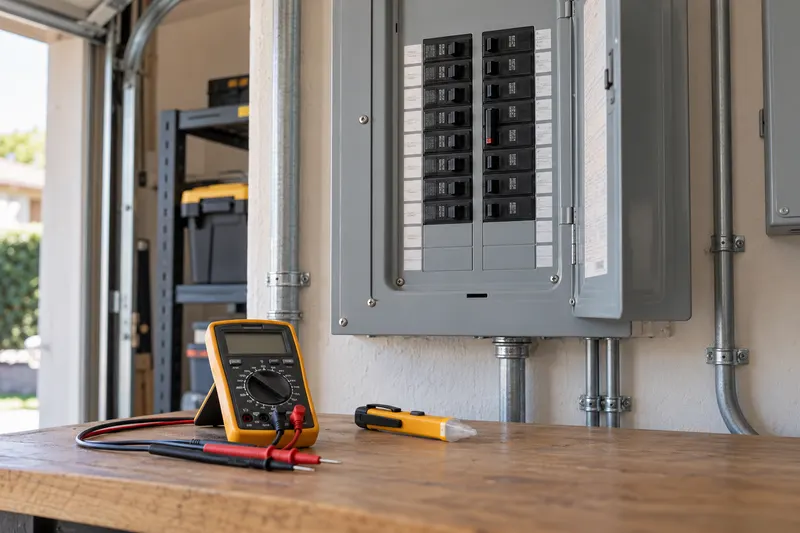
Stop first if you notice any of these
Do not troubleshoot. Leave the area and call for help if you see or smell:
- A burning or rubbery smell
- Buzzing, crackling or sparks from an outlet, switch or the panel
- A hot or discolored outlet, switch plate or panel door
- Water near the panel, outlets or meter
- Smoke, which means call 911
SCE says to call 911 for electrical equipment that is on fire, smoking or sparking, and never to put water on an electrical fire. NFPA lists warm or discolored outlets, a burning smell, sparks and dimming or flickering lights as reasons to call a qualified electrician. The emergency electrician page explains who to call and what to do while you wait.
Step 1: Is it your home only?
SCE asks customers to check whether neighbors’ lights are off too before they call. That tells you if the cause is on the street or in your house. If the whole block is dark, report it to your utility and wait. If your neighbors have power and part of your home does not, keep going.
Also note which parts are dead. A pattern helps the electrician. Is it one wing of the house, one floor, the kitchen, the garage? Do the big 240-volt appliances, such as the range, dryer or air conditioner, still work?
Step 2: Reset every GFCI
One GFCI outlet can cut power to other outlets after it on the same circuit. NFPA says homes should have GFCIs in the kitchen, bathrooms, laundry, basement, garage and outdoor areas. A tripped one is often hidden: look in the garage, on the outside wall, in a bathroom and behind a shelf. Press RESET on each. If one will not reset, or trips right away, leave it and see the outlet not working page.
Step 3: Look at the panel
SCE’s steps for a tripped breaker, in short:
- Turn off the light switches and unplug appliances in the rooms that lost power.
- Open the panel door and look for a breaker in the off position or in the middle position.
- Push it fully to off, then back to on. Use one hand and stand to the side, in case of arcing.
If the breaker trips again, SCE says the cause may be too many devices, a damaged cord or plug, a short in a fixture or outlet, or faulty wiring. Reset it only after the problem is fixed, and call an electrician if it keeps tripping. The breaker keeps tripping page covers that case.
Do not open the cover that hides the wires inside the panel. Only touch the breaker handles.
Step 4: AFCI breakers and shared circuits
Two things can make a dead area confusing.
AFCI breakers. An arc-fault breaker shuts off a circuit when it detects dangerous arcing. NFPA recommends AFCIs and says to test AFCIs and GFCIs once a month. If one trips for no clear reason, the wiring or a cord on that circuit may be at fault. The GFCI and AFCI page explains the difference.
Shared circuits. In older homes, a single breaker can feed outlets in more than one room, so the dead area may not match your idea of the room layout. Plug a lamp into the dead outlets to confirm they are dead, and keep a list.
When the problem is bigger than a breaker
Sometimes the loss is not a tripped device. The fault can be at the meter, at the main breaker, at a connection in the service, or on the utility side. Signs include:
- A large part of the house is dark, and big 240-volt appliances stopped too
- No tripped breaker anywhere, and every GFCI is set
- A main breaker that trips, or will not reset
- Lights that are dim in some rooms and unusually bright in others, or buzzing appliances
Utilities, such as DTE, list dim or overly bright lights among the signs of a voltage problem, and say abnormal voltage can cause problems for equipment. A connection problem in the service can cause that mix. If you see it, turn off computers and sensitive electronics if you can do it safely, stay out of the panel, and call your utility and an electrician right away. If there is a hot smell, smoke or sparks, call 911.
Utilities generally handle the lines up to the meter. The electrician handles the wiring from the meter into the home. Reporting it to the utility first is reasonable when you are not sure.
What an electrician checks
An electrician will usually test voltage at the meter, the main breaker and the panel, then work out which circuits are dead. The fix might be a failed breaker, a loose or burned connection, a bad GFCI, or damaged wire. A burned connection at the panel can also show up as a hot or discolored breaker. The service call cost page shows the typical SoCal range for a diagnostic visit.
While you wait
- Unplug sensitive electronics and large appliances from the dead and the live areas
- Do not run extension cords across rooms to borrow power from another circuit. USFA says to plug major appliances directly into a wall outlet and not to use extension cords with them
- Keep the refrigerator closed
- Leave the panel door closed once you are done looking
- Take photos of the panel, the breaker positions and any marks to send to the electrician
How the job goes
- Stop on warning signsburning smell, buzzing, heat, water or scorch marks mean leave it alone and call.
- Look outsidecheck whether neighbors have power and whether the utility lists an outage.
- Reset GFCI outletspress RESET on every GFCI outlet, even in a garage or outdoors.
- Check the panelfind any breaker in the off or middle position, then switch it fully off and on once.
- Note the patternwrite down which rooms and which big appliances are dead, then call an electrician if it will not clear.
Questions people ask
Why is half my house without power but no breaker tripped?
A breaker can look fine and still be bad, and a GFCI outlet can cut power to outlets that sit after it. The fault can also be at the service, such as a loose connection at the meter or panel, or a problem on the utility side. Check your neighbors and GFCIs first. If both are fine, call an electrician.
My lights are dim in one room and very bright in another. Is that dangerous?
Treat it as urgent. Utilities list dim or overly bright lights as signs of a voltage problem, and abnormal voltage can damage appliances and electronics. A loose connection in the service can cause it. Turn off sensitive devices if that is safe, stay away from the panel, and call your utility and an electrician. Call 911 for smoke, sparks or fire.
Should I keep flipping the breaker until it stays on?
No. SCE says to reset a breaker only after the cause is fixed, and to call an electrician if it trips again and again. Reset it once, using one hand and standing to the side. A breaker that will not stay on, or trips with nothing plugged in, is telling you the circuit has a fault.
Do I call the power company or an electrician?
If neighbors are also dark, call the utility. If only your home is affected, check GFCIs and the panel, then call an electrician. Utilities generally handle the lines up to the meter, and the electrician handles the wiring on your side. If you are unsure, report it to the utility, and they can tell you which side the fault is on.
Could an AFCI breaker be the reason part of my house is dead?
It could. An AFCI breaker shuts a circuit off when it detects dangerous arcing, and it can trip without an obvious sign. NFPA recommends testing AFCIs and GFCIs monthly. If an AFCI keeps tripping, do not bypass it. A loose wire or damaged cord can be the cause, and an electrician can trace it.
Keep reading
Electrical repair: what to check, what to shut off, and when to call
Most electrical repairs are small, but a hot outlet, a burning smell or a breaker that will not stay on…
Why your breaker keeps tripping
A breaker trips to stop too much current. The cause is an overload, a short circuit, a ground fault or a…
An outlet that stopped working
Check for a tripped GFCI first, then the breaker. Most dead outlets come back with a reset. If you smell…
GFCI and AFCI: where code requires them and what they do
A GFCI stops current that leaks to ground, which protects people from shock. An AFCI stops electrical…
Flickering lights: harmless, annoying or dangerous?
One flickering bulb is usually the bulb or the dimmer. Lights that flicker across several rooms, flicker…
Hot outlet or burning smell: act first, diagnose later
Turn off the breaker for that room now. If you cannot tell which breaker it is, or you see smoke, turn off…
Electrical emergency: what to do first and who to call
If you see fire, smoke or sparks, get out and call 911. If the danger is contained and the power is off…
What does an electrician service call cost?
A typical flat-rate electrical repair in SoCal runs $185 to $575 as of October 2026. Some electricians…
Send a photo, get a range.
Share your ZIP and a photo of your panel. Your request goes to a licensed partner electrician, who contacts you.
Get this quoteAurion Electric is a referral service operated by Roviq LLC. Electrical work is done by a licensed partner electrician.
