Smart switches and dimmers: what your wall box can handle
Most smart switches need a neutral (white) wire in the switch box. Many homes built before the 1980s do not have one. Open one box with the power off, or have an electrician check, before you buy.
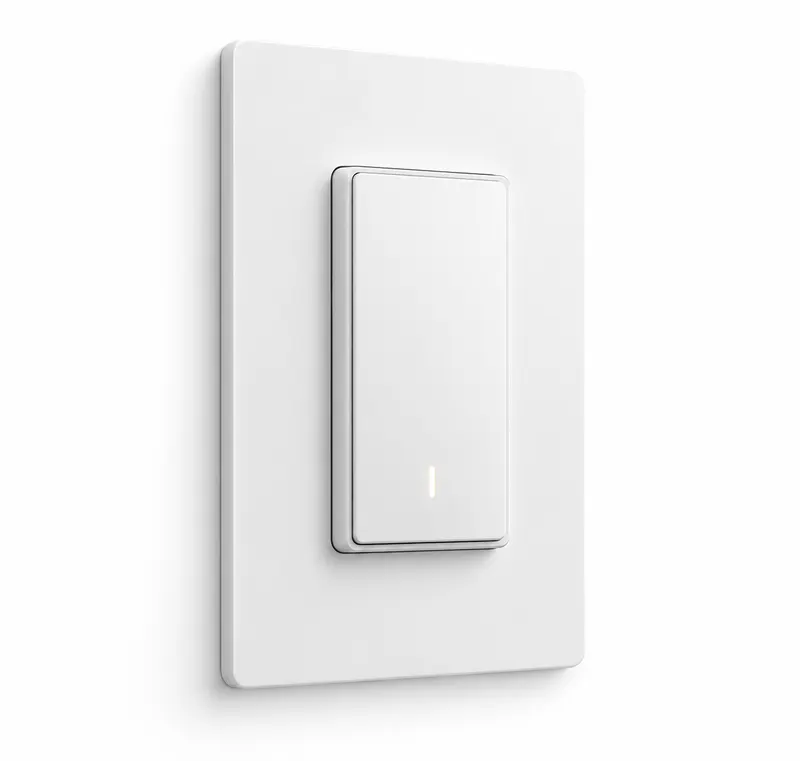
Check the box before you buy
A smart switch has a small circuit inside that stays powered all the time, even when the light is off. That circuit needs a path back to the panel. The standard path is the neutral (white) wire. In an older wiring method, the switch box holds only the hot wire going in and the switched wire going out to the light. The neutral is spliced at the light fixture and never reaches the switch.
Ceiling fans need a fan-rated box and their own controls, so see the ceiling fan installation page and its cost page before picking a switch.
To check, turn off the breaker and confirm with a tester that the box is dead. Pull the switch forward. Look for a group of white wires capped together at the back. If there is one, a neutral is present. If you only see black or red wires on the switch, with white wires used as hot, there is no neutral.
If you cannot tell, have an electrician look. The risk of guessing wrong is small for the device, but a mis-wired switch can leave a fixture stuck on or damage the switch.
What the code says about neutrals
NEC 404.2(C) requires a grounded conductor (neutral) at switch locations that control lighting in bathrooms, hallways, stairways and habitable or occupied rooms, so electronic switches have power. There are exceptions, including some 3-way and 4-way switches, closets, and switches in series with a ceiling sensor. Another exception covers retrofit switches installed in locations that were wired before the rule was adopted, where a neutral cannot be added without removing finished walls. Those devices must be listed and labeled for retrofit use, and the exception limits how many are allowed per circuit. Which edition applies, and how your city reads it, can change the answer. Ask the electrician or the building department.
For a new circuit or a remodel with open walls, the electrician will bring a neutral to the box.
Options for homes with no neutral
- Run a neutral. Possible if the wall is open, the ceiling above is accessible or a fish route exists. This is the best option.
- Use a no-neutral smart switch. These draw tiny power through the light. They can work with LED bulbs but may flicker or hum with very low loads, and some need a bypass module at the fixture. Test one before buying many.
- Use a smart bulb. The bulb is smart and the switch stays regular. The switch must be left on or the bulb loses connection.
- Use a battery-powered or wireless remote. Stick-on remotes control smart bulbs or a smart relay.
3-way and 4-way circuits
A 3-way setup has two switches controlling one light, such as at the top and bottom of stairs. Smart 3-way systems usually pair a main smart switch with a companion that does not need a neutral, or with a switch that needs the neutral at both locations. Do not mix brands unless the instructions say it works. A 3-way with the neutral at only one box is the case that stumps most do-it-yourselfers.
California Energy Code and dimming
Smart switches and dimmers are covered by Title 24, Part 6. Under section 150.0(k)2 in the 2022 Energy Code summary:
- Lighting needs a readily accessible wall-mounted manual on and off control.
- Lighting in habitable spaces needs a readily accessible wall-mounted dimming control. Exceptions include ceiling fan lights on a remote, lighting circuits under 20 watts and lights on a vacancy or occupancy sensor.
- Forward phase-cut dimmers controlling LED sources must meet NEMA SSL 7A.
- Bathrooms, garages, laundry rooms, utility rooms and walk-in closets need at least one luminaire on an occupancy or vacancy sensor.
- A control installed for compliance must not be bypassed.
The Energy Code is updated every three years and the 2025 edition took effect in 2026. Section numbers and wording may differ, so verify with your electrician or building department. For new work, the inspector may look at the control type. Replacing a switch in the same spot may not trigger it.
Vacancy sensors turn lights off when the room is empty and require someone to turn them on. They fit bathrooms and garages well. Occupancy sensors turn on automatically.
Matching switches and bulbs
Matching is where most problems start. Dimmers have a minimum load and a maximum load. LED bulbs use few watts, so a dimmer rated for 600 watts may not run three 8-watt bulbs smoothly. Use a dimmer rated for LED, use bulbs marked dimmable, and avoid mixing brands on one dimmer. A buzzing or flickering dimmer is covered on the flickering lights page.
Switches that control a ceiling fan need a fan-speed control, not a dimmer. The ceiling fans page covers fan controls.
Cost
As of October 2026, Fixr lists about $75 to replace a single-pole switch and $120 to $200 to install an outlet. Smart devices sit at the higher end, plus the device cost. Adding a neutral or running new wire to the switch box costs more and depends on access. The outlet and GFCI cost page lists related ranges. Ask whether the quote includes the switch itself and how many boxes the electrician will check.
For a whole-house approach with apps and circuit monitoring, see smart electrical panels, and for more on the room’s other lighting see recessed lighting.
Questions people ask
How do I know if my switch box has a neutral wire?
Turn off the breaker and test the wires with a tester to confirm no power. Then remove the plate and pull the switch out. A neutral is usually a bundle of white wires twisted together with a wire nut at the back of the box. If you see only a black or red wire pair and a ground, there is no neutral. Ask an electrician if unsure.
Can I install a smart switch with no neutral?
Some models are made for it, using a small current through the bulb to power themselves. They work best with a few dimmable LED bulbs and can flicker or hum with certain bulbs. Others need a bypass at the fixture. Read the model's requirements. Where a neutral can be added without opening finished walls, an electrician can do that.
Do smart switches work with 3-way circuits?
Yes, but all switches on the loop must be compatible. Many systems use one main smart switch and a companion switch at the other location, wired to talk to it. Putting a smart switch on one end and a regular switch on the other often works only with specific models. Follow the maker's 3-way diagram.
Are dimmers required by California code?
California's Energy Code asks for dimming controls on lighting in habitable spaces, with exceptions, and for a vacancy or occupancy sensor on at least one light in bathrooms, garages, laundry rooms, utility rooms and walk-in closets. A smart dimmer can meet the dimming rule if it is listed. Check section 150.0(k)2 of the current edition.
Why do my LED bulbs buzz or flicker on a new dimmer?
The bulb and dimmer are mismatched. Use bulbs marked dimmable and a dimmer rated for LEDs. Set the minimum brightness on the dimmer if it has the option. Mixing different brands of bulbs on one dimmer, or a very low total wattage, makes flicker more likely. Trying a different LED-rated dimmer often solves it.
Keep reading
Home lighting: recessed, landscape and smart controls
New lighting is a wiring job first and a fixture choice second. The wiring, the box, the switch and…
Recessed lights in California: what the code requires
California requires recessed ceiling lights to use a certified high-efficacy source, to be rated for…
Flickering lights: harmless, annoying or dangerous?
One flickering bulb is usually the bulb or the dimmer. Lights that flicker across several rooms, flicker…
Ceiling fan installation: the box matters most
A ceiling fan must hang from a box listed and marked for fans, not an ordinary light box. A swap on an…
How much does it cost to install or replace an outlet or GFCI?
Outlet work typically runs $135 to $850 in SoCal. That is a desk range. Fixr lists $120 to $200 to install…
Smart electrical panels
A smart panel is a main panel with built-in monitoring and remote-controlled breakers. It can cap total…
Get a quote
Send a photo, get a range.
Share your ZIP and a photo of your panel. Your request goes to a licensed partner electrician, who contacts you.
Get this quoteAurion Electric is a referral service operated by Roviq LLC. Electrical work is done by a licensed partner electrician.
