Why your breaker keeps tripping
A breaker trips to stop too much current. The cause is an overload, a short circuit, a ground fault or a worn breaker. If it trips again right after you reset it, stop resetting it and have the circuit checked.
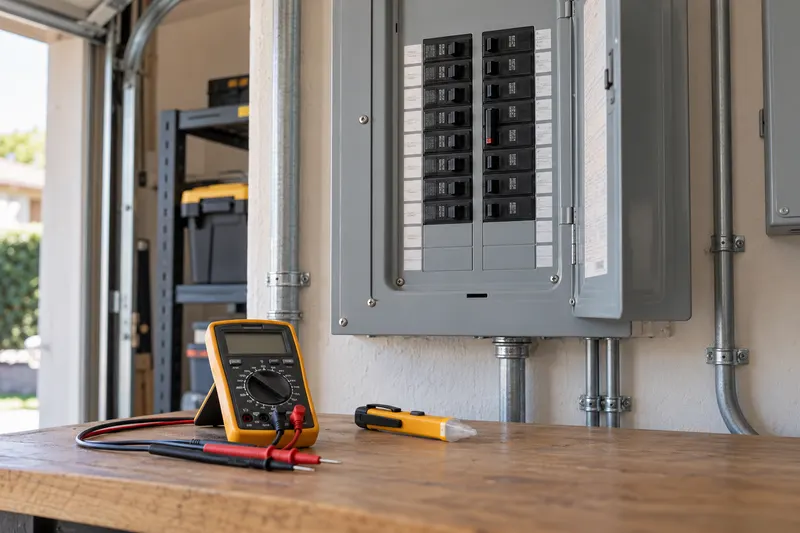
Stop and look before you reset
If a breaker tripped and you smell burning, see scorch marks, or find the breaker or panel hot to the touch, do not reset it. Leave it off and call an electrician. If there is smoke, get out and call 911.
If there is no smell, heat or noise, you can reset it once. Push the handle all the way to off first, then to on. Many breakers sit in a middle position after tripping, and pushing straight to on does nothing. If it holds, note what was running when it tripped. If it trips again right away, the problem is not the load. Leave it off.
Standing at a panel is safe if you only touch the handles. Do not take the cover off the panel. That is electrician work.
The four reasons a breaker trips
A breaker is a switch that opens when the current is too high or the wiring is faulty. There are four main causes. Knowing which one fits helps you describe the problem.
Overload. Too many devices on one circuit. A typical bedroom or living room circuit is 15 amps. A kitchen or garage circuit is often 20 amps. Space heaters, hair dryers, window air conditioners and microwaves each use a large share. The breaker trips after a few seconds or minutes of heavy use. This is the most common and least dangerous cause.
Short circuit. A hot wire touches a neutral wire. The current jumps, and the breaker trips at once, often with a pop. A short can come from a damaged cord, a loose wire in a box or a rodent chew. It does not clear on its own.
Ground fault. A hot wire touches a ground wire or a metal box, or current leaks through water. A ground-fault breaker or outlet trips on a very small leak. Wet outdoor outlets and bathroom fans are common spots.
A bad breaker. Old or heat-damaged breakers can trip early or not at all. A loose wire at the breaker can heat it up and trip it. A breaker that does not trip when it should is the opposite problem, and it is worse. A federal review of Federal Pacific (FPE) Stab-Lok breakers, closed in 1983 without a recall, found that some failed lab calibration tests. For Zinsco panels, trade sources describe breakers and bus bars that overheat or fuse together. If your panel carries either name, a breaker that never trips is not proof that the circuit is fine. See the Zinsco and Federal Pacific page and the panel upgrade page.
Safe checks you can do
These checks only need your hands and a flashlight:
- Unplug everything on the circuit. Find what is on it by looking at which rooms lost power.
- Reset the breaker once. If it holds with nothing plugged in, plug devices back in one at a time.
- If one device trips it, that device or its cord is the likely cause. Try it on another circuit. If it trips there too, replace or repair the device.
- If it trips with nothing plugged in, the fault is in the wiring, a hard-wired fixture or the breaker. Stop here.
- Check for a GFCI outlet or breaker that has tripped. A GFCI on the same circuit can also cut power downstream.
The guide to reading your panel shows how to find the right breaker and what the numbers mean.
When to call an electrician
Call if any of these is true:
- The breaker trips with nothing plugged in
- It trips again within minutes of a reset
- It trips more than a few times a month for no clear reason
- You see black marks, a burnt smell, or a buzzing or crackling sound
- The breaker is hot to the touch
- Lights dim when large appliances start
A circuit that is overloaded because you have more devices than before may only need a new circuit. A dedicated circuit for a space heater, freezer or window air conditioner is a common fix. Fixr lists $100 to $150 for a 20-amp outlet, and no neutral guide prices a full dedicated run from the panel, so get a written quote.
What the electrician will do
The electrician measures the load on the circuit and tests the wiring for shorts and ground faults. They check the connection at the breaker and look at the panel for heat damage. If the breaker is bad, it is replaced with the correct type for that panel. If a wire is damaged, they find the splice or run a new section. They explain the finding before replacing parts.
Cost depends on how hard the fault is to find. A typical SoCal flat-rate repair runs $185 to $575, and Fixr’s national guide lists a service call at $176 to $327 as of its January 2025 update. See electrician service call costs for what that range covers. Hidden shorts in old walls take longer.
GFCI and AFCI breakers trip for a reason
If your breaker has a test button, it is a GFCI or an AFCI. These trip on conditions that a standard breaker would miss. A GFCI trips on a small leak to ground. An AFCI trips on an arc, such as a pinched wire behind a wall or a loose connection. Do not replace one with a standard breaker to stop the tripping. The GFCI and AFCI page explains what each protects and why code requires them.
The 2023 National Electrical Code, which California’s 2025 Electrical Code is built on, widened GFCI protection. It now covers all 125 to 250 volt receptacles in kitchens, all basements, garages and outdoor receptacles, and listed appliances such as dishwashers, dryers, ranges, wall ovens, microwaves and sump pumps (rated 150 volts to ground or less and 60 amps or less). AFCI protection for the main living areas of a home has been in the code since before 2020. The result is that more circuits in newer or remodeled homes have a GFCI or AFCI device, and more homeowners meet a breaker that trips.
Before you blame the breaker, think about what the device sees. A damp outdoor box, a worn appliance cord or an old appliance with a little leakage can trip a GFCI, especially when a new GFCI breaker is added to an older circuit. A pinched cable, a loose wire nut or a damaged cord can trip an AFCI, and some trips follow a device plugged in downstream. Moving one device to another circuit and watching which one trips usually points to the cause. If it trips with nothing plugged in, the fault is in the wiring. Tell the electrician exactly when it trips, because that detail finds the fault faster.
If the breaker is hot or the smell is stronger near an outlet, read hot or burning-smell outlets. For after-hours cases, see the emergency electrician page.
How the job goes
- Note what was runningList what was on that circuit when it tripped, and unplug all of it.
- Reset oncePush the breaker fully to off, then to on. If it trips with nothing plugged in, leave it off.
- Add devices back one at a timePlug in each item and wait a few minutes. The one that trips it is the likely problem.
- Stop if it smells or is warmLeave the breaker off and call an electrician.
Questions people ask
Is it safe to keep resetting a breaker that trips?
No. Reset it once. If it trips again right away, or trips every few minutes or hours, leave it off. A breaker that trips is doing its job. Forcing it back on over and over can heat a loose wire or a failing breaker. A breaker that feels warm, buzzes or smells of burning needs an electrician the same day.
Why does my breaker trip when I use the microwave or hair dryer?
Those devices pull a lot of power, often 10 to 15 amps. If other loads share the circuit, the total passes the 15 or 20 amp rating and the breaker trips. This is an overload. Moving the device to another circuit helps. If the circuit keeps tripping with only that device on it, the breaker or wiring may be at fault.
Can a breaker go bad and trip for no reason?
Yes. Breakers wear out, especially ones that have tripped many times or sit in a hot panel. A weak breaker can trip below its rating. A loose connection at the breaker can also make heat that trips it. An electrician can test the breaker under load and replace it if the panel brand still has parts.
What is the difference between a trip and a GFCI or AFCI trip?
A standard breaker trips on overload or a hard short. A GFCI trips on a small current leaking to ground, which can be a person. An AFCI trips on an electrical arc, such as a damaged wire. A GFCI or AFCI that trips often points to a real fault, not a nuisance. Check the device before you replace it.
Keep reading
Electrical repair: what to check, what to shut off, and when to call
Most electrical repairs are small, but a hot outlet, a burning smell or a breaker that will not stay on…
Hot outlet or burning smell: act first, diagnose later
Turn off the breaker for that room now. If you cannot tell which breaker it is, or you see smoke, turn off…
GFCI and AFCI: where code requires them and what they do
A GFCI stops current that leaks to ground, which protects people from shock. An AFCI stops electrical…
Electrical panel upgrades in Southern California: when and how
A panel upgrade replaces the main breaker box, and most SoCal homes that need one are moving from 60 to…
How to read your electrical panel
A safe five-step read of your panel: main breaker, label, brand, free spaces and directory, plus when to…
What does an electrician service call cost?
A typical flat-rate electrical repair in SoCal runs $185 to $575 as of October 2026. Some electricians…
Electrical emergency: what to do first and who to call
If you see fire, smoke or sparks, get out and call 911. If the danger is contained and the power is off…
Power out in part of the house
If some rooms are dark and others work, check whether neighbors have power, then reset any tripped GFCI or…
Send a photo, get a range.
Share your ZIP and a photo of your panel. Your request goes to a licensed partner electrician, who contacts you.
Get this quoteAurion Electric is a referral service operated by Roviq LLC. Electrical work is done by a licensed partner electrician.
