Recessed lights in California: what the code requires
California requires recessed ceiling lights to use a certified high-efficacy source, to be rated for insulation contact (IC), and to be airtight.
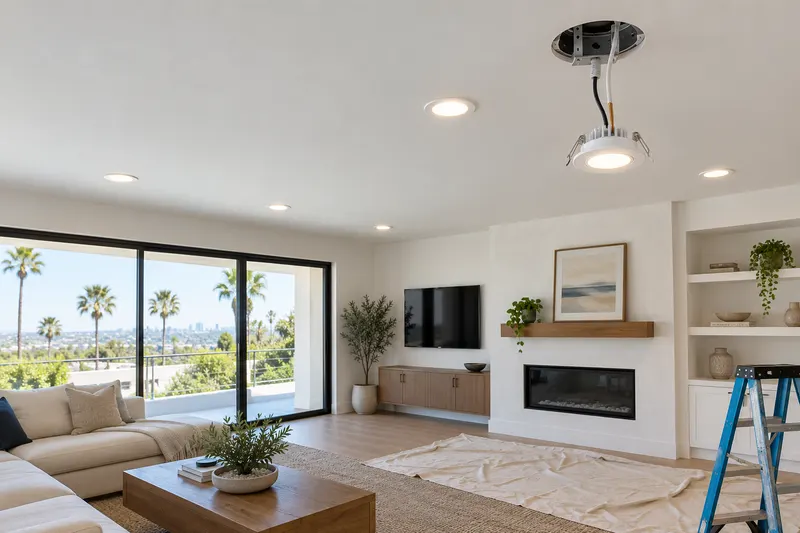
The three rules for recessed downlights
California’s Energy Code treats recessed downlights in a ceiling as a special case, because a hole in the ceiling leaks heated or cooled air into the attic. The rules in section 150.0(k) are:
- A certified high-efficacy source. Every light source in a ceiling recessed downlight must be certified under Joint Appendix JA8 and marked for it (JA8-2022 or JA8-2025). Screw-base sockets are not allowed in these fixtures. JA8 also sets a color rendering index of 90 or higher, 45 or more lumens per watt and dimming down to 10 percent.
- Rated for insulation contact (IC). The fixture must be listed to touch attic insulation. Non-IC cans need clearance and cause problems in a modern insulated ceiling.
- Airtight. The fixture must be certified as airtight, with leakage under 2.0 cfm at 75 Pascals when tested under ASTM E283. It must also be sealed with gasket or caulk at the ceiling.
The older Energy Code Ace guide for the 2019 standards states that recessed downlights that do not meet all of these “cannot be used for residential lighting.” The 2025 compliance forms keep the same JA8 and airtight checks. Exhaust-fan housings with a built-in light are exempt. Because the Energy Code changes every three years, check the current section with your electrician or city.
The driver or ballast must be reachable from below the ceiling, so it can be replaced without cutting a new hole.
What the label should say
Look for three things on the fixture or box:
- JA8 marking, such as JA8-2022 or JA8-2025, on the light source
- “IC” or “ICAT” (insulation contact, airtight)
- An airtight statement with the 2.0 cfm at 75 Pascals figure
If the electrician supplies the fixtures, ask which ones and keep the box. Inspectors sometimes ask for it.
Wafer lights and housings
Two kinds of fixtures are common.
Housing cans. A metal or plastic housing sits above the ceiling and the trim snaps in below. They are the traditional type, but need space above the ceiling and are slower to install in a finished ceiling.
Slim “wafer” lights. These have a thin LED panel and a small junction box that sits beside it. They need only a small hole and little room above the ceiling. They suit a ceiling with joists close to the drywall. Check that the whole unit, not just the LED, is marked IC and airtight.
Planning the layout
Layout matters more than count.
- Spacing. A rough rule is lights about half the ceiling height apart. On an 8 foot ceiling, about 4 feet apart.
- Distance from walls. Keep 2 to 3 feet from walls to avoid harsh scallops on the wall, or closer if you want to light art or shelves.
- Joists. Lights cannot go where a joist is. The electrician finds the joists and shifts a light if needed.
- Ducts and pipes. An air duct, plumbing or a beam above can block a spot.
- Kitchen and bath. Task areas need more light than living areas. A light over a shower must be rated for damp or wet locations.
A fixture with adjustable color temperature is useful, because it lets you match the existing room.
Controls
Under section 150.0(k)2 of the 2022 Energy Code, lighting needs a readily accessible wall-mounted on and off control. Lights in habitable rooms need a wall-mounted dimming control, and lights in bathrooms, garages, laundry rooms, utility rooms and walk-in closets need at least one fixture on an occupancy or vacancy sensor. Use dimmers that are rated for LED. Buy dimmable lights if you plan to dim, and match the dimmer and bulb. The smart switches and dimmers page covers the details.
How the job goes
For a typical room with attic access, the electrician marks the layout, cuts the holes, runs wire from the switch or a nearby box, mounts the housings, connects them and installs the trims. Drywall patching is a separate cost if the ceiling needs opening. In a finished ceiling without attic access, expect several small cutouts and patching. Plan for dust, and ask whether patching and paint are in the quote.
A permit is generally needed for new wiring. The inspector checks the wiring and may check the fixture labels. The permits guide covers how this varies by city.
Cost
As of October 2026, published guides put recessed lighting at about $125 to $300 per light in an existing ceiling. Fixr’s national guide (January 2025) puts the average at $1,467 for six lights. The recessed lighting cost page lists the factors. Cost goes up with a finished ceiling, a second-story location, new switch wiring and patching. It goes down when lights are installed during a remodel with the ceiling open.
For a bright room that also needs air movement, consider a ceiling fan on its own box instead of cutting extra cans.
Questions people ask
Can I use any LED can light in California?
No. A recessed downlight must have a JA8-certified light source, be rated for insulation contact (IC), and be airtight, with leakage under 2.0 cfm at 75 Pascals. Screw-base lamps are not allowed in them. Check the label before you buy. Fixtures that do not meet all of these cannot be used for residential lighting.
Do I need an attic to install recessed lights?
It helps a lot, but it is not required. With attic access, wire is run from above and the holes are cut from below. Without it, the electrician may open the ceiling at several points to run wire, or use thin wafer lights. Expect patching and paint afterward. Insulated attics need IC-rated, airtight housings.
How far apart should recessed lights be?
A common guide is to place lights about half the ceiling height apart, and about 2 to 3 feet from walls. For an 8 foot ceiling that is about 4 feet apart. Closer spacing gives even light. Wide spacing gives pools of light. Kitchens and work areas usually need more lights than bedrooms.
Does the electrician need a permit for recessed lighting?
Usually yes, if new wiring or new fixtures are added. A like-for-like swap in the same holes often does not. Cities set their own rules, so check with the building department. The inspection covers the wiring and, since these are Title 24 items, may check that the lights are IC-rated, airtight and marked JA8.
Keep reading
Home lighting: recessed, landscape and smart controls
New lighting is a wiring job first and a fixture choice second. The wiring, the box, the switch and…
Smart switches and dimmers: what your wall box can handle
Most smart switches need a neutral (white) wire in the switch box. Many homes built before the 1980s do…
How much does recessed lighting cost per light?
Recessed lighting typically costs $125 to $300 per light in an existing ceiling. A room of 4 to 6 lights…
Electrical permits in Southern California: what needs one and who pulls it
What needs an electrical permit, who pulls it, what the inspector checks, and what happens if the work was…
Ceiling fan installation: the box matters most
A ceiling fan must hang from a box listed and marked for fans, not an ordinary light box. A swap on an…
Get a quote
Send a photo, get a range.
Share your ZIP and a photo of your panel. Your request goes to a licensed partner electrician, who contacts you.
Get this quoteAurion Electric is a referral service operated by Roviq LLC. Electrical work is done by a licensed partner electrician.
