Ceiling fan installation: the box matters most
A ceiling fan must hang from a box listed and marked for fans, not an ordinary light box. A swap on an existing fan box is simple. A new fan where there is no wiring is a bigger job.
- Typical SoCal range: $151 to $415
- Box weight limit: 70 lb max (NEC 314.27(C))
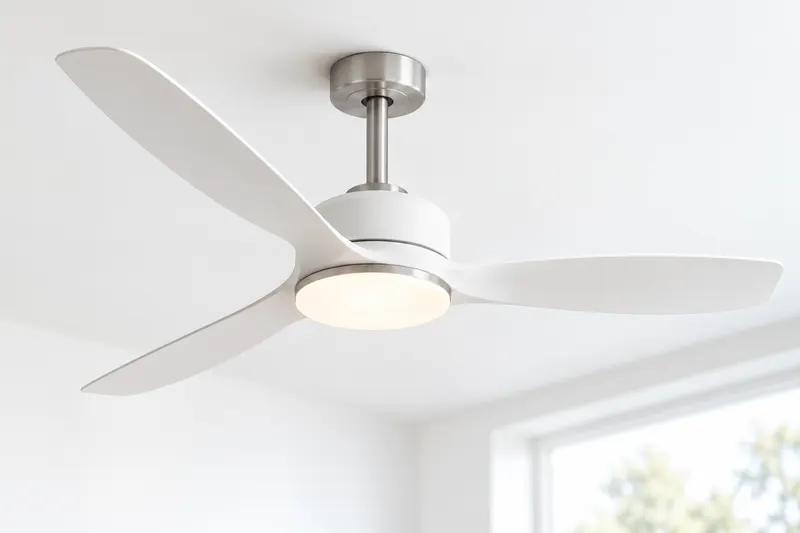
Start with the box
A ceiling fan weighs 15 to 50 pounds and shakes as it turns. A normal light box, held by two small screws, can work loose over months. A falling fan is a real injury risk. The first thing to check is what the fan will hang from.
NEC 314.27(C) says an outlet box used as the sole support of a ceiling-suspended (paddle) fan must be listed, marked by its maker as suitable for that purpose, and may not support a fan over 70 pounds. A fan-rated box that is made for fans over 35 pounds must also be marked with the maximum weight it can carry. Fans over 70 pounds need independent support.
The same section says that boxes in the ceilings of habitable rooms, in a spot where a fan could go, must either be fan-rated or give access to the framing so a fan brace can be added later. California adopts the 2023 NEC as its 2025 Electrical Code, effective January 1, 2026.
Look at the existing box. A fan-rated box is usually metal or heavy plastic, and is marked “Acceptable for Fan Support” with a weight. If it is not marked, treat it as a light-fixture box.
Three common jobs
Swap a fan for a fan. The wiring and box exist. The electrician checks that the box is fan-rated, replaces the fan and checks the controls. The simplest and cheapest job.
Replace a light fixture with a fan. A new fan-rated box or brace is usually needed. The electrician may open the ceiling or work from the attic. The wiring may already be there for the light.
Add a fan where there is no wiring. This is the biggest job. The electrician finds a power source, runs new wire to the ceiling and to the switch, installs a fan-rated box and patches drywall. A permit is usually needed.
Controls: remote, wall or app
| Control | Works best when | Watch for |
|---|---|---|
| Pull chains | Simple fans, no wall switch | Every use is by hand |
| Remote | Old wiring with one switch, no extra wire | Lost remotes, battery changes |
| Wall control for fan and light | Two switch wires (or one with remote) | Needs a fan-rated control, not a dimmer |
| App or smart control | You want schedules and voice | Needs neutral for some models, see smart switches |
A ceiling fan with a light usually needs two switched wires from the wall to the ceiling to control fan and light separately. Many older rooms have only one. A remote receiver in the fan canopy solves that with no new wire. California’s Energy Code also lets ceiling fan lights be controlled by remote.
Do not put a standard dimmer on a fan motor. It can cause humming and heat, and could damage the motor. Fans need a speed control.
When new wiring is needed
New wiring is needed when:
- There is no switch or power at the ceiling location
- You want separate wall switches for fan and light and only one switch wire exists
- The box is in a vaulted or sloped ceiling with no access
- The circuit is overloaded or has no ground
- The location is far from any existing box
The electrician opens the ceiling, runs wire from the attic or from the nearest box, and adds a fan-rated box. Cost depends on access. The cost section below gives ranges.
Fan size and fit
A hugger or low-profile fan suits a low ceiling. A longer downrod suits a high or sloped ceiling. Match the fan size to the room, and follow the fan’s instructions for blade height and clearance from walls. Check that the fan is listed for the location, with a damp or wet rating for covered patios.
Outdoor and bathroom fans
Fans on covered patios need a damp-rated or wet-rated fan. The outlet must be GFCI protected if it is an outdoor receptacle. Bathroom exhaust fans are a separate job, with their own ducts. The recessed lighting page covers fixtures that share the ceiling.
Permit and inspection
Replacing a fan on an existing, fan-rated box usually does not need a permit. New wiring, a new box or a new switch circuit generally does, and the city inspects it. Check with the building department. The permits guide covers how this varies in Southern California.
What it costs
As of October 2026, Angi’s Los Angeles page shows an average of $266, with a range of $151 to $383. Fixr’s national guide lists $228 to $415 of electrician labor to replace an existing fan, so this site uses $151 to $415. New wiring costs more. The fan is extra if you buy it yourself. The ceiling fan cost page breaks down what changes the number.
A fan that wobbles, hums, or has lights that flicker may have a loose box, bad capacitor or bad dimmer. See flickering lights. Send the room details through the quote form.
Questions people ask
Can I hang a ceiling fan from a regular light fixture box?
Not safely. An ordinary light box is built to hold a fixture's weight, not a fan that moves and shakes. NEC 314.27(C) requires a box listed and marked for ceiling fan support. The fan vibrates, and a loose box can fail and drop the fan. Replace the box with a fan-rated box or a brace before you hang the fan.
How much weight can a fan-rated box hold?
A box used as the only support for a ceiling fan must be listed and marked for it, and cannot support a fan over 70 pounds. If a fan-rated box is made for fans over 35 pounds, it must also be marked with its maximum weight. A fan over 70 pounds has to be supported independently of the box.
Do I need a wall switch for a ceiling fan?
No, but you need a way to control it. Choices are pull chains, a remote, a wall control or an app. If the room needs a wall switch for the light, California's Energy Code lets a ceiling fan light be run on a remote. Fans need a fan-speed control at the wall, not a regular dimmer.
How much does it cost to install a ceiling fan?
As of October 2026, published Los Angeles pricing averages about $266, with a range of $151 to $383 (Angi), to replace or install a fan on existing wiring. Fixr's national guide lists $228 to $415 of electrician labor to replace an existing fan, so this site uses $151 to $415. New wiring costs more. The fan itself is extra unless the electrician supplies it.
Do I need a permit to install a ceiling fan?
Replacing a fan or light on an existing, working box usually does not need a permit. Adding new wiring, a new circuit or a new box location generally does, and rules vary by city. Check the building department or ask your electrician. A permit means an inspection that confirms the box, wiring and connections.
Keep reading
Home lighting: recessed, landscape and smart controls
New lighting is a wiring job first and a fixture choice second. The wiring, the box, the switch and…
Smart switches and dimmers: what your wall box can handle
Most smart switches need a neutral (white) wire in the switch box. Many homes built before the 1980s do…
Recessed lights in California: what the code requires
California requires recessed ceiling lights to use a certified high-efficacy source, to be rated for…
How much does ceiling fan installation cost?
Installing a ceiling fan typically costs $151 to $415 in the Los Angeles area. A Los Angeles cost guide…
Flickering lights: harmless, annoying or dangerous?
One flickering bulb is usually the bulb or the dimmer. Lights that flicker across several rooms, flicker…
Electrical permits in Southern California: what needs one and who pulls it
What needs an electrical permit, who pulls it, what the inspector checks, and what happens if the work was…
Get a quote
Send a photo, get a range.
Share your ZIP and a photo of your panel. Your request goes to a licensed partner electrician, who contacts you.
Get this quoteAurion Electric is a referral service operated by Roviq LLC. Electrical work is done by a licensed partner electrician.
