Landscape lighting: low-voltage or line voltage
Most home landscape lighting is low voltage, 12 volts from a transformer, and the cable can lie shallow. Line voltage (120 volts) is for large or permanent runs and has to be buried deeper and protected by a GFCI.
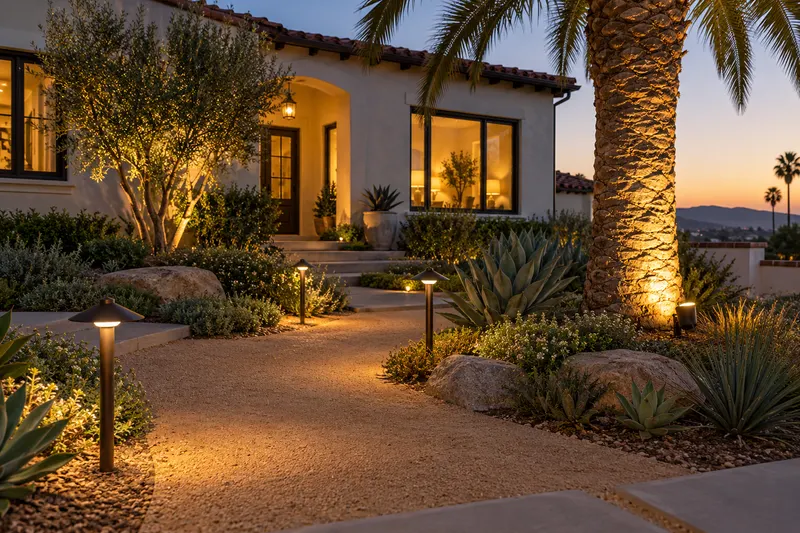
The two systems
Low voltage (12 volts, sometimes up to 15 or 24). A transformer plugs into an outdoor outlet and steps 120 volts down. Thin two-wire cable runs to each fixture. The shock risk on the fixture side is small, the cable can be shallow, and it is easy to add fixtures later. Most pathway, uplight, spot and deck lights are this type.
Line voltage (120 volts). The fixtures run on full house voltage through conduit or direct-burial cable. It suits big spaces, high-output floodlights, pole lights, long runs and permanent outdoor circuits. Shock and fire risk is higher, the wire is thicker, the trench is deeper, and permits are more likely.
| Low voltage | Line voltage | |
|---|---|---|
| Typical use | Paths, trees, walls, steps | Floodlights, poles, long driveways |
| Power source | Transformer on a GFCI outlet | New or extended 120V circuit |
| Cable depth (NEC 300.5) | About 6 inches | 12 to 24 inches by method |
| Permit | Usually only if a new circuit is added | Usually yes |
| Who installs | Homeowner or electrician | Licensed electrician |
Safety first
Do not dig without knowing what is underground. Call 811 (DigAlert serves Southern California) at least two working days before digging. Gas, water and power lines are common in yards.
Never run an extension cord to landscape lights permanently. Never run line-voltage wire loose on the ground. Treat a damaged outdoor cable as live until the breaker is off.
Power source and GFCI
The transformer needs 120 volts. In California, outdoor outlets in a dwelling must have GFCI protection under NEC 210.8, which means either a GFCI outlet or a GFCI breaker. The transformer should plug into a weather-resistant outlet with an in-use cover. If a nearby outdoor outlet is missing, an electrician adds one from a nearby circuit, or runs a new outdoor circuit. A GFCI that trips in wet weather may be a failed cover seal or a cable nick, not a bad GFCI. See GFCI and AFCI protection.
Put the transformer where it is easy to reach, near a timer or photocell, and at least a foot above ground.
How deep to bury cable (NEC 300.5)
Table 300.5 sets the minimum cover for buried wiring. Published summaries of the table agree on these typical depths, though code text and local rules should be checked before digging:
- Low-voltage landscape lighting cable at 30 volts or less: about 6 inches
- 120-volt direct-burial UF cable: 24 inches
- 120-volt wire in PVC conduit: 18 inches
- 120-volt wire in rigid metal conduit: 6 inches
- Some GFCI-protected residential circuits at 20 amps or less: 12 inches, though sources differ on which wiring methods this covers
The 6-inch figure only applies to the low-voltage side after the transformer. The wire carrying 120 volts to the transformer follows the deeper rules. Deeper cover is usually required under driveways. Rocky or clay soil may need conduit even when direct burial is allowed. Ask your electrician which method the city expects.
Sizing the transformer and cable
Add up fixture watts and keep the load under the transformer rating, with some room to add more later. A 12-volt LED fixture often draws 3 to 10 watts. Cable gauge matters. Thin wire loses voltage over a long run, and the last lights are dimmer. Common fixes are heavier cable, a shorter run, a “hub” layout with several runs and a transformer with multiple taps.
Brass or copper fixtures last longer in coastal yards than painted aluminum. Look for fixtures marked for wet locations.
Controls and Title 24
Outdoor lighting attached to a house follows the California Energy Code. Under section 150.0(k)3A in the 2022 Energy Code summary, these fixtures must be high efficacy, have a manual on and off switch, and use a photocell with a motion sensor or time switch, or an astronomical time clock. An override to on has to return to normal operation within 6 hours. Free-standing landscape fixtures that are not attached to the building may be treated differently, so ask the inspector or your electrician. LED fixtures installed outdoors are counted as high efficacy.
Permits
Plug-in low-voltage systems usually do not need a permit, though some HOAs and cities have rules. A new outdoor circuit, a new outlet or any line-voltage wiring generally does. The permits guide explains the variation between cities.
Cost
Landscape lighting varies too much by yard size, fixture type and cable length to quote one typical SoCal range. A new outdoor GFCI outlet or circuit is the electrician part: Fixr’s national guide (updated August 2025) puts an outlet install at $120 to $200. A new dedicated circuit costs more and is quoted by the run. See the outlet and GFCI cost page. Ask for a written quote that lists fixture count, transformer size, cable length, whether trenching is included and who fixes the lawn.
If outdoor lights keep burning out after storms, a surge device may help. See surge protection. For timers and app control, see smart switches and dimmers.
Questions people ask
How deep must landscape lighting cable be buried?
Low-voltage cable (30 volts or less) is commonly buried 6 inches under NEC Table 300.5. A 120-volt direct-burial UF cable is 24 inches, and 120-volt wire in PVC conduit is 18 inches. Some GFCI-protected circuits allow 12 inches. Code details and local rules vary, so ask the electrician and the city before digging.
Do I need an electrician for 12-volt landscape lights?
The low-voltage side is simple, and many homeowners lay it themselves. The transformer needs 120-volt power from a GFCI-protected outdoor outlet. If no outlet is nearby, a new outdoor circuit is electrician work, and usually needs a permit. A licensed electrician should also run any line-voltage wiring.
Why do my landscape lights get dimmer farther from the transformer?
Voltage drops over long runs of thin wire, so the last lights in a run are dimmer. Fixes are heavier wire (12 gauge instead of 14 or 16), shorter runs, or a transformer with several voltage taps. Splitting the system into two runs from the transformer also helps. Keep total fixture wattage under the transformer rating.
Do landscape lights work with the HOA rules?
Many HOAs have rules on brightness, color, timers and where fixtures can go. Look up the community's design guidelines and submit the plan if approval is required. Warm white light, shielded fixtures and timers rarely draw complaints. Some California cities also have dark-sky or light-trespass rules for outdoor lighting.
Keep reading
Home lighting: recessed, landscape and smart controls
New lighting is a wiring job first and a fixture choice second. The wiring, the box, the switch and…
GFCI and AFCI: where code requires them and what they do
A GFCI stops current that leaks to ground, which protects people from shock. An AFCI stops electrical…
Smart switches and dimmers: what your wall box can handle
Most smart switches need a neutral (white) wire in the switch box. Many homes built before the 1980s do…
Electrical permits in Southern California: what needs one and who pulls it
What needs an electrical permit, who pulls it, what the inspector checks, and what happens if the work was…
How much does it cost to install or replace an outlet or GFCI?
Outlet work typically runs $135 to $850 in SoCal. That is a desk range. Fixr lists $120 to $200 to install…
Whole-home surge protection
A whole-home surge protector mounts at your panel and clamps voltage spikes before they reach your…
Get a quote
Send a photo, get a range.
Share your ZIP and a photo of your panel. Your request goes to a licensed partner electrician, who contacts you.
Get this quoteAurion Electric is a referral service operated by Roviq LLC. Electrical work is done by a licensed partner electrician.
