Smoke and CO detectors: California rules and installation
California requires State Fire Marshal listed smoke alarms in every bedroom, outside sleeping areas and on each level, plus CO alarms in most homes. Battery units are allowed in some homes, and hardwired, interconnected sets are the other route.
- Typical SoCal range: $150 to $450
- Battery life rule: 10-year sealed
- Permit trigger: Work over $1,000
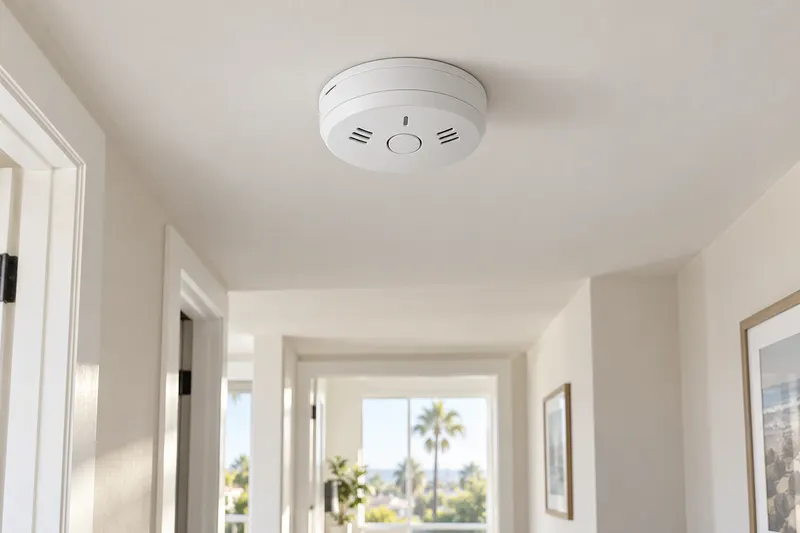
Where the alarms go
For smoke alarms, California follows the placement list that appears in summaries of Health and Safety Code 13113.7:
- Inside each sleeping room.
- Outside each separate sleeping area, close to the bedrooms.
- On every additional story, including basements and habitable attics.
- At least three feet horizontally from the door of a bathroom with a tub or shower.
Alarms must be approved and listed by the State Fire Marshal and installed to the maker’s instructions. A combined smoke and carbon monoxide unit is allowed if it meets both standards and clearly tells the two warnings apart.
Carbon monoxide alarms follow Health and Safety Code 17926. A State Fire Marshal approved CO device is required in each existing unit that has a fossil-fuel heater or appliance, a fireplace or an attached garage. Placement follows the maker’s instructions and current new-construction standards: near the bedrooms, on every occupiable level and inside any bedroom that has a fuel-burning appliance. The deadlines were July 1, 2011 for existing single-family homes and January 1, 2013 for other units.
Battery, hardwired and interconnected
This is the question people ask most, and the honest answer is that it depends on the house and the work.
- Existing home, no permit work. Section 13113.7 says a battery-operated alarm that met the standard when installed satisfies the section, unless local rules prohibit it. Existing working alarms do not have to be torn out.
- Battery-only alarms. Since July 1, 2014, a battery-only alarm can be listed only with a nonreplaceable, nonremovable battery that lasts at least 10 years. Since January 1, 2015, listed alarms show a manufacture date and have a hush feature.
- Hardwired with battery backup. When an electrician has the ceiling or walls open, hardwired alarms with battery backup are the normal choice. They are wired to a circuit, and interconnected models sound all alarms together when one detects smoke. New construction and larger remodels are where cities most often ask for it. Ask the city whether your permit requires it.
- Wireless interconnect. Some systems link alarms by radio. Ask the electrician whether the model is listed for the way you plan to use it.
This page does not claim one rule for every case. The permit comment sheet from your building department is the document that counts.
The $1,000 permit trigger
When a building permit is issued for alterations, repairs or additions that cost more than $1,000 on an existing dwelling, the permit issuer cannot sign off until the permit holder shows that all required smoke alarms are State Fire Marshal listed. A kitchen remodel, a panel upgrade rolled into a bigger job or an ADU conversion can set this off. Put the alarms in the electrician’s scope at the start, so the final inspection does not stall. See electrical permits in Southern California.
Rentals
Owners of rental homes must make sure alarms work when a tenant moves in, and tenants must report problems. A violation of the CO rules is an infraction with a $200 maximum fine, and an owner first gets a 30-day notice to correct. If you are a landlord with older units, test each alarm, check the manufacture date and replace anything past its life.
Selling a house
The state’s Real Estate Transfer Disclosure Statement, from Civil Code 1102.6, includes a seller certification about smoke detectors. The form says the property will have operable smoke detectors that are approved, listed and installed under State Fire Marshal rules. Its checklist also includes carbon monoxide devices, and a footnote warns that the CO device may not be in compliance. In practice:
A buyer’s inspector may flag alarms along with other items, and the home electrical inspection cost page shows what an inspection and common fixes run.
- Test every alarm before the listing photos.
- Replace any unit with an old or missing date.
- Add alarms where the layout above calls for one.
- Keep a receipt or a note for the buyer’s agent.
A buyer’s inspector will often flag missing alarms. It is the cheapest finding on the report to clear. The home-sale electrical inspection guide has the rest of the list.
What the work costs
As of October 2026 the typical SoCal range is $150 to $450 for a small set of hardwired, interconnected detectors, an estimate. This is a desk estimate and not a published price list, so the range is a desk estimate: the cost of each unit plus the labor to run interconnect wire between them. See smoke detector installation cost. Cost goes up when:
- Ceilings are finished and the electrician must fish wire.
- The home needs a new circuit or junction box.
- Many alarms have to be linked across several floors.
Swapping a battery alarm for another battery alarm needs no electrician. Adding hardwired units, moving them, or fixing an alarm that chirps or trips for no reason is electrician work.
Back to the hub
This page is part of electrical inspections and code fixes. If an alarm keeps going off with no smoke, or a hardwired unit is hot or discolored, treat it like any electrical fault and read hot or burning-smell outlets. Hardwired alarms keep a battery backup for outages, and backup power covers keeping the rest of the house running.
Questions people ask
Do I need hardwired smoke detectors, or are battery ones enough?
For many existing homes, battery alarms are enough. Health and Safety Code 13113.7 says a battery alarm that met the standard when installed satisfies the section unless local rules prohibit it. Hardwired alarms with battery backup are what electricians install when walls are open or when your city's permit requires them. Ask the building department which applies.
How often should smoke detectors be replaced?
Follow the manufacture date printed on the alarm and the maker's instructions. Since July 1, 2014, battery-only alarms sold in California must have a sealed battery rated for at least 10 years. Many makers list a service life of about ten years for the alarm itself. If the date is missing or past, replace the unit.
Where do carbon monoxide alarms go?
Near the bedrooms and on every level, including basements, and inside any bedroom that has a fuel-burning appliance. Health and Safety Code 17926 requires one in each unit that has a fossil-fuel appliance, a fireplace or an attached garage. A combination smoke and CO alarm is allowed if it meets both standards and tells the two warnings apart.
What do I have to say about smoke alarms when I sell my house?
The state transfer disclosure form has the seller certify that the home will have operable, listed smoke detectors installed to State Fire Marshal rules, and it lists carbon monoxide devices on the checklist. A footnote warns the CO device may not be in compliance. Test every alarm before listing and replace old units so the form is accurate.
Keep reading
Electrical inspections and code fixes
If an inspector flagged your wiring, you need a licensed electrician to fix each item and, for anything…
How much does it cost to install hardwired smoke and CO detectors?
Hardwired smoke and CO detectors typically cost $150 to $450 for a small interconnected set in SoCal, an…
Selling a house in SoCal: the electrical inspection
What inspectors flag at sale, what a California seller must disclose, and which electrical repairs pay off…
Electrical permits in Southern California: what needs one and who pulls it
What needs an electrical permit, who pulls it, what the inspector checks, and what happens if the work was…
Hot outlet or burning smell: act first, diagnose later
Turn off the breaker for that room now. If you cannot tell which breaker it is, or you see smoke, turn off…
Backup power for a Southern California home
Pick the backup setup by outage length and by what must stay on. An interlock or transfer switch lets a…
Send a photo, get a range.
Share your ZIP and a photo of your panel. Your request goes to a licensed partner electrician, who contacts you.
Get this quoteAurion Electric is a referral service operated by Roviq LLC. Electrical work is done by a licensed partner electrician.
