How much does a transfer switch cost installed?
A transfer switch installed in SoCal typically costs $400 to $2,500. A manual switch runs $400 to $1,300 and an automatic switch $600 to $2,500, as of October 2026.
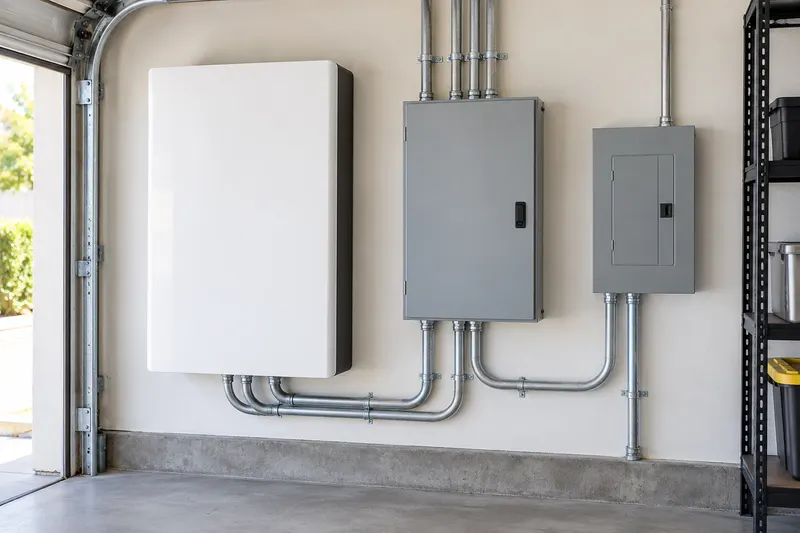
Typical SoCal range, October 2026
$400 to $2,500
manual $400 to $1,300; automatic $600 to $2,500. Built from the published ranges listed under Sources.
A transfer switch is the clean way to move your house between utility power and a generator. The typical range as of October 2026 is $400 to $2,500 installed, and the spread comes from one choice: manual or automatic. HomeGuide lists manual at $400 to $1,300 and automatic at $600 to $2,500. HomeGuide’s own pages are not fully consistent with each other and some are marked as dated, so use these numbers to sanity-check bids, not to set a budget to the dollar.
Manual and automatic types, and which circuits to put on one, are on the transfer switch page.
Manual switch: you do the switching
With a manual switch, you start the generator, plug it in and flip the switch. The switch itself costs about $200 to $800 in HomeGuide’s data. The rest is labor and wiring. This is the right fit for a portable generator and for homeowners who are home during outages. It is also the closest match to the interlock option, which costs less but works on the whole panel instead of chosen circuits.
Automatic switch: it senses the outage
An automatic switch watches utility power. When it drops, the switch tells a standby generator to start and moves the load over. HomeGuide lists the unit at $400 to $2,000 and the installed price at $600 to $2,500. Automatic switches mostly go with permanent generators. For the whole system, see the standby generator hookup page.
The circuit-count decision
A switch that covers a few circuits needs a smaller generator. A switch that covers many circuits works like a whole-house system and needs a bigger generator. Many homes pick a middle path: refrigerator, lights, furnace fan, internet and a bedroom outlet. A critical-loads subpanel is a related approach.
Where this fits among backup choices
Generators run on fuel and make noise. Batteries are quiet and cost more up front. The generator vs battery guide compares them. If your main worry is wildfire shutoffs, read the PSPS explainer.
Where the money goes
HomeGuide’s labor figures let you check a bid. At $50 to $130 an hour for 2 to 4 hours, plus a $75 call-out fee, labor comes to roughly $175 to $595. The rest of a quote is the switch and the wire. If a bid for a manual switch is far above $1,300, ask what is in it. If it is under $400, ask what is missing. For an automatic switch the same check applies against $600 to $2,500.
Sizing the switch to the generator
The switch must match what the generator can supply. A small portable unit cannot carry a switch built for a whole panel, and a large standby unit wastes a small switch. Give the electrician the generator’s wattage rating, or ask them to size the generator from your loads. Bring the make and model if you already own one. A mismatch is one of the common reasons a quote changes after the site visit.
Permit and utility involvement
A transfer switch connects to the panel, so it is permitted work. Fees depend on the city. See Santa Ana, Irvine or Temecula, or the Orange County hub. Utility involvement is limited for a customer-side switch.
How to compare quotes
- Manual or automatic, and the amperage rating.
- Number of circuits covered and which ones.
- Whether it works with your existing generator, and what inlet or cord it needs.
- Whether the permit and inspection are in the price.
- Labor hours and any call-out fee, listed separately.
What is not included
The generator, a generator pad or gas line, a critical-loads subpanel, trenching, and a main panel upgrade if the panel is full. HomeGuide’s installed ranges include labor and the switch, not these.
What moves the price
| Factor | Effect | Range |
|---|---|---|
| Manual or automatic | HomeGuide lists manual switches installed at $400 to $1,300 and automatic at $600 to $2,500 | |
| Unit price | The switch itself is $200 to $800 for manual and $400 to $2,000 for automatic (HomeGuide) | |
| Number of circuits it covers | More circuits means a larger switch and more wiring to the panel | |
| Distance to the panel and the generator | Longer runs add wire, conduit and labor | |
| Labor rate | HomeGuide lists $50 to $130 an hour plus a $75 call-out fee, with 2 to 4 hours typical |
Questions people ask
Do I need a transfer switch for a portable generator?
You need a safe way to connect it. A transfer switch is one way, and an interlock kit on the panel is another. A cord plugged into a wall outlet to feed the house is not safe and can send power back to the grid. A licensed electrician chooses the option that fits your panel.
Manual or automatic transfer switch?
A manual switch needs you to start the generator and flip the switch. It costs less. An automatic switch senses the outage, starts a standby generator and switches by itself, and costs more. Automatic switches usually go with permanent standby generators, which have their own hookup cost page.
How many circuits should the switch cover?
Enough for what you need in an outage: refrigerator, some lights, internet, a furnace fan, and a medical device if you use one. More circuits means a larger generator and a higher price. The electrician can run a load calculation to match the switch to the generator you own.
Related
Transfer switches for generators: manual vs automatic
A transfer switch connects your generator to selected house circuits and cuts them off from the grid while…
Backup power for a Southern California home
Pick the backup setup by outage length and by what must stay on. An interlock or transfer switch lets a…
Generator interlock kit and inlet: what it costs installed
A generator interlock installed in SoCal typically costs $400 to $850 for the interlock alone, and $400 to…
Standby generator electrical hookup cost
The electrical work to connect a standby generator typically costs $1,500 to $3,000 in SoCal, as of…
Critical loads subpanel for a battery or generator
A critical loads subpanel is a small second panel that holds only the circuits you want during an outage…
Generator vs battery backup
A decision guide for outages and wildfire shutoffs: runtime, typical cost, fuel, permits, noise and…
PSPS power shutoffs explained: how they work and how long they last
What a PSPS is, how utilities warn you, how long outages last, and four dated SoCal examples.
Panel upgrade cost estimator
Pick your panel, target size and site conditions to get a typical SoCal range.