Transfer switches for generators: manual vs automatic
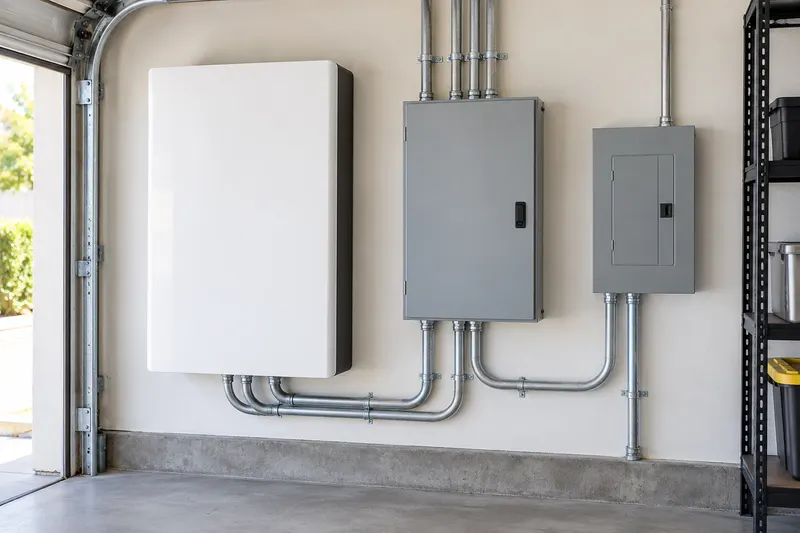
A transfer switch connects your generator to selected house circuits and cuts them off from the grid while it runs. A manual switch is flipped by hand, and an automatic one moves the load on its own.
- Manual: $400 to $1,300
- Automatic: $600 to $2,500
- Circuits served: Typically 6 to 16
The short version
A transfer switch has two inputs and one output. One input is the utility. The other is the generator. The output goes to the circuits you want to keep running. A mechanical interlock inside the switch makes it impossible to connect both inputs at once, so the generator cannot feed power back onto the street. That is the same safety goal as an interlock kit, reached with a different box.
Two main types
Manual transfer switch. A small panel with its own breakers, wired next to the main panel. Each breaker is a circuit you picked. During an outage you plug the generator into an inlet, start it, and flip the switch to generator. A published cost guide lists installed prices at about $400 to $1,300 as of October 2026.
Automatic transfer switch (ATS). It watches the utility voltage. When power drops, it signals a standby generator to start, then moves the load over in seconds. When power returns it moves back and shuts the generator off. The same guide lists $600 to $2,500 installed for the switch. The generator is extra. Permanently installed generator hookup labor runs about $1,500 to $3,000, covered on the standby generator hookup page.
See the full range on the transfer switch cost page.
Which circuits to put on it
Pick by what hurts when it is off, then check the wattage. Start with the refrigerator, a freezer if you have one, furnace fan, a handful of lights, the garage door opener, internet and phone chargers. A well pump or sump pump belongs on the list if you have one. Air conditioning and electric ranges usually do not fit a portable generator. A load calculation is how the electrician adds up the watts so the generator is not asked to carry more than it can.
Starting a motor draws far more power than running it. A refrigerator may need three times its running watts for a second. The generator has to handle that spike, so size by startup watts for the biggest motors.
A switch versus a subpanel
A transfer switch moves existing circuits. That means the electrician rewires those circuits to pass through the switch. A critical loads subpanel does the same job in a different layout: the chosen circuits are moved to a new small panel that is fed from the main panel normally, and from the generator or battery in an outage. Subpanels cost more but handle batteries and generators the same way.
What the install includes
- The switch or panel mounted near the service
- Rewiring the selected circuits through it
- A power inlet or a hardwired connection to a standby unit
- Labels at the service equipment
- The permit and inspection
Ask which of these your quote includes. Some bids leave out the inlet or the labels.
What affects the price
- Number of circuits. Each one is another wire to reroute.
- Distance between the panel and the switch.
- Whether the work is inside a finished wall or in a garage with open framing.
- Automatic versus manual.
- Panel capacity. If the main panel is full or old, a panel upgrade may come first.
Permit
A transfer switch is a change to the home’s service wiring. Cities usually require an electrical permit and an inspection. A licensed C-10 electrician applies, and the inspector confirms the lockout, labels and wire sizes. Steps differ by city, so the building department’s page is the final word. See electrical permits in Southern California.
Use safely
Run a generator outdoors only, away from windows and doors. Fuel it when it is cool. Never connect it by a cord with two plugs to a wall outlet. Utilities warn that this can push power onto the lines and hurt line workers, and a transfer switch avoids the risk.
Choosing between manual and automatic
Pick manual if outages are short and rare, you will be home, and a portable generator is enough. Pick automatic if you travel, if someone at home depends on powered equipment, or if you already have a permanent generator on a gas line. An automatic switch is also the better match for a long outage because it restarts the generator on a schedule without anyone getting up at night.
Ask the electrician what rating the switch needs. Common home sizes are 30 amp, 50 amp and 100 amp. The rating should match the generator and the service, and the electrician should write it on the quote so you can compare bids on the same basis.
Questions people ask
What is the difference between a manual and automatic transfer switch?
A manual switch needs you to start the generator and flip a handle or breakers. An automatic switch senses an outage, starts a standby generator, and moves the load by itself. Automatic costs more and normally pairs with a permanently installed generator on a gas line, not a portable unit.
Is a transfer switch better than an interlock kit?
It is easier to use and safer to run, because the switch feeds only the circuits you chose, so you cannot overload the generator by turning on everything. It costs more and takes more wall space. An interlock is cheaper and gives you the whole panel but needs more care during an outage.
Where does the transfer switch go?
Usually next to the main panel, inside or outside. The wall space, a clear working area in front of it, and a short cable run all matter. Some outdoor panels allow an outdoor-rated switch beside the meter. The electrician checks clearances and what the inspector will allow in your city.
How many circuits can a transfer switch run?
Common home kits come in 6, 8, 10, 12 and 16-circuit versions. The number is limited by the generator wattage as well as the switch. Most people choose the fridge, a few lights, internet, a gas furnace blower and a bedroom or two. Large 240-volt loads like electric ovens and dryers are usually left off.
Keep reading
Backup power for a Southern California home
Pick the backup setup by outage length and by what must stay on. An interlock or transfer switch lets a…
Generator interlock kit: how it works
An interlock kit is a metal plate on your main panel that stops the main breaker and the generator breaker…
Critical loads subpanel for a battery or generator
A critical loads subpanel is a small second panel that holds only the circuits you want during an outage…
Generator inlet box (power inlet) installation
An inlet box is a weatherproof outdoor plug wired to your panel. You connect the generator cord to it…
How much does a transfer switch cost installed?
A transfer switch installed in SoCal typically costs $400 to $2,500. A manual switch runs $400 to $1,300…
Standby generator electrical hookup cost
The electrical work to connect a standby generator typically costs $1,500 to $3,000 in SoCal, as of…
Load calculation explained in plain English
The 220.83 method step by step with a worked example for a 1,800 sq ft home, and the 220.87 option based…
Standby generator installation: the electrical work
A permanent standby generator needs an automatic transfer switch, a correctly sized circuit, a gas or…
Send a photo, get a range.
Share your ZIP and a photo of your panel. Your request goes to a licensed partner electrician, who contacts you.
Get this quoteAurion Electric is a referral service operated by Roviq LLC. Electrical work is done by a licensed partner electrician.
