Solar and battery tie-in at the electrical panel
A tie-in is the wiring that connects solar panels, inverter, battery and your main panel. Owners need it to add a battery to existing solar or to fix a stopped system. The electrical side of a battery is typically $1,500 to $4,000.
- Battery electrical side: $1,500 to $4,000
- Battery hardware: Priced by kWh and brand
- Federal 25D credit: Ended for 2026
What “tie-in” means
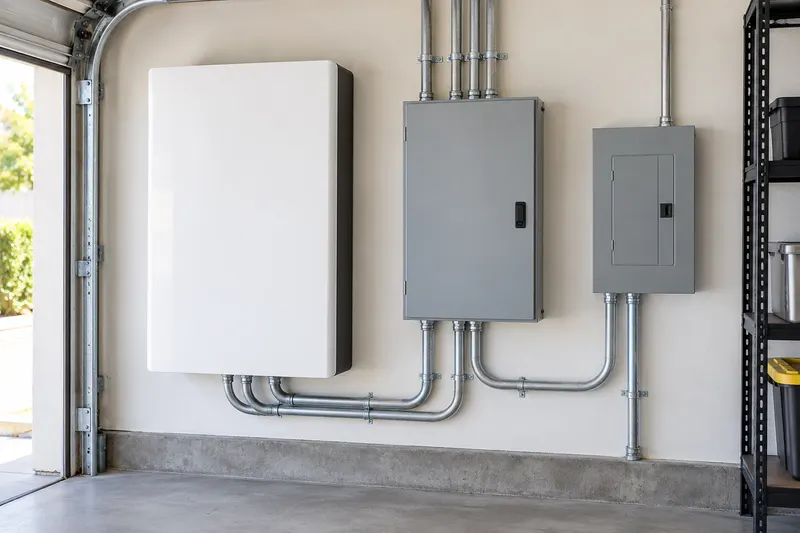
Solar and batteries do not plug into a house like an appliance. They connect to the electrical system at set points, and those connections are where most jobs, delays and faults happen. In plain terms, a tie-in covers:
- The wire from the roof to the inverter
- The inverter, which turns panel output into house power
- A connection to the main panel, usually a breaker or a tap
- The battery, a disconnect and sometimes a gateway
- Any critical loads or backup panel
- Labels, rapid shutdown devices and the utility meter connection
The electrician makes sure those parts are sized for the service, the panel has room, and the connections meet the code. The city inspects, and the utility approves operation.
Three common starting points
1. You have solar and want a battery. The big question is how the battery connects. An AC-coupled battery has its own inverter and connects at the panel, so it works with most existing systems. A DC-coupled battery shares an inverter with the solar and may require swapping it. Read home battery installation for location rules, permits and incentives.
2. You want backup during outages. Solar alone will shut off when the grid goes down. A battery with the right gateway can keep selected circuits on. A critical loads subpanel is the usual way to choose them.
3. Something stopped working. An error on the inverter, a dead monitoring app or zero production. That is a service problem. See solar inverter and system repair for who to call.
Cost, as of October 2026
The electrical side of a battery install is a desk estimate of $1,500 to $4,000 in SoCal. The battery itself is priced by capacity, brand and installer, so get written quotes. The electrical range is covered on the home battery cost page. Extra costs show up if the main panel is full, the panel is outdated, or the battery needs to move away from the panel. A panel upgrade may come first.
Incentives
- The federal 25D credit ended for property placed in service after December 31, 2025. See federal tax credits status 2026.
- The state’s SGIP ratepayer budgets closed to new applications at the end of 2025. The income-qualified equity budget was on a waitlist in most areas as of October 29, 2026 (SDG&E, LADWP, SoCalGas and SCE’s non-municipal area). Check the program page.
- Some municipal utilities have their own rebates. Riverside Public Utilities, for example, pays $500 per kWh up to $10,000 for storage bought on or after July 1, 2026, subject to funding and a time-of-use rate. Look up your own utility before you buy.
Who can do the work
A C-10 electrical contractor’s license covers installing solar photovoltaic cells and the related wiring. A C-46 solar contractor can install and repair solar systems. The state board has been writing a rule on who may install batteries, so confirm the license before you sign. The state board’s online lookup shows classification, bond and workers’ compensation status.
If your solar installer is gone
Some companies that sold systems have closed. The tie-in and warranty may go with them. The solar installer bankrupt guide tells you what records to gather and who can service the system.
Permits and inspections
A battery or inverter change needs a city electrical permit and an inspection in most places. The battery has location and size limits in the residential code, which a city handout from 2024 summarizes. The inspector also checks labels and the rapid shutdown device. The utility must approve interconnection before you turn it on. Ask your installer in writing who handles each step.
Questions for a quote
Ask for the inverter model, how the battery connects, the panel space it needs, and who files with the utility. Ask whether a new subpanel is in the price. Get the permit and inspection as their own lines, so you can compare bids that are built on the same plan.
Common problems at the tie-in
Full panels, breakers that do not fit, undersized service and long wire runs account for most extra costs. Older homes may need grounding and bonding fixes before an inspector will sign off. If the main panel is a Zinsco or Federal Pacific model, expect a replacement discussion. Another frequent snag is a battery sold by one company and wired by another, with no one owning the commissioning step. Ask who tests the system and who answers the phone when the gateway shows an error.
In this section
Questions people ask
Can I add a battery to solar I already have?
Usually yes. The choice is between an AC-coupled battery with its own inverter, which works with most existing systems, and a DC-coupled setup that may need an inverter swap. An electrician checks the inverter model, the panel space and the utility approval steps before quoting.
Why does my solar system shut off in a blackout?
Grid-tied systems without storage are required to stop when the grid goes down, so line workers are not shocked by power coming back from rooftops. A battery system with a proper gateway can keep running part of the house during an outage. Solar alone, without a battery, will not.
Do I need the utility's permission to tie in a battery?
In most cases yes, because changing an interconnected system needs an application or notice to the utility, plus the city's permit. The paperwork depends on the utility and on whether the battery can export power. Many installers file it. Ask who will file it and how long it takes.
Is there still a tax credit for solar and batteries?
Not for homeowners buying in 2026. The IRS says the residential clean energy credit, 25D, is not available for property placed in service after December 31, 2025. State and local programs may still help. Check the current status before you count on any incentive.
Keep reading
Solar inverter faults and system repair: who to call
Start with the inverter display and the app. For a fault or zero output, call the solar installer or a…
Home batteries: what the electrician does and where one can go
The electrician mounts the battery, connects it to the panel or a backup subpanel, and gets it permitted…
Critical loads subpanel for a battery or generator
A critical loads subpanel is a small second panel that holds only the circuits you want during an outage…
How much does a home battery installation cost in Southern California?
The electrical work to connect a home battery is typically $1,500 to $4,000 in SoCal. The battery itself…
Your solar installer went bankrupt: what to do next
Who owns your system, which warranties survive a solar company bankruptcy, and who can service it now.
Federal tax credits for home electrical work: status in 2026
What each federal credit covered, the dates it ended, who might still claim, and where to look for money…
Electrical panel upgrades in Southern California: when and how
A panel upgrade replaces the main breaker box, and most SoCal homes that need one are moving from 60 to…
Send a photo, get a range.
Share your ZIP and a photo of your panel. Your request goes to a licensed partner electrician, who contacts you.
Get this quoteAurion Electric is a referral service operated by Roviq LLC. Electrical work is done by a licensed partner electrician.
