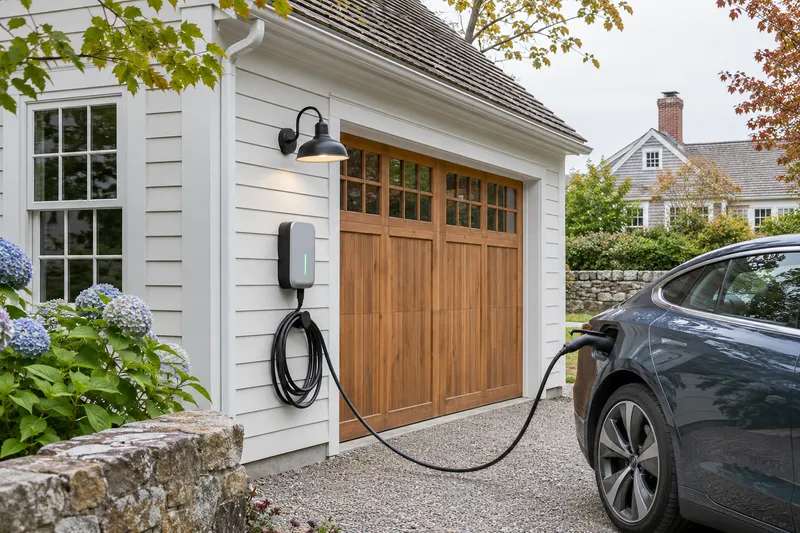
Level 1 or Level 2, amps, and whether your panel can carry it
How fast each level charges, what circuit a charger needs, and how a load management charger can keep a panel from needing an upgrade.
- Last checked: November 8, 2026
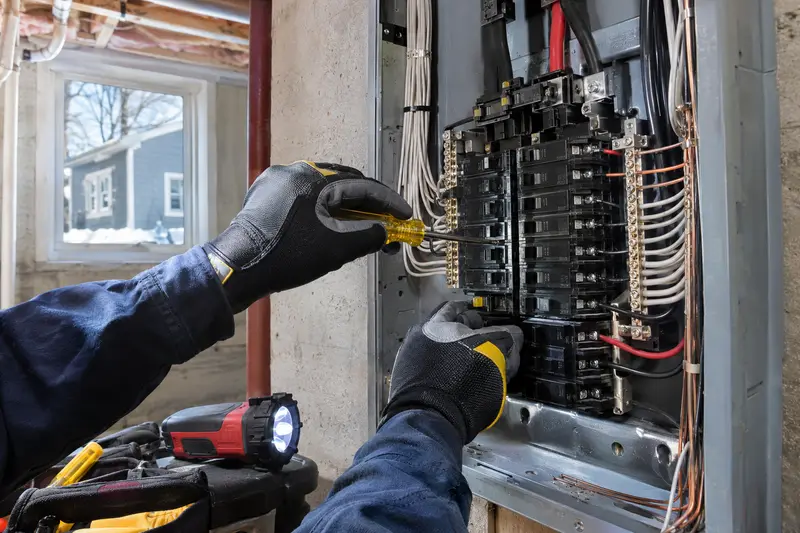
Last checked November 8, 2026
The short version. Most home chargers are 240 volt Level 2 units on a dedicated circuit rated above the charger's draw. Whether your panel can take that circuit depends on the service size, the free spaces and what else the house runs. A load management charger can limit its own draw so a smaller panel keeps working. Part of the EV charger installation guide.
Level 1 against Level 2
| Level 1 | Level 2 | |
|---|---|---|
| Voltage | 120 V, a standard outlet | 240 V, typical in homes |
| Range per hour | About 5 miles (at 1.9 kW) | About 25 miles |
| After 8 hours | About 40 miles of range for a mid-size EV | About 200 miles, at 25 miles an hour times 8 |
| Power | 1.9 kW as assumed by the Department of Energy | 2.9 to 19.2 kW units exist. Most residential units: 7.2 kW at 30 amps. |
| Equipment | Portable cordset that comes with most EVs. NEMA 5-15 plug into a three-prong outlet. | A wall unit or plug-in unit, installed on its own circuit |
| Connector | J1772 on the vehicle end | J1772, or J3400 (NACS) on Tesla vehicles |
Breaker, amps and kilowatts
The Department of Energy says most residential Level 2 chargers run at up to 30 amps and 7.2 kW, and need a dedicated 40 amp circuit to meet Article 625 of the National Electrical Code. It also says the code treats EV charging as a continuous load. Tesla's installation manual publishes the same relationship for its Wall Connector:
| Circuit breaker | Charger output | Power at 240 volts |
|---|---|---|
| 60 amps | 48 amps | 11.5 kW |
| 50 amps | 40 amps | 9.6 kW |
| 40 amps | 32 amps | 7.6 kW |
| 30 amps | 24 amps | 5.7 kW |
| 20 amps | 16 amps | 3.8 kW |
| 15 amps | 12 amps | 2.8 kW |
The pattern: charger output is 80% of the breaker rating. Pick the circuit for the charger you want, not the other way round, and have the electrician check the wire size for the length of the run. Massachusetts follows the 2026 National Electrical Code with state amendments for permits granted after April 24, 2026 (527 CMR 12.00).
Can your panel handle it?
The Department of Energy says an electrician can tell you whether your home has adequate electrical capacity, some homes might not, and a qualified electrician can add circuits to fit Level 2. Four things decide it:
- Service size. The amperage coming into the house, often printed on the main breaker. Older homes may have a fuse box or a small service.
- Free spaces. A charger takes a double-pole breaker, two spaces. A full panel is a common stopper.
- Other loads. Electric cooking, a dryer, a heat pump, a hot tub. The electrician adds the charger to the list and checks the total.
- The run. The distance from panel to parking spot sets the wire and the work.
If the numbers do not fit, there are two ways out: a bigger panel or service, or a charger that manages its own load. Read our panel upgrade guide for the first. Money for the first exists in places: RMLD pays $500 for a panel upgrade to higher amperage, and Mass Save's enhanced incentives can cover up to 100% of a panel upgrade needed to support new equipment for income-eligible households (Mass Save).
Load management: avoiding a panel upgrade
A load management charger lowers its own draw when the rest of the house needs the power. Tesla describes the Wall Connector as incorporating automatic load management that lets its maximum output be customized to an existing power supply. Its Dynamic Power Management option adds an energy meter in the panel that watches live current, and the charger raises charging when other loads drop, up to a limit the installer sets. Tesla notes it supports a single Wall Connector on a split-phase service, and that the alternative to a smaller breaker is a panel upgrade (Tesla application note).
- What it trades. A slower charge at moments when the house is busy.
- What it still needs. A permit, a licensed electrician and an inspection, like any circuit. Ask the electrician how the code applies to the setup you pick.
- Not the same as utility "managed charging." Eversource and National Grid use that phrase for shifting charging to off-peak hours for a reward. See rebates and rates.
Send a photo of the panel and your town with the button above, or call (781) 210-8400. Aurion takes it from there.
Common questions
Is Level 1 charging enough?
For many drivers, yes. The U.S. Department of Energy says many EV owners can meet their daily range overnight with Level 1, with no extra equipment, if there is an outlet on a dedicated branch circuit near where the car parks. Eight hours at 120 volts replenishes about 40 miles of range for a mid-size EV. Level 2 is for longer commutes, irregular schedules and large batteries.
How many amps should my charger be?
Match the circuit and the car. The Department of Energy says most residential Level 2 chargers run at up to 30 amps, 7.2 kW, on a dedicated 40 amp circuit. Tesla's table for its Wall Connector shows a 40 amp breaker gives 32 amps of output, a 50 amp breaker 40 amps and a 60 amp breaker 48 amps. The car's onboard charger also limits the rate, so a bigger charger does not always charge faster.
Why is the circuit bigger than the charger?
Because the National Electrical Code treats EV charging as a continuous load, according to the Department of Energy. Tesla's table above shows the pattern: a 40 amp breaker supports 32 amps of charging, which is 80% of the breaker size.
Will I need a panel upgrade?
It depends on what your service and panel can carry alongside everything else. A qualified electrician adds up the load. The Department of Energy notes that some homes have insufficient capacity for Level 2, and an electrician can add circuits to fit. Send a photo of the panel with the door open.
What is a load management charger?
A charger or system that adjusts its own power to match what the rest of the house is using. Tesla's Wall Connector has automatic load management so its output can be set to an existing power supply, and a Dynamic Power Management option that reads an energy meter in the panel and raises or lowers charging as other loads change. Utilities use the phrase "managed charging" differently, to mean shifting charging to off-peak hours.
Can I add a charger and a heat pump on the same panel?
Often yes, but check both together. Each adds load, and the panel check should count them as one project. Mass Save notes that where a home needs a panel upgrade to support new equipment, income-eligible enhanced incentives can cover up to 100% of that cost. The heat pump rebate guide has the rest.
Is there a rebate for a panel upgrade?
RMLD in Reading pays $500 to customers who upgrade a panel to a higher amperage, including to carry an EV charger. Eversource's EV rebate covers wiring or panel upgrades needed for a Level 2 charger when the program is open, and National Grid's covers the 240 volt circuit or outlet. See rebates and rates.
Not sure your panel can carry it?
Open the door, take one photo, and send your town. We look at the panel before a charger is planned. Or call (781) 210-8400.
Send a photo, get a price