100A vs 200A: do you need an upgrade?
The answer is arithmetic on the nameplates in your house. This page walks through it, names every assumption, and gives you a calculator that shows its work.
- Checked: November 2026
- Method: DOE worksheet, NEC 220.83
The short version. Service size is the most current the utility can deliver to your panel, in amps. A heat pump, EV charger or range is a load in watts. Add up the loads the way the electrical code does, divide by 240 volts, and compare the answer with your service. This page shows each step and lets you try it with your own numbers.
Amps, volts and watts, in one line
Volts times amps equals watts. U.S. Department of Energy A 100 amp service at 240 volts can deliver 24,000 volt-amps. A 200 amp service can deliver 48,000. The electrical code adds up your loads in volt-amps (VA), and your electrician compares that total with the service.
The DOE factsheet adds a margin: electricians recommend the load never exceeds 80 percent of the service capacity. U.S. Department of Energy The bars above show that line. Loads on a worksheet are the nameplate, the most a device can draw. Real use is usually lower. U.S. Department of Energy That is why a worksheet can say "tight" for a house that never trips a breaker.
Try it with your numbers
Fill in what you have. Skip what you do not. Nothing leaves your browser.
Load estimator
Will it fit on your service?
Estimated demand
Enter your square footage and the nameplate numbers you have. Nothing is saved or sent.
Fill in what you know. The bars move as you type.
Method: the DOE factsheet's worksheet for an existing home (NEC 220.83). 3 VA per square foot, 1,500 VA per small-appliance or laundry circuit, nameplate ratings for fixed appliances, first 8,000 VA at 100% and the rest at 40%, plus the larger of heating or cooling, divided by 240 V. It follows the DOE's printed steps. Massachusetts now enforces the 2026 NEC, so the electrician's calculation under 527 CMR 12.00 is the one that counts, and the job still needs a permit. Method and sources
Send photos, get a priceThe method, step by step
This is the DOE's "Optional Method Two" for an existing home, which follows NEC 220.83. U.S. Department of Energy The estimator above runs these steps and nothing else.
| Step | What you add | How it is counted |
|---|---|---|
| 1 | Lighting and general receptacles, from the finished floor area | 3 VA per square foot |
| 2 | 20 A small-appliance and laundry circuits | 1,500 VA each, at least 3 |
| 3 | Every appliance fastened in place: range, dryer, water heater, dishwasher, disposal, pumps, hot tub | Nameplate rating |
| 4 | The sum of steps 1 to 3 | First 8,000 VA at 100%, the remainder at 40% |
| 5 | Cooling load or heating load, whichever is larger | Nameplate, not both |
| 6 | Step 4 plus step 5, divided by 240 volts | Amps of service the worksheet asks for |
A worked example
The DOE prints the worksheet with blank lines. Lawrence Berkeley National Laboratory published one filled in for an existing 2,000 square foot home on 100 amp service, adding a 17 amp heat pump and a 12 amp heat pump water heater. Lawrence Berkeley National Laboratory Type the same numbers into the estimator and you get the same answer.
| Line | How it is counted | VA |
|---|---|---|
| Lights and plugs | 2,000 sq ft at 3 VA | 6,000 |
| Two kitchen circuits and laundry | 3 at 1,500 VA | 4,500 |
| Refrigerator, dishwasher, disposal | 1,200 + 1,200 + 600 | 3,000 |
| Heat pump water heater (new) | 12 A x 240 V | 2,880 |
| General load after step 4 | First 8,000 at 100%, the other 8,380 at 40% | 11,352 |
| Heat pump (new) | 17 A x 240 V, at 100% | 4,080 |
| Total | 15,432 VA / 240 V = 64.3 A. LBNL rounds up to 65. | 15,432 |
About 65 amps on a 100 amp service is under the 80% line, which is 80 amps. In LBNL's example the new equipment fits without a service upgrade. A different house, a bigger heat pump or backup strips would change that, which is why the electrician works from your nameplates.
Assumptions the estimator makes
- Voltage is 240 V for every amp-to-VA conversion except rows you mark "amps at 120 V".
- Every rating is yours. The page has no default appliance ratings. If you leave a row empty it counts as zero.
- The EV charger is counted in full on top by default. That is the cautious choice. LBNL's guide says chargers belong in the general loads with everything except heating and cooling Lawrence Berkeley National Laboratory, so untick the box to see that reading. Either way a charger never counts below 7,200 VA: LBNL reports that the 2023 NEC uses the larger of 7.2 kW and the nameplate. Lawrence Berkeley National Laboratory Which treatment applies on your permit is your electrician's call.
- One heating and cooling load. The larger of the two. If you have backup electric heat, add it to the heating row.
- The 80% line is a guide. It comes from the DOE factsheet, not from a Massachusetts rule.
What it does not do
- It is not the code calculation. Massachusetts enforces the 2026 NEC with state amendments for permits granted after April 24, 2026. Mass.gov Mass.gov The DOE factsheet was written before that edition. LBNL's 2024 briefing lists changes proposed for the 2026 code, including a lower baseline for new dwellings and a change to how new HVAC is treated in existing dwellings, and says they were not final at the time. Lawrence Berkeley National Laboratory Your electrician uses the edition on your permit.
- It cannot see your wiring. Conductor condition, panel space, grounding and the utility's own equipment are all outside the worksheet.
- It does not use your meter data. NEC 220.87 starts from measured demand: LBNL writes it as metered load times 1.25 plus the new load. Lawrence Berkeley National Laboratory It is an option to raise with your electrician and inspector.
Reading the result
| Result | What it usually means | Next step |
|---|---|---|
| Under 80% of your service | The numbers fit with margin. | New circuits and a permit. Photos of the panel confirm space and condition. |
| 80% to 100% | It fits on paper with no margin. | Compare a service upgrade with load management or lower-power equipment. |
| Over 100% | The service is smaller than the loads you want to add. | A service upgrade, or a smaller set of loads. Start the utility request early. |
Why 200 amps shows up everywhere
Eversource describes typical residential service as one meter, 200 amp, single-phase, three-wire, 120/240 volt. Eversource It also says load breakdown is not required on a request for a single-phase, single-family home with a maximum 200 amp main switch. Eversource That is the standard size the utility paperwork is built around. It is not a statement that 200 amps is enough for every house.
A bigger panel alone does not raise your service. National Grid says replacing only the electrical panel or wiring does not increase your home's power capacity. National Grid To go from 100 to 200 amps, the service itself changes and the utility is involved: how each utility handles it.
Common questions
Is 100 amp service enough for a heat pump?
There is no honest yes or no without the numbers. It depends on the heat pump's nameplate, what else the house runs, and the house itself. Add up the loads with the worksheet on this page: if the total stays under 80 percent of 100 amps, the numbers point to yes. If not, the options are a larger service, a load management device, or lower-power equipment. Either way, the electrician's load calculation and the permit decide.
Is 200 amp service enough for a heat pump, an EV charger and an induction range?
Often it is, but the only way to know is to add up the nameplates. Eversource lists a 200 amp single-phase service as typical for a residential meter, and says a load breakdown is not required for a single-family home with a 200 amp main switch. That is a paperwork rule at the utility. It does not mean every combination of loads fits.
How many amps does a heat pump use?
Read the nameplate or data sheet for your exact model. The electrician uses the nameplate rating, which is the most the unit can draw. The DOE factsheet notes that actual use is usually well below nameplate. Watts divided by volts gives amps: a load in watts divided by 240 volts is the amps on a 240 volt circuit.
What is NEC Article 220?
It is the part of the National Electrical Code that tells electricians how to calculate branch-circuit, feeder and service loads. In the 2023 edition, section 220.83 is the optional method for adding loads to an existing dwelling, and 220.87 sets existing load from metered data. Massachusetts now enforces the 2026 NEC, which moved these rules into Article 120; LBNL, for example, lists the 2023 energy management section 220.70 as 120.7 in the 2026 edition. Your electrician may quote 120-series numbers.
Why does the worksheet use 40 percent?
Not every load runs at once. After the first 8,000 VA at full value, the worksheet counts the rest of the general loads at 40 percent. That is the diversity step in the DOE's printed worksheet. Heating or cooling, whichever is larger, is then added in full.
What is the 80 percent rule?
The DOE factsheet says electricians recommend that the load never exceeds 80 percent of the electrical service capacity. For a 100 amp service at 240 volts, that line is 19,200 VA. For 200 amps, 38,400 VA.
Can the utility's meter data replace the nameplate method?
The NEC has a second method for existing homes, section 220.87, that starts from metered peak demand. LBNL describes it as metering data plus a 25 percent safety factor, with new loads added at 100 percent of nameplate. Whether your inspector accepts it for your job is a question for them.
Does a bigger panel mean a bigger service?
No. A 200 amp panel on a 100 amp service still has a 100 amp service. National Grid says replacing only the panel or wiring does not increase the power your home receives. The service has to be raised, with a request to the utility.
Heat pump coming and the panel is old?
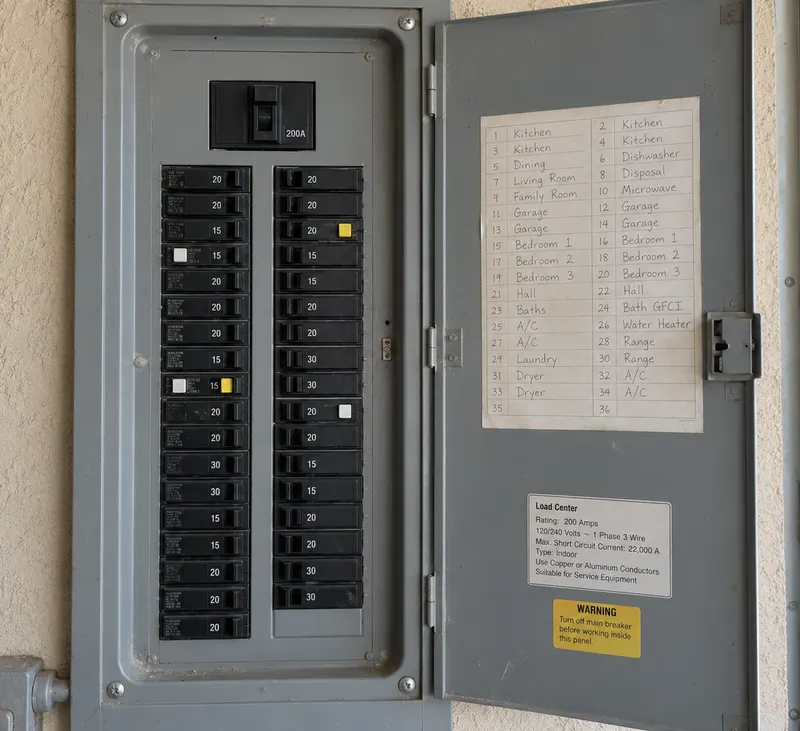
Send a photo of the panel with the door open. We look at it and get back to you.
Send photos