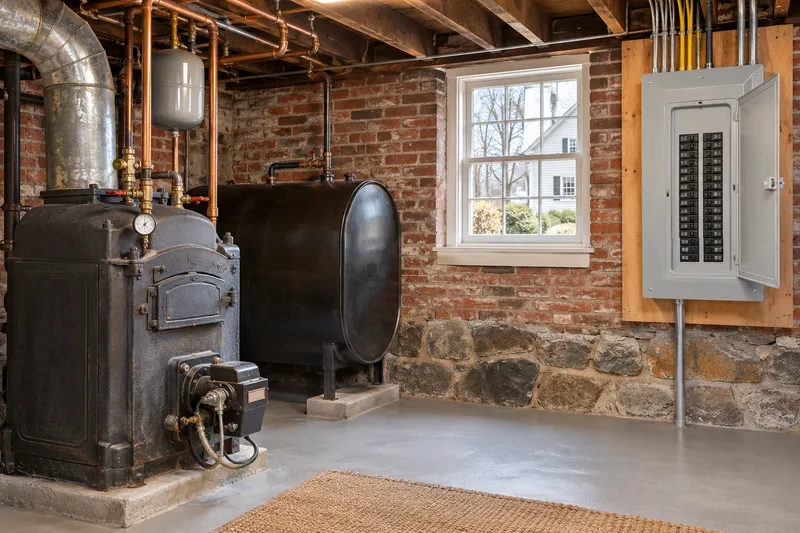
Oil tank removal and abandonment in Massachusetts
Switching off oil leaves a tank behind. Here is what the state says about removing it, closing it in place, and what to do if it leaks.
- Last checked: November 8, 2026
- Sources: MassDEP, Fire Services
Last checked November 8, 2026
If a tank is leaking
Call the local fire department first, then MassDEP's 24-hour Emergency Response line, 1-888-304-1133. Call your oil company too: it can help you shut off valves. Ventilate any area where you smell oil. (MassDEP homeowner guide)
At a glance
The short version. An unused underground tank is the one to deal with first. Above-ground tanks follow the oil burner permit rules. When in doubt, call the fire department that covers your address before anyone digs.
Above ground, in the basement or outside
The Department of Fire Services Form 1, which covers the burner, the tank and its piping, sets what a compliant tank installation looks like:
- A single unenclosed tank cannot be larger than 660 gallons, and an unenclosed tank must be at least five feet from an internal or external flame.
- Inside tanks need an audible fill device (vent alarm), a tank gauge and a thermal shutoff valve at the bottom of the tank.
- An outside tank sits on a continuous 4-inch slab that extends 8 inches beyond the tank perimeter, with vent pipes ending at least 3 feet above grade.
- New oil supply and return lines are continuously sleeved with non-metallic tubing. Oil safety valves can be used on existing lines not exposed to freezing. For a residential above-ground tank, the oil burner technician completes a supply-line certificate (Form 1A, under M.G.L. c. 148, section 38J) and a copy goes to the local fire department.
Sources: Form 1 (FP-056), Form 1A. Read November 6, 2026.
MassDEP's homeowner guide offers advice, not a legal age limit: replace an outdoor above-ground tank that has been uncovered for 10 years or longer, and know that indoor tanks generally do not last more than about 30 years and often far fewer. We found no state rule setting a tank age at which replacement is mandatory.
Underground tanks: remove, or close in place
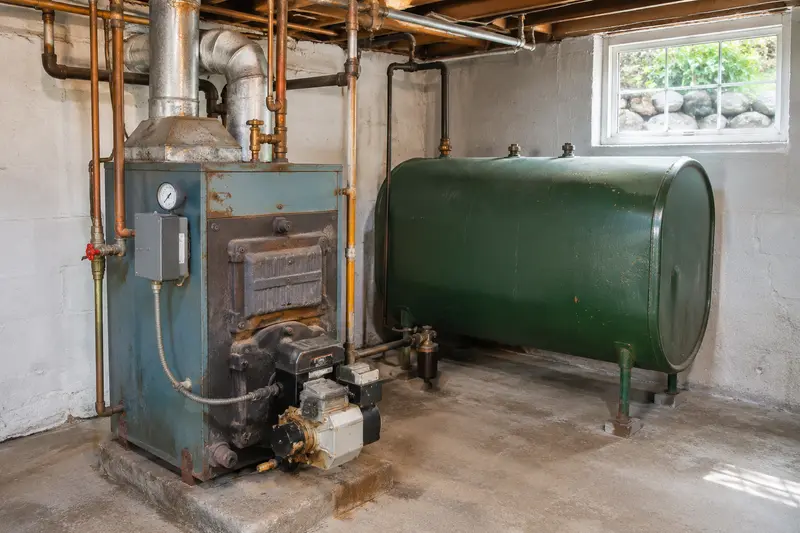
The MassDEP and Fire Services guide, Removing Your Underground Heating Oil Tank (revised spring 2008), says many buried home heating oil tanks are the same type of 275-gallon bare steel tank seen in basements and garages. They were not designed to be buried and, if left in place, will eventually rust and leak. Keep in mind that its cost and phone numbers are from 2008.
- 1Step 1Hire a contractorOne who knows 527 CMR 9.00 and 502 CMR 3.00 and local rules for underground tank removal.
- 2Step 2PermitThe contractor obtains the required permits from the local fire department.
- 3Step 3Empty and cleanOil pumped out, residues cleaned. Ask your oil company for credit on usable fuel.
- 4Step 4Dig and removeTank and piping excavated and hauled to authorized disposal. Fire dept observes.
- 5Step 5Measure, documentContamination measured within 24 hours. Keep the removal permit and shipping records.
The state guide says the contractor's duties include getting all required permits; emptying the oil and cleaning the residues; excavating the tank and piping; disposing of the tank, piping, residues, soil and any remaining oil at locations authorized to accept them; backfilling to grade; and providing written documentation of the removal. The fire department observes the removal, ensures the tank and surrounding area are free of safety hazards, ensures a contamination measurement is made, and notes on the removal permit the tank condition and whether any contamination was observed. Keep the shipping records for the tank, piping, residues, soil and fuel.
Closing a tank in place
Allowed "only in limited conditions and only if your local fire department approves. Typically, leaving a tank in place will be allowed only if its removal will jeopardize the structural integrity of your home." Once the area is determined clean, the fire department permits filling with sand or concrete. The same 24-hour contamination measurement applies before abandonment in place.
Town permit fees we could read
| Town | Oil burner install or alter | Tank removal | Source |
|---|---|---|---|
| Boston | $100 per instance | $110 | Fire schedule effective 9/22/2016, may be out of date |
| Somerville | $100 per job | $200 per job (above or underground) | Fire Prevention, effective Nov 1, 2026 |
| Arlington | $50 | $50 above ground; $360 underground removal or relocation | Fire Prevention fees |
Other towns: call the fire department that covers your address. The permit office cards list the building and inspections office for 23 towns.
Leaks and reporting
MassDEP says the first point of contact should be the local fire department. A spill must be reported to MassDEP, in as little as 2 hours after you become aware, if there is: more than 10 gallons of oil within 24 hours; any quantity that creates a sheen on a surface water body; oil floating on the groundwater table; or explosive concentrations of petroleum vapors in a building or confined space. MassDEP lists 22 threshold conditions under the Massachusetts Contingency Plan, 310 CMR 40.0300.
A smaller spill may qualify for a Limited Removal Action: if less than 10 gallons spilled and no oil floats on the groundwater, you may be able to excavate and manage up to 100 cubic yards of oil-contaminated soil and, if you finish within 120 days, not report it to MassDEP. A spill that must be reported needs a Licensed Site Professional. The MassDEP page gives older figures, about $50 per ton to dispose of contaminated soil, a $1,200 filing fee after 120 days and compliance fees of up to $5,000 a year. Treat those as dated and ask for current numbers.
MassDEP, dealing with a spill at your home; homeowner oil spill cleanup guide (published 2017). Read November 6, 2026.
Who pays for a cleanup
MassDEP: "Heating oil releases are not always covered by homeowner insurance policies, but prompt notice is an absolute requirement for making a successful insurance claim when you are covered." The state guide adds that a "pollution exclusion" clause, which many policies contain, could leave you with the bill. The state's Underground Storage Tank Petroleum Product Cleanup Fund, under M.G.L. c. 21J, reimburses tank owners and operators, and its definition of petroleum product excludes fuel oil used for heating. We found no reimbursement program for residential heating oil.
Switching to a heat pump: the tank checklist
- Find out what you haveAbove ground or buried, how big, how old. Photos of the tank and the fill pipe help.
- Use up or credit the oilAsk your oil company if it will credit you for any usable fuel removed from the tank.
- Ask the fire departmentWhich permit and which fee apply to removing or abandoning your tank, and whether it must observe.
- Put it in the quoteTank removal, line capping, disposal and the contamination measurement, priced and in writing. See the quote checklist.
- Keep the paperRemoval permit, disposal records and the contamination measurement. You will want them when you sell.
Where Aurion takes the project
Aurion takes the project from the oil boiler to the heat pump: the quote, the permits and the rebate paperwork. Licensed Massachusetts technicians do the licensed work. Tank removal needs its own fire department permit, so we put it on the quote and say who does it. Send a photo of the boiler, the tank and the panel. Related: oil to heat pump, heat pump or new oil boiler.
Common questions
Do I have to remove my oil tank when I switch to a heat pump?
We found no state rule that forces you to remove an above-ground tank the day you switch. An underground tank is different: the state guide says unused buried tanks rust and eventually leak, and removal needs a fire department permit. Ask your local fire department what it requires, and ask your oil company for credit on any usable fuel left in the tank.
Can I leave an underground oil tank in the ground?
Only in limited conditions and only if your local fire department approves. The state guide says this is typically allowed only if removal would jeopardize the structural integrity of the home. Once the area is determined clean, the fire department permits filling with sand or concrete.
Who permits an oil tank removal?
The local fire department. The state guide says the department observes the removal, makes sure the tank and surrounding area are free of safety hazards, ensures a contamination measurement is taken, and notes the tank condition and any contamination on the removal permit.
What is the contamination measurement?
State law requires that a measurement for contamination be taken within 24 hours of the time a tank is removed from the ground, or before it is abandoned in place.
How much does tank removal cost?
The state guide, revised in spring 2008, said removal contractors generally charged between $1,000 and $2,500 or more, based on tank size, condition and access. That is 2008 data, not a current price, so get written quotes. Permit fees are set by each town. Somerville's fee schedule effective November 1, 2026 lists $200 per job to remove an above- or underground tank.
My tank is leaking. What do I do?
Call your local fire department, then MassDEP's 24-hour line at 1-888-304-1133. Also call your oil company, which will usually have 24-hour service technicians to help you shut off valves. Ventilate any area where you smell oil.
When does a spill have to be reported to MassDEP?
MassDEP lists a spill of more than 10 gallons of oil within 24 hours, any amount that creates a sheen on surface water, oil floating on the groundwater table, or explosive vapors in a building. MassDEP says there are 22 threshold conditions, some requiring notice in as little as 2 hours.
Does homeowners insurance or a state fund pay for a heating oil leak?
Not always. MassDEP says heating oil releases are not always covered by homeowner policies, and that many policies have a pollution exclusion. The state petroleum product cleanup fund defines petroleum product to exclude fuel oil used for heating, and we found no state reimbursement program for residential heating oil cleanup.
How old is too old for an oil tank?
There is no age law we could verify. MassDEP's guidance says most steel underground tanks last roughly 10 to 20 years, that indoor tanks generally do not last more than about 30 years, and that an outdoor above-ground tank uncovered for 10 years or longer should be replaced. That is advice, not a rule.
Questions? Call (781) 210-8400 or send two photos and your town.
Have an oil boiler?
Send a photo of the boiler and one of your panel. We look at them and get back to you.
Send photos, get a price