How much is a dirty mini-split costing you?
Put in your units, hours and rate. You get a range, not a promise: it comes from published studies, and it says plainly when a cleaning will not pay for itself on the bill alone.
Your numbers
Default is the Massachusetts residential average, 30.19 cents (year to date through August 2026, U.S. EIA). Your bill shows your own.
Change the running power per unit (an assumption)
600 W is our assumption for a typical wall unit running at part load. It is not a published statistic. Your unit's label or your bill gives a better number.
More than two years ago, or never
Published ranges put the extra use at about 2 to 12 percent for a unit in this condition.
— a year, extra
53 to 315 kWh a year of electricity you probably do not need to use. This is an estimate from a published range, not a reading of your unit.
A deep clean of 2 heads costs $328 once.
How we get the range
- Yearly use = units x watts x hours a day x 365.
- Cleaned within a year: 0 to 2 percent extra. 2 percent is the low end of the Lawrence Berkeley National Laboratory estimate for a fouled coil.
- One to two years: 2 to 5 percent. LBNL reports typical efficiency losses of under 5 percent, and 2 to 4 percent in its model.
- More than two years or never: 2 to 12 percent. The top is one published test where a 25 percent loss of evaporator airflow cut efficiency by 12 percent. That is a heavily fouled coil, so treat it as a ceiling.
Where the numbers come from
Massachusetts residential electricity averaged 30.19 cents per kilowatt-hour year to date through August 2026, against 18.19 cents for the U.S. (U.S. Energy Information Administration, Electric Power Monthly, released October 23, 2026). EIA Only three states were higher (see the EIA table).
The efficiency loss from a fouled coil comes from Lawrence Berkeley National Laboratory work, which finds typical losses under 5 percent LBNL, and from one published test with heavier fouling that reached 12 percent Purdue University. The Department of Energy puts a clean filter in place of a clogged one at 5 to 15 percent less energy use for air conditioners DOE; we use that as context, not as the answer for a mini-split.
The one number that is ours is the running power per unit. We assume 600 watts, you can change it, and it is labeled as an assumption.
Why we show a payback that is not great
Most calculators on this topic promise big savings. The published figures do not support that, and you would find out. For most homes the bill is the smallest reason to clean. The bigger ones are the smell, the airflow and the water drips.
What we do
- 1
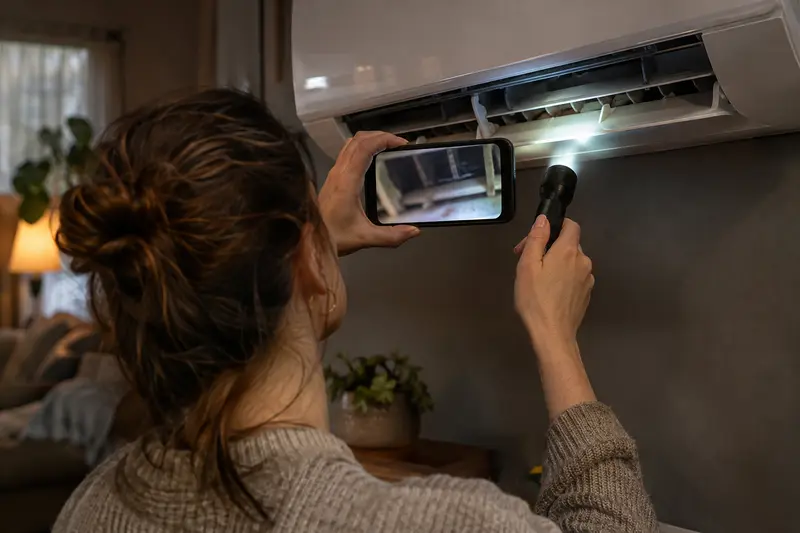
You send a photo or a number
A photo of the vent, or your number and how many indoor units you have.
- 2
We confirm price and time
The price is confirmed before the visit, and every head is done on the same visit.
- 3
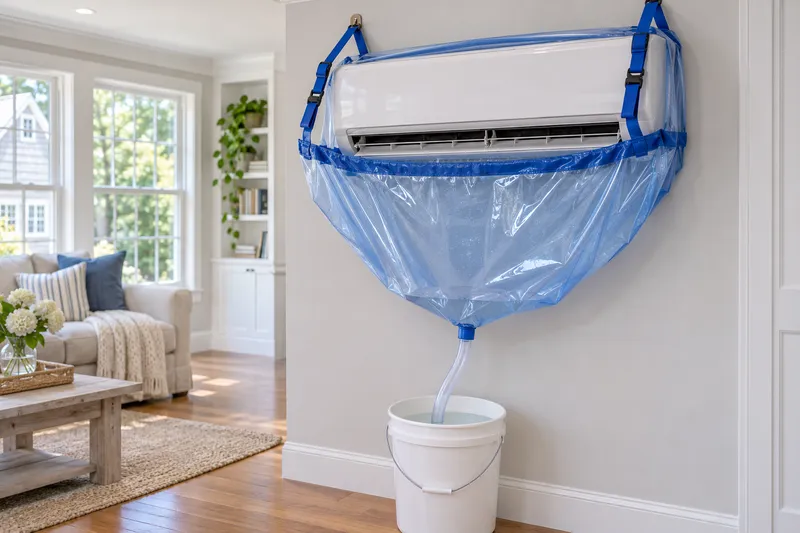
Each head gets a full wash
A licensed Massachusetts technician washes the coil and blower wheel with a bag kit that keeps the rinse water in a bucket, cleans the filters and checks the condensate line.
What it costs
$179 for the first head and $149 for each additional head, all on one visit.
| Indoor units | Price |
|---|---|
| 1 unit | $179 |
| 2 units | $328 |
| 3 units | $477 |
| 4 units | $626 |
| 5 units | $775 |
| 6 units | $924 |
The outdoor unit is not part of this service.
Questions people ask
Why does the result say a cleaning may not pay for itself?
Because on published figures the extra electricity from a dirty unit is modest. The calculator shows the payback in years so you can decide.
Is this my actual bill?
No. It is an estimate from published ranges and a running-power assumption you can change. Your bill is the real number.
Where does the rate come from?
The U.S. EIA, Table 5.6.B, Massachusetts residential, year to date through August 2026: 30.19 cents per kilowatt-hour.
What does a mini-split deep clean cost?
$179 for the first head and $149 for each additional head, confirmed before the visit.